Facts
The decree-holders obtained money decrees against N. Sonai Muthu and filed execution petitions in 2016.
Source reference: p. 3–5They later sought amendments to the property schedules to clarify the descriptions and facilitate identification of the properties.
Source reference: p. 3–5The Executing Court allowed the amendments.
Source reference: p. 3–5Sonai Muthu challenged those orders, arguing that he had been adjudicated insolvent and that the Official Assignee should have been impleaded.
Source reference: p. 3–5The decree-holders responded that the amendment applications were merely clarificatory and would not determine the execution petitions on their merits
Source reference: p. 3–5Issues
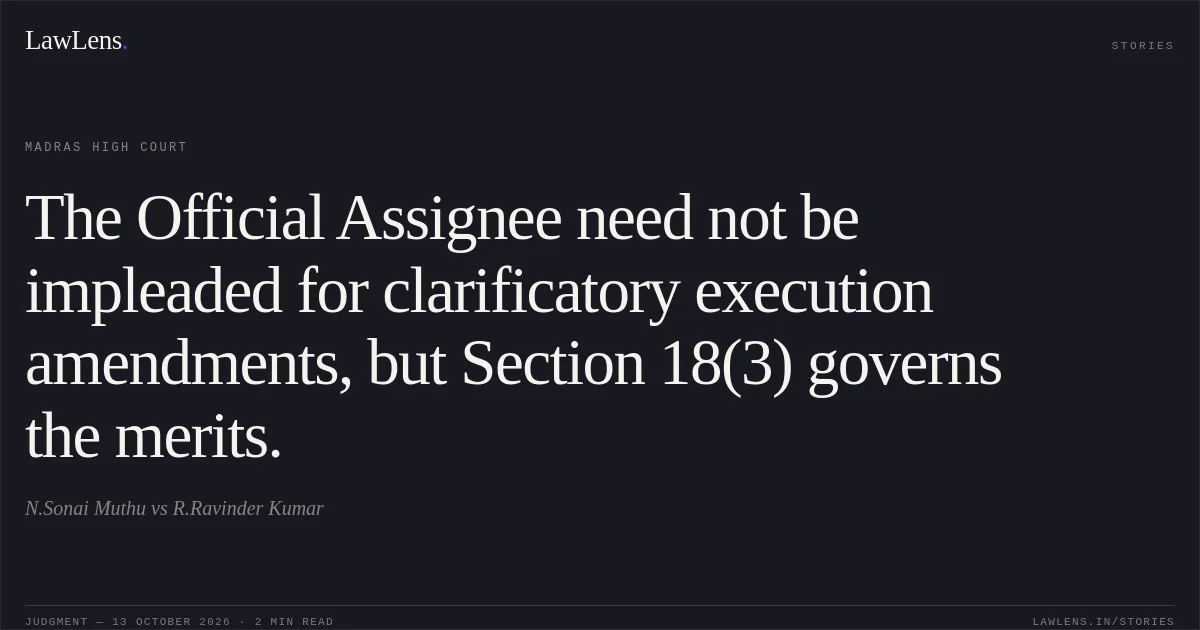
Whether the Executing Court could allow amendments clarifying the property descriptions in the execution petitions without impleading the Official Assignee
Source reference: p. 3–6Whether the execution proceedings must be considered in light of Section 18(3) of the Presidency-Towns Insolvency Act, 1909, following the judgment debtor’s alleged adjudication as insolvent
Source reference: p. 5–6Law Applied
Section 18(3) of the Presidency-Towns Insolvency Act, 1909 provides that, when an adjudication order is brought to the Court’s notice in pending proceedings against the debtor, the Court may stay those proceedings or allow them to continue on such terms as it considers just
Source reference: p. 5Upon adjudication as insolvent, the debtor’s estate vests in the Official Assignee, who must be made a party where the proceedings concern that estate
Source reference: p. 5The judgment also treated an amendment that only clarifies a property description, without deciding the execution petition on its merits or affecting substantive rights, as capable of being considered separately from the merits of execution
Source reference: p. 5–6Reasoning
The Court found that the amendments added details to identify the scheduled properties more precisely and were therefore clarificatory, not determinative of the parties’ substantive rights or the merits of execution
Source reference: p. 5–6Because the properties’ identity and their status as part of the judgment debtor’s estate had yet to be established, the Court held that the Official Assignee’s presence was not necessary for deciding the amendment applications.
Source reference: p. 5–6However, once the amendments were allowed, the Executing Court would have to address Section 18(3) when considering the execution petitions
Source reference: p. 5–6Holding
The High Court declined to interfere with the Executing Court’s orders and disposed of all three civil revision petitions.
It directed the Executing Court, when considering the main execution petitions, to take Section 18(3) of the Presidency-Towns Insolvency Act, 1909 into account and pass appropriate orders.
Source reference: p. 6The connected miscellaneous petitions were closed; no costs were ordered
Source reference: p. 6Acts & Sections Cited
2 provisions across 2 statutes referred to in this judgment. Each provision opens on LawLens.
Code of Civil Procedure, 19081
Presidency-Towns Insolvency Act, 19091
Original Court PDF
N.Sonai MuthuvsR.Ravinder Kumar
Click to open original judgment
Original judgment, available to read, download and summarize on LawLens.in
![Failure to assess whether proceedings were pending at retirement warrants recall for reconsideration.. Vishvambhar Singh vs D/O POST. CAT - ['Allahabad']. LawLens](/stories/thumbnails/failure-to-assess-whether-proceedings-were-pending-at-retirement-warrants-recall-for-recon-071167e5391949abbe500a070b3ff27b.webp)