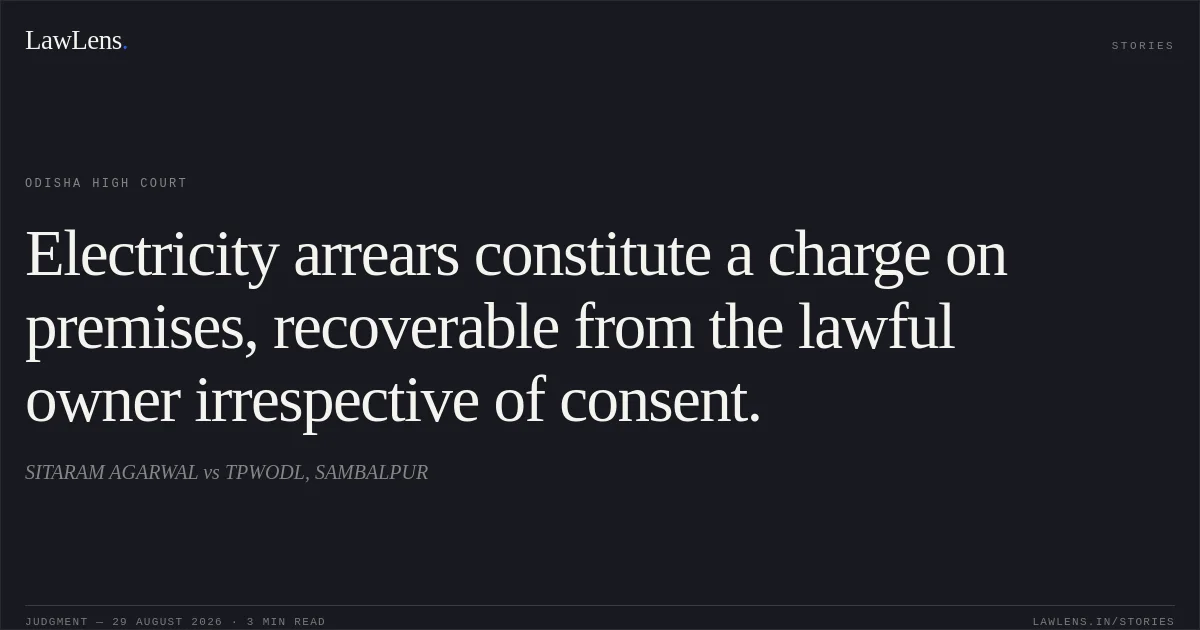
Facts
The petitioner claimed ownership and possession of premises comprising Plot No. 1305 of Khata No. 257/181 and Plot No. 13057/18521 of Khata No. 257/182 at Khetrajpur, Sambalpur.
Source reference: p. 2–3; paras. 3, 13, 15He held one electricity connection in his own name. A separate connection had been granted to Sanjay Kumar Agrawalla, the petitioner’s son, for a portion of the same premises under a separate consumer number.
Source reference: p. 2–3; paras. 3, 13, 15Sanjay defaulted in payment of electricity dues amounting to ₹1,35,679 up to April 2016, resulting in disconnection of that supply.
Source reference: p. 2–3; paras. 3, 13, 15The petitioner contended that the connection had been obtained without his knowledge or consent and that he was not liable for Sanjay’s dues.
Source reference: p. 3–4; para. 4After the petitioner’s challenge before the High Court was disposed of with liberty to approach the Grievance Redressal Forum, the Forum rejected his complaint on 19 August 2021. The Ombudsman-II, Odisha Electricity Regulatory Commission, affirmed that decision on 7 March 2022.
Source reference: p. 2–3; para. 3The petitioner consequently challenged the Ombudsman’s order before the High Court.
Source reference: p. 2–3; para. 3Issues
Whether unpaid electricity dues arising from a separate electricity connection granted to Sanjay Kumar Agrawalla could constitute a charge or encumbrance upon the premises and be recovered from the petitioner as the lawful owner in possession.
Source reference: p. 4–6; paras. 8–11Whether the petitioner’s lack of knowledge or consent to the electricity connection excluded his liability under Section 17(vi) of the Odisha Electricity Regulatory Commission Distribution (Conditions of Supply) Code, 2019.
Source reference: p. 3–4, 6–7; paras. 4, 7, 10, 14–17Whether the concurrent findings of the Grievance Redressal Forum and the Ombudsman disclosed any perversity or infirmity warranting interference under Articles 226 and 227 of the Constitution.
Source reference: p. 7–8; paras. 18–19Law Applied
Section 17(vi) of the Odisha Electricity Regulatory Commission Distribution (Conditions of Supply) Code, 2019 provides that unpaid electricity charges or other sums due from a deceased consumer, erstwhile owner, or occupier constitute a charge on the premises and are recoverable from the legal representative, successor-in-interest, or new owner/occupier having lawful occupation of the premises.
Source reference: p. 6; para. 10The Supreme Court’s decision in K.C. Ninan v. Kerala State Electricity Board, (2023) 14 SCC 431, establishes that subordinate legislation framed under Sections 50 and 181 of the Electricity Act, 2003 may create a statutory charge or impose conditions for recovery of arrears from a subsequent owner or occupier of the premises.
Source reference: p. 4–6; paras. 8–9The Court also applied the principle that writ jurisdiction should not be exercised to re-appreciate evidence or disturb concurrent factual findings absent perversity, relying on MSEDCL v. APML & Others, 2023 SCC OnLine SC 233.
Source reference: p. 7–8; para. 18Reasoning
The Court found that Sanjay had admittedly obtained a separate electricity connection for a portion of the petitioner’s premises and had left ₹1,35,679 unpaid, leading to disconnection.
Source reference: p. 7; para. 13Under Section 17(vi), the liability attached to the premises rather than being confined to the individual consumer who incurred the dues.
Source reference: p. 7; para. 13Consistent with K.C. Ninan, the Court held that the electricity distribution framework could create such a charge to protect the financial interests of public utilities and ensure recovery of electricity arrears.
Source reference: p. 5–6; paras. 9–11The petitioner’s assertion that the connection was granted without his consent did not alter the statutory character of the charge, since Section 17(vi) made no distinction between connections obtained with or without the lawful owner’s consent.
Source reference: p. 7; paras. 14–17The petitioner was therefore liable as the lawful owner in possession.
Source reference: p. 7; paras. 14–17The Court further held that the petitioner had identified no perversity in the concurrent findings of the Forum and the Ombudsman warranting constitutional interference.
Source reference: p. 7–8; paras. 18–19Holding
The High Court held that the unpaid electricity dues constituted a charge and encumbrance upon the premises and were recoverable from the petitioner as the lawful owner in possession, notwithstanding his alleged lack of consent to or knowledge of Sanjay’s connection.
Finding no infirmity or perversity in the orders of the Grievance Redressal Forum and the Ombudsman, the Court dismissed the writ petition as devoid of merit.
Source reference: p. 8; paras. 19–20Acts & Sections Cited
2 provisions across 1 statute referred to in this judgment. Each provision opens on LawLens.
Electricity Act, 20032
Original Court PDF
SITARAM AGARWALvsTPWODL, SAMBALPUR
Click to open original judgment
Original judgment, available to read, download and summarize on LawLens.in
![A police constable cannot be removed for unauthorized absence without a Rule 359-compliant inquiry.. Mohammad Sidiq Khan vs D/o Home Ut Of Jammu & Kashmir. CAT - ['Srinagar']. LawLens](/stories/thumbnails/a-police-constable-cannot-be-removed-for-unauthorized-absence-without-a-rule-359-compliant-7b43fc316bd94f22a62676153bbc9d54.webp)
![A Review DPC lacks authority to determine or alter inter se seniority.. SAURABH KUMAR vs REVENUE. CAT - ['Patna']. LawLens](/stories/thumbnails/a-review-dpc-lacks-authority-to-determine-or-alter-inter-se-seniority-4b21640f20af46fcabdfc8273d2ce959.webp)