Facts
On May 14, 2004, the deceased, Rajivsingh, suffered a fatal electric shock while adjusting a TV antenna and wire when he came into contact with a high-tension wire
Source reference: p. 1The heirs of the deceased (the plaintiffs) filed Special Civil Suit No. 289 of 2008 alleging absolute negligence by the Dakshin Gujarat Vij Company Limited (DGVCL) and sought compensation of Rs. 11,00,000/-
Source reference: p. 2The DGVCL contested the suit, attributing the incident to the sole negligence of the deceased for failing to take necessary care
Source reference: p. 2The Trial Court partly decreed the suit, awarding Rs. 7,96,816/- with 9% interest
Source reference: p. 1The DGVCL appealed this judgment under Section 96 of the CPC, challenging the findings on negligence and the quantum of compensation
Source reference: p. 2Issues
1. Whether the deceased was negligent and if such negligence caused the incident, thereby absolving the electricity company of liability?
Source reference: p. 3 / para. 72. Whether the Trial Court erred in its calculation of compensation and the rate of interest?
Source reference: p. 2-3 / para. 5Law Applied
The court applied the principle of Absolute Liability, an extension of the "Strict Liability" rule from Rylands v. Fletcher, as established by the Supreme Court in M.C. Mehta v. Union of India
Source reference: p. 4, para. 9This doctrine mandates that an enterprise engaged in hazardous or inherently dangerous activities (like the supply of high-voltage electricity) is liable to compensate for harm resulting from such activities regardless of the precautions taken
Source reference: p. 5, para. 9The court further cited H.S.E.B. v. Ram Nath, which clarifies that power companies are duty-bound to ensure safety even near unauthorized constructions
Source reference: p. 5, para. 10M.P. Electricity Board v. Shailkumar, which holds that the "onus is on the licensee" to prevent accidents
Source reference: p. 6-7, para. 11Reasoning
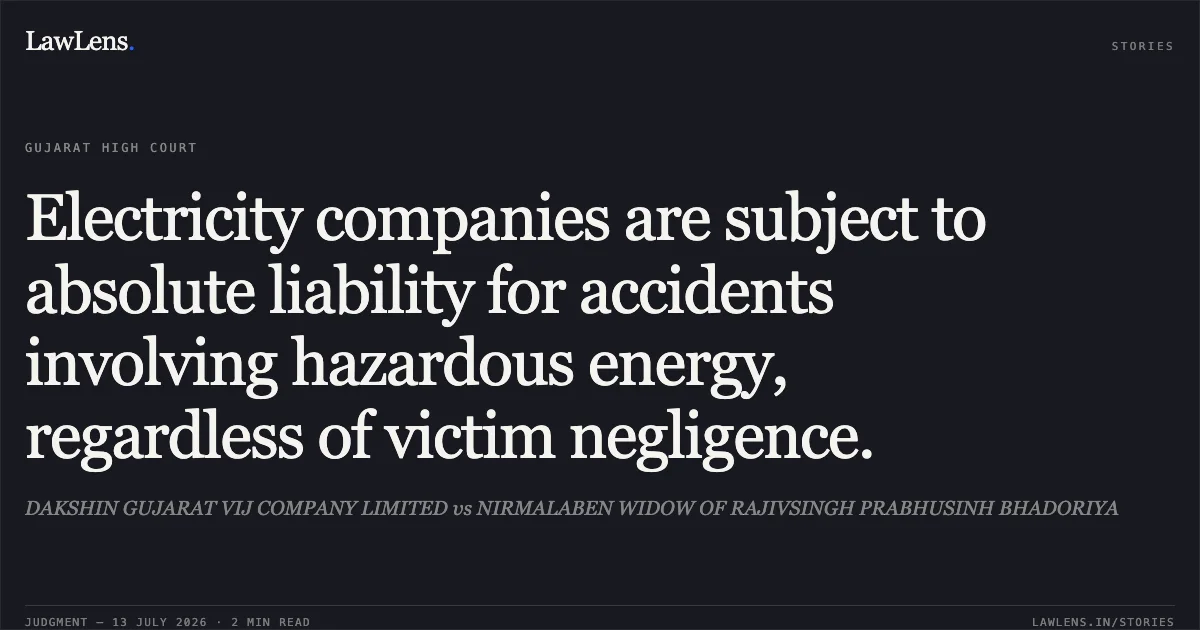
The Court reasoned that since DGVCL is engaged in the hazardous business of transmitting high-voltage electricity, it is subject to the principle of absolute liability
Source reference: para. 13-14The Court rejected the appellant's defense of contributory negligence, noting that in cases of inherently dangerous activities, the liability is "strict regardless of whether [the defendant] could have avoided the particular harm by taking precautions"
Source reference: p. 9, para 14The Court emphasized that it is the primary duty of the electricity company to maintain and insulate wires to prevent the escape of energy
Source reference: p. 8, para. 14Consequently, the Trial Court’s findings against the DGVCL regarding the lack of safety measures and the low height of wires in a residential area were upheld, as the company failed to prove it followed all safety rules under the Indian Electricity Act
Source reference: p. 3-4, para. 7-8Holding
The High Court dismissed the appeal and upheld the Trial Court's judgment and decree
The Court held that the DGVCL is absolutely liable for the death caused by its high-tension wires, irrespective of any alleged negligence by the deceased
Source reference: para. 15The court ordered the disbursement of the deposited compensation amount (Rs. 7,96,816/-) along with the accrued 9% interest to the plaintiffs
Source reference: p. 10, para. 18Acts & Sections Cited
1 provisions across 1 statute referred to in this judgment. Each provision opens on LawLens.
Code of Civil Procedure, 19081
Original Court PDF
DAKSHIN GUJARAT VIJ COMPANY LIMITEDvsNIRMALABEN WIDOW OF RAJIVSINGH PRABHUSINH BHADORIYA
Click to open original judgment
Original judgment, available to read, download and summarize on LawLens.in