Facts
Petitioner No. 1, Ajit Kumar Singh, and Petitioner No. 2, Aarti Singh, his wife, held separate domestic electricity connections in their respective names.
Source reference: pp. 4–5; paras. 5, 9Outstanding dues of approximately ₹3,17,005 relating to two electricity accounts standing in Petitioner No. 2’s name were not paid, following which the respondents issued a notice dated 08.11.2022 stating that the dues would be transferred to Petitioner No. 1’s running electricity account.
Source reference: pp. 4–5; paras. 5, 9The petitioners contended that the connections were distinct and that Petitioner No. 2 lived separately.
Source reference: pp. 3–4; para. 4They further claimed that the premises had been sold to Rajesh Raushan in 2019 and vacated, and that post-sale dues could not be recovered from them.
Source reference: pp. 3–4; para. 4The petitioners also pursued proceedings before the Consumer Grievance Redressal Forum and the District Consumer Disputes Redressal Commission.
Source reference: pp. 5–6; paras. 7–8Issues
Whether the licensee could transfer the outstanding electricity dues of Petitioner No. 2 to the separate electricity account of Petitioner No. 1 merely because the petitioners were husband and wife, under Clause 10.15(a) of the Bihar Electricity Supply Code?
Source reference: pp. 6–7; paras. 11–14Whether the notice/order dated 08.11.2022 transferring Petitioner No. 2’s dues to Petitioner No. 1’s account was legally sustainable?
Source reference: p. 8; para. 15Law Applied
The Court applied Clause 10.15(a) of the Bihar Electricity Supply Code, which empowers the electricity licensee to transfer outstanding dues from one running electricity account to another running account of the same defaulting consumer, subject to compliance with the prescribed procedure and due notice.
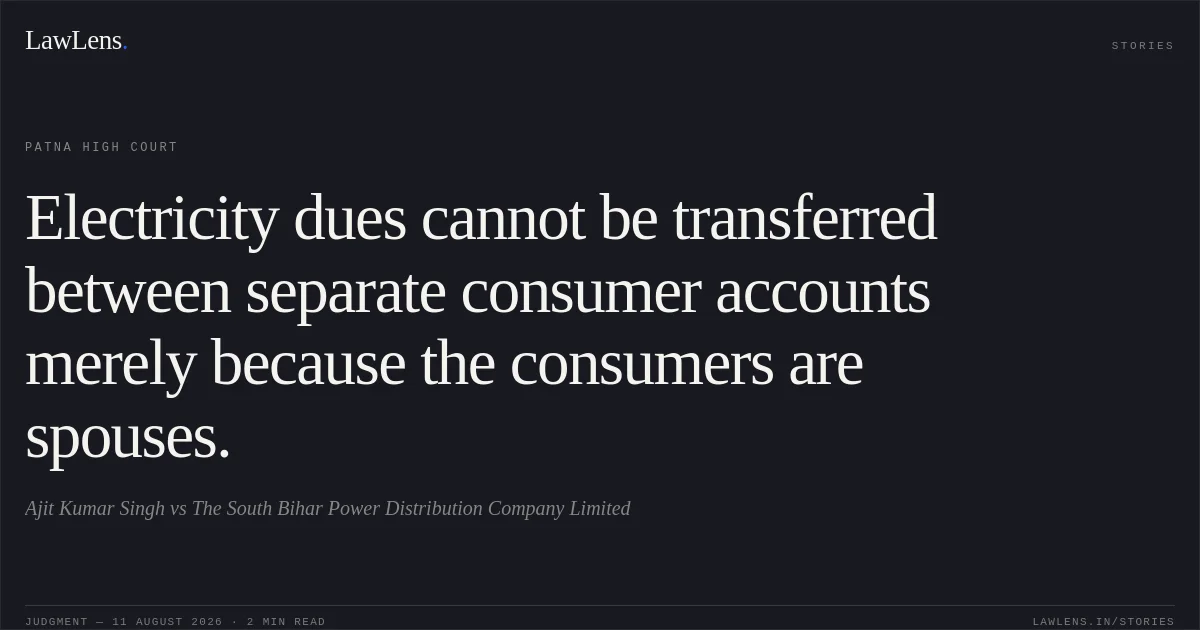
Source reference: pp. 6–7; paras. 9, 12The provision does not authorize transfer of one consumer’s dues to the account of another independent consumer merely because the two consumers are related, including as spouses.
Source reference: p. 7; para. 13Reasoning
The Court found that the electricity connections of Petitioner No. 1 and Petitioner No. 2 were separate and stood in their respective individual names.
Source reference: p. 6; para. 11Although Clause 10.15(a) permits transfer between accounts, its operation is confined to accounts belonging to the “same defaulting consumer”.
Source reference: p. 7; para. 12The Court interpreted that expression according to its ordinary meaning and held that it could not encompass two distinct consumers merely because they were husband and wife.
Source reference: p. 7; para. 13Consequently, Petitioner No. 1’s separate electricity account could not lawfully be burdened with Petitioner No. 2’s alleged outstanding dues.
Source reference: p. 7; para. 14Holding
The Court held that the respondents’ transfer of Petitioner No. 2’s outstanding electricity dues to Petitioner No. 1’s electricity account was unsustainable under Clause 10.15(a) of the Bihar Electricity Supply Code.
The notice/order dated 08.11.2022 issued by the Electrical Assistant Engineer was quashed and set aside, and the writ petition was allowed.
Source reference: p. 8; paras. 15–16Original Court PDF
Ajit Kumar SinghvsThe South Bihar Power Distribution Company Limited
Click to open original judgment
Original judgment, available to read, download and summarize on LawLens.in