Facts
The petitioner operated a captive generating power plant and supplied electricity for its own consumption, for use by its shareholder/member companies, and through the grid to the Power Trading Corporation and third parties.
Source reference: paras. 2–4The Chief Electrical Inspector raised several electricity-tax demands under the Tamil Nadu Tax on Consumption or Sale of Electricity Act, 2003, including a Form E-2 demand of approximately ₹4.03 crores for electricity allegedly consumed captively during specified periods.
Source reference: para. 5The petitioner disputed liability, contending that tax had already been paid on captive consumption and by the relevant consuming entities, and that tax on third-party sales was either not payable by it or had been deposited to the extent admitted.
Source reference: paras. 6, 19–20The petitioner earlier challenged the demand in W.P. (MD) No. 6210 of 2011. This Court directed the petitioner to pursue the statutory appeal and directed the appellate authority to take the appeal on file and decide it on merits.
Source reference: para. 21The Government, however, rejected the appeal on the ground that the assessed tax of ₹4.03 crores and penal interest had not been paid.
Source reference: para. 27Issues
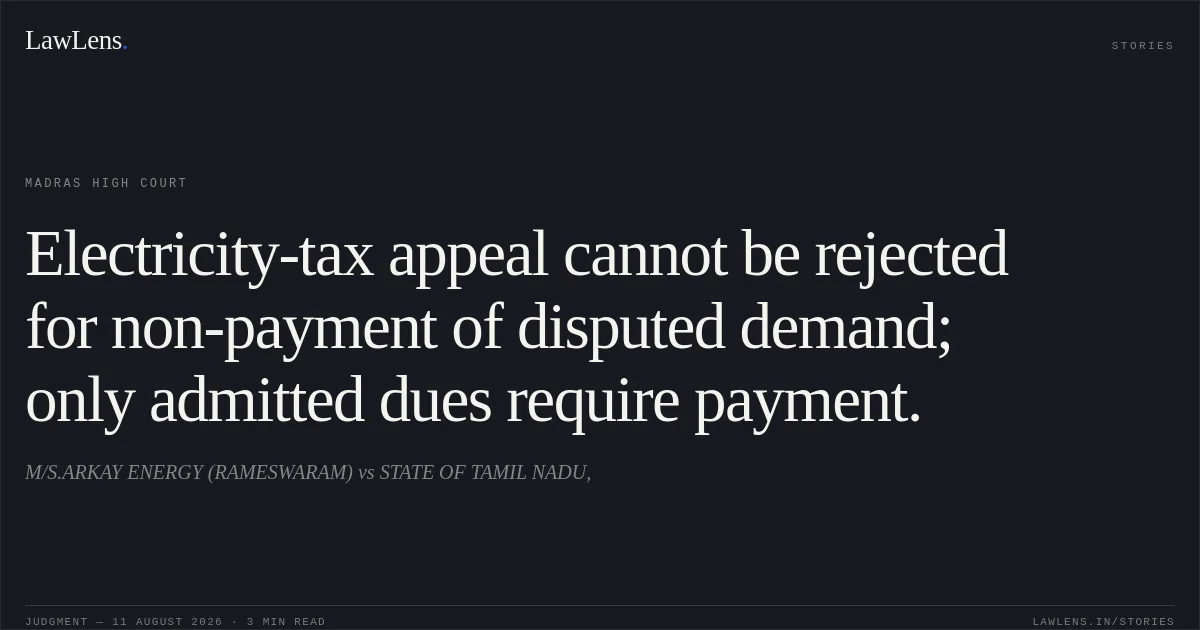
Whether the appellate authority was entitled to insist upon payment of the entire assessed electricity-tax demand as a condition for entertaining the appeal under Section 10 of the Act and Rule 17 of the Rules?
Source reference: paras. 22–25Whether the appellate authority acted unlawfully by dismissing the appeal without deciding the petitioner’s substantive objections on merits, despite the earlier direction of this Court?
Source reference: paras. 21, 27–30Whether the petitioner’s liability to pay electricity tax on captive consumption, wheeled electricity, and third-party sales could be adjudicated in the writ proceedings?
Source reference: para. 30Law Applied
The Court applied Section 10(1) of the Tamil Nadu Tax on Consumption or Sale of Electricity Act, 2003, under which an appeal against an electricity-tax assessment cannot be entertained unless the appellant pays the amount of tax or interest that the appellant admits to be due.
Source reference: para. 22Rule 17(1)(i)(e) and Rule 17(1)(iii)(a) of the Tamil Nadu Tax on Consumption or Sale of Electricity Rules, 2003 require the appeal to disclose the tax and interest admitted to be payable and to be endorsed with confirmation that the admitted amount has been paid.
Source reference: para. 23The governing principle is that the statutory pre-condition is limited to payment of the admitted dues, and does not require pre-deposit of the entire amount assessed or demanded.
Source reference: paras. 24–25The Court also applied the principles of judicial discipline, non-application of mind, and compliance with a prior judicial direction requiring the appellate authority to decide the appeal on merits.
Source reference: paras. 21, 28–29Reasoning
The Court interpreted Section 10 and Rule 17 as requiring payment only of the amount expressly admitted by the appellant, rather than the entire assessed demand.
Source reference: paras. 24–25The petitioner had disputed liability for the principal demand and asserted that tax had already been paid in respect of captive consumption and electricity used by shareholder companies; it had also deposited ₹2,95,385 towards tax on electricity sold to third parties.
Source reference: paras. 20, 26, 28Consequently, the appellate authority erred in treating the entire ₹4.03-crore assessment and penal interest as amounts mandatorily payable before the appeal could be heard.
Source reference: paras. 27–29Its order merely reproduced the statutory requirement and mechanically rejected the appeal without examining the petitioner’s objections or complying with the earlier direction to decide the matter on merits.
Source reference: paras. 21, 28–29Since the statutory authority had not adjudicated the substantive issues, the High Court declined to determine the petitioner’s tax liability itself.
Source reference: para. 30Holding
The writ petition was allowed and the impugned Government order rejecting the appeal was set aside.
The matter was remanded to the appellate authority with directions to entertain and decide the appeal on merits without insisting upon payment of the entire amount demanded by the Chief Electrical Inspector, after giving the petitioner an opportunity of hearing and permitting it to produce supporting documents.
Source reference: para. 31The appeal was directed to be disposed of within twelve weeks from receipt of the Court’s order.
Source reference: para. 31All substantive questions concerning liability to electricity tax on captive consumption, wheeled electricity, and third-party sales were left open for determination by the appellate authority.
Source reference: para. 30No order as to costs was made, and the connected miscellaneous petitions were closed.
Source reference: para. 31Acts & Sections Cited
3 provisions across 1 statute referred to in this judgment. Linked provisions open on LawLens.
Tamil Nadu Tax on Consumption or Sale of Electricity Act, 20033
Original Court PDF
M/S.ARKAY ENERGY (RAMESWARAM)vsSTATE OF TAMIL NADU,
Click to open original judgment
Original judgment, available to read, download and summarize on LawLens.in