01Facts
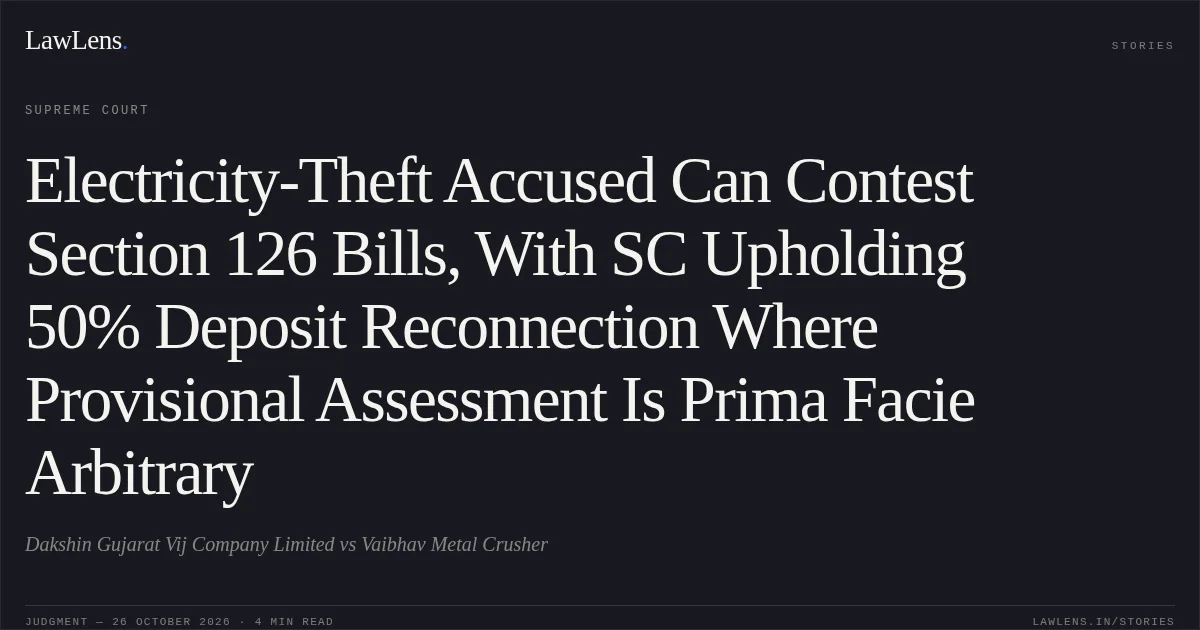
In the first appeal, the distribution licensee issued Vaibhav Metal Crusher a supplementary bill for alleged theft of electricity, together with compounding charges. The High Court initially directed restoration of supply on payment of 50% of the bill; on appeal, its Division Bench permitted the consumer to object to the assessment and made the deposit and reconnection directions subject to the authority’s decision.
¶ 4(i)–(iv) · pp. 2–5In the second appeal, Jamanbhai Nanajibhai Bhuva challenged a supplementary bill for alleged theft. The Single Judge directed a 50% deposit, stayed recovery of the balance, and directed that a fresh connection not be refused solely because of arrears. The Division Bench remitted the matter for a fresh order.
¶ 5(i)–(iii) · pp. 5–7The licensees challenged the High Court’s approach, arguing that assessment and appeal under Sections 126 and 127 did not apply to theft, and that civil liability was for the Special Court under Section 154(5).
¶ 7–8 · pp. 8–1202Issues
i.1. Whether, following disconnection for alleged electricity theft, the amount payable to obtain restoration of supply under the third proviso to Section 135(1A) must be assessed under the procedure in Section 126 and the applicable Supply Code.
¶ 31, 34–37 · pp. 31–41ii.2. Whether that assessment may be challenged under Section 127, and how it relates to the Special Court’s determination of civil liability under Section 154(5).
¶ 35–37 · pp. 38–41iii.3. Whether the High Court may direct restoration of supply on payment of less than the full provisionally assessed amount.
¶ 38–41 · pp. 42–4503Law Applied
Sections 126 and 127 of the Electricity Act, 2003 provide for assessment of charges for unauthorised use, an opportunity to object to provisional assessment, and an appeal against final assessment.
¶ 31, 34–37 · pp. 31–41Section 135(1A), including its third proviso, permits disconnection upon detection of theft but requires restoration within 48 hours upon deposit or payment of the assessed amount.
¶ 31, 33–37 · pp. 31–41Where the Supply Code prescribes no separate assessment procedure for this purpose, the amount required for restoration must be determined by applying the Section 126 procedure and the applicable Supply Code.
¶ 31, 33–37 · pp. 31–41In a theft case, a Section 127 determination is final only for the purpose of restoration; it does not bind the Special Court’s determination of civil liability under Section 154(5), and any excess deposit is refundable under Section 154(6).
¶ 35–37 · pp. 38–41The Court relied on West Bengal State Electricity Distribution Company Ltd. v. M/s Orion Metal Pvt. Ltd., which held that assessment under Section 126 may proceed alongside a theft complaint under Section 135, and that the Special Court separately determines civil liability.
¶ 32–33 · pp. 32–36The High Court’s constitutional powers are not wholly displaced by the statutory scheme, but restoration applications in theft cases require a circumspect, fact-sensitive approach; where provisional assessment is prima facie arbitrary, restoration may be ordered on a deposit of at least 50% for recorded reasons.
¶ 39–40 · pp. 43–45Provisions in the judgment · 20 · Linked ones open on LawLens
Electricity Act, 2003 17 provisions
Section 8Section 50Section 126Section 127Section 135Section 136Section 137Section 138Section 139Section 140Section 150Section 151Section 152Section 153Section 154Section 181Section 183Gujarat Electricity Industry (Reorganisation and Regulation) Act, 2003 Section 42
Code of Criminal Procedure, 1973 Section 173Section 300
04Reasoning
The Court rejected the licensees’ argument that theft cases could not be assessed under Section 126. Section 135 contains no separate assessment machinery, and the Gujarat Supply Code uses the same assessment formula for theft and unauthorised use; moreover, the third proviso to Section 135(1A) contemplates payment of an assessed amount to secure prompt restoration, which would be frustrated if the consumer had to await the Special Court’s final determination.
¶ 29–34 · pp. 28–37Applying Sections 126 and 127 therefore provides the procedure for determining the restoration amount, while Section 154(5) preserves the Special Court’s distinct authority to determine civil liability where a theft complaint is filed.
¶ 35–37 · pp. 38–41The Court also held that a High Court may, in an appropriate case, order restoration on a deposit of at least 50% where the provisional assessment is prima facie arbitrary, but must give reasons and assess the circumstances of the case.
¶ 39–40 · pp. 43–4505Holding
The Court held that, absent a separate procedure in the Supply Code, the amount payable to obtain restoration after disconnection for alleged theft must be assessed under Section 126 and is subject to appeal under Section 127. That determination governs restoration only; where a criminal complaint is filed, civil liability remains for the Special Court under Section 154(5), with any excess deposit refundable under Section 154(6).
¶ 37 · pp. 40–41The appeal concerning Vaibhav Metal Crusher was dismissed, subject to clarification that the assessment is subject first to any Section 127 appeal and ultimately, if prosecuted, to the Special Court’s determination of civil liability.
¶ 41 · p. 45The appeal concerning Jamanbhai Nanajibhai Bhuva was also dismissed because the High Court had merely remitted the matter for decision in accordance with law.
¶ 41 · p. 46Original Court PDF
Dakshin Gujarat Vij Company LimitedvsVaibhav Metal Crusher
Click to open original judgment
Original judgment, available to read, download and summarize on LawLens.in