Facts
The respondents (legal heirs of Sh. Sanoj Kumar) filed a claim application alleging that the deceased suffered fatal electrocution on 08.04.2022 while performing flooring work at the appellant’s premises
Source reference: p. 2The appellant filed a written statement denying the employer-employee relationship, asserting that the work was contracted to one Shyam Kumar via an agreement dated 06.04.2022
Source reference: p. 3, 5The appellant subsequently abandoned the proceedings and was proceeded against ex parte
Source reference: p. 2The Commissioner awarded compensation of Rs.15,88,425/- plus interest and funeral expenses
Source reference: p. 2The appellant’s review application was dismissed after he again failed to appear
Source reference: p. 4Issues
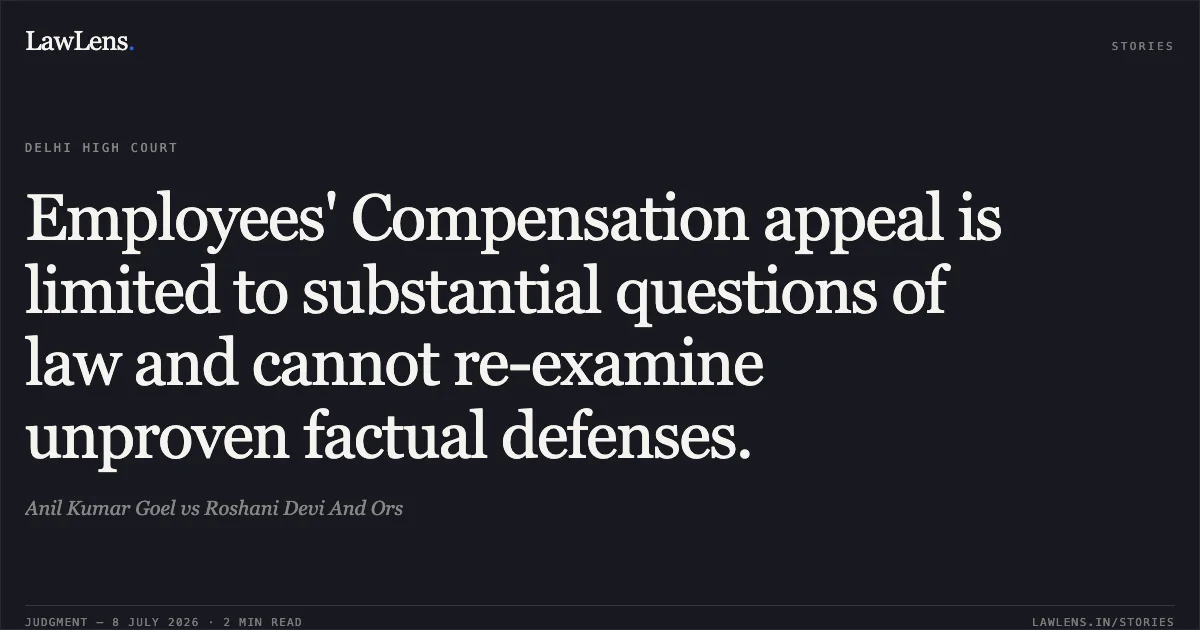
1. Whether a substantial question of law exists under Section 30 of the Employees’ Compensation Act, 1923 to warrant interference with the Commissioner's factual findings
Source reference: p. 3, 52. Whether the appellant proved the existence of an independent contractor agreement to absolve himself of liability as an employer
Source reference: p. 4, 53. Whether discrepancies in the timing of the incident between the FIR and the claim application vitiate the respondents' case
Source reference: p. 5Law Applied
Section 30 of the Employees’ Compensation Act (EC Act), 1923, which restricts the scope of appeals to "substantial questions of law" and establishes the Commissioner as the final authority on facts
Source reference: p. 3The precedent Golla Rajanna & Ors. v. Divisional Manager & Anr., which clarifies that the EC Act is welfare legislation intended to protect workmen
Source reference: p. 3Principles of the Indian Evidence Act regarding the burden of proof, noting that a document (like the unregistered agreement) must be proved in accordance with law to be considered as evidence
Source reference: p. 5Reasoning
The court observed that the appellant failed to produce the alleged agreement with Shyam Kumar during the evidence stage and did not cite him as a witness
Source reference: p. 4, 5The document remained "unproved" as it was an unregistered paper and the appellant’s repeated absence led to ex parte proceedings
Source reference: p. 4Regarding the employer-employee relationship, the court found no reason to disturb the Commissioner’s findings because the work was admittedly performed at the appellant's premises for his benefit
Source reference: p. 5Addressing the discrepancy in timing (6:00 p.m. vs 11:00 p.m.), the court held it was immaterial as the date, location, and occurrence of the fatal accident were not in dispute
Source reference: p. 5The court emphasized that since the appellant could not demonstrate any perversity in the factual findings, no substantial question of law arose under Section 30
Source reference: p. 6Holding
The findings of the Commissioner did not suffer from any legal infirmity or perversity and the appellant failed to prove the intervention of an independent contractor and that factual discrepancies in timing did not overrule the reality of the employment-related death
The High Court dismissed the appeal. The award of Rs.15,88,425/- with 12% interest remains upheld. All pending applications were disposed of
Source reference: p. 6Acts & Sections Cited
1 provisions across 1 statute referred to in this judgment. Linked provisions open on LawLens.
Employee1
Original Court PDF
Anil Kumar GoelvsRoshani Devi And Ors
Click to open original judgment
Original judgment, available to read, download and summarize on LawLens.in