Facts
The respondent, an Indian Revenue Service officer, was appointed through the Civil Services Examination, 2015 under the Persons with Benchmark Disabilities (PwBD) category on the basis of a disability certificate dated 27 December 2013 issued by the Medical Superintendent, VMCC and Safdarjung Hospital, certifying 40–50% bilateral hearing impairment.
Source reference: pp. 2–3, paras. 3–4She was subsequently examined by Ram Manohar Lohia Hospital before joining service and assessed as having 50.94% disability.
Source reference: pp. 2–3, paras. 3–4She joined service in 2016, was confirmed with effect from 29 August 2018, and promoted as Deputy Commissioner with effect from 1 January 2021.
Source reference: p. 3, para. 5Pursuant to a Department of Personnel and Training circular dated 5 August 2024 concerning alleged fraudulent PwBD claims, the respondent underwent a fresh medical examination on 29–30 August 2024.
Source reference: pp. 4, 8–10, paras. 10–12, 18The resultant report dated 20 September 2024 assessed her hearing impairment at 9%.
Source reference: pp. 4, 8–10, paras. 10–12, 18On that basis, the Union issued a show-cause notice dated 4 December 2024 alleging that she had fraudulently obtained employment under the PwBD category and proposing disciplinary proceedings under Rules 14 and 15 of the CCS (CCA) Rules, 1965, potentially resulting in dismissal or removal.
Source reference: pp. 4–5, para. 12The respondent challenged the show-cause notice before the Central Administrative Tribunal.
Source reference: pp. 5–8, paras. 13–14The Tribunal quashed it on grounds including non-disclosure of relied-upon material, denial of meaningful opportunity, lack of reasons for the re-examination, delay, and procedural unfairness.
Source reference: pp. 5–8, paras. 13–14The Union of India challenged that order before the High Court under Article 226 of the Constitution.
Source reference: no citationIssues
Whether an employee possessing disability certificates issued by competent statutory medical authorities, on the basis of which she was appointed under the PwBD category, could be subjected nearly nine years later to a fresh medical examination and disciplinary inquiry merely because the later examination assessed her disability below 40%.
Source reference: pp. 1–2, para. 1; pp. 10–13, paras. 20–26Whether the subsequent medical examination and the alleged reduction in the percentage of disability constituted sufficient prima facie material to allege that the original disability certificates had been fraudulently obtained.
Source reference: pp. 10–14, paras. 21–22, 29–32Whether the High Court could interfere at the stage of the show-cause notice where the proposed disciplinary proceedings were legally misconceived and unsupported by the material disclosed in the notice.
Source reference: pp. 3, 10, 13–14, paras. 9, 27–28, 33–34Law Applied
The Court applied the Rights of Persons with Disabilities Act, 2016 (RPwD Act), under which disability and benchmark disability must be assessed through the statutory framework and competent certifying authorities; a duly issued disability certificate cannot ordinarily be displaced merely by a later independent medical examination.
Source reference: pp. 10–13, paras. 22–26Relying on Ravinder Kumar Dhaliwal v. Union of India, (2023) 2 SCC 209, the Court emphasized that disability under the RPwD Act is a social and participatory concept, not merely a medical condition.
Source reference: p. 11, para. 23The Court also relied on Oryx Fisheries (P) Ltd. v. Union of India, (2010) 13 SCC 427, for the principle that a show-cause proceeding must be initiated fairly, with an open mind and disclosure of the foundational material.
Source reference: pp. 5–7, paras. 14, 16, 19Under Union of India v. Upendra Singh, (1994) 3 SCC 357, judicial interference at the inception of disciplinary proceedings is permissible where the allegations, even if accepted, do not constitute misconduct.
Source reference: p. 13, para. 27The Court distinguished the general caution against interference at the show-cause stage, reflected in Union of India v. Kunisetty Satyanarayana, 2006 (12) SCC 28, and held that the DOPT circular dated 5 August 2024 could apply only where there was prima facie material indicating fraudulent procurement of the original disability certificate, not merely a later medical assessment below 40%.
Source reference: pp. 8–10, 13–14, paras. 18–19, 29–32Reasoning
The Court held that the respondent possessed two disability certificates issued by competent government medical institutions, both certifying disability exceeding 40%, and that neither certificate was alleged to be fabricated or fraudulently obtained.
Source reference: pp. 2–3, 10–14, paras. 3–4, 21, 30–31The only basis for the allegation of fraud was the 2024 examination reporting 9% hearing impairment.
Source reference: pp. 10–12, paras. 21–25That later assessment did not, by itself, establish that the earlier certificates were fraudulently procured, nor did the show-cause notice disclose any justification for reopening the respondent’s eligibility after approximately nine years of service.
Source reference: pp. 10–12, paras. 21–25The Court further held that the employer could not effectively sit in appeal over certificates issued by competent authorities under the RPwD Act through an unexplained subsequent examination.
Source reference: pp. 1–2, paras. 1–2; p. 11, para. 22Given the protective and accommodative philosophy of the RPwD Act, reopening the respondent’s settled eligibility solely on the basis of a later medical test would undermine the statutory scheme and amount to an unfair and legally misconceived proceeding.
Source reference: pp. 12–13, paras. 24–26Accordingly, the case fell within the exception permitting judicial interference before completion of disciplinary proceedings.
Source reference: pp. 13–14, paras. 27–28Holding
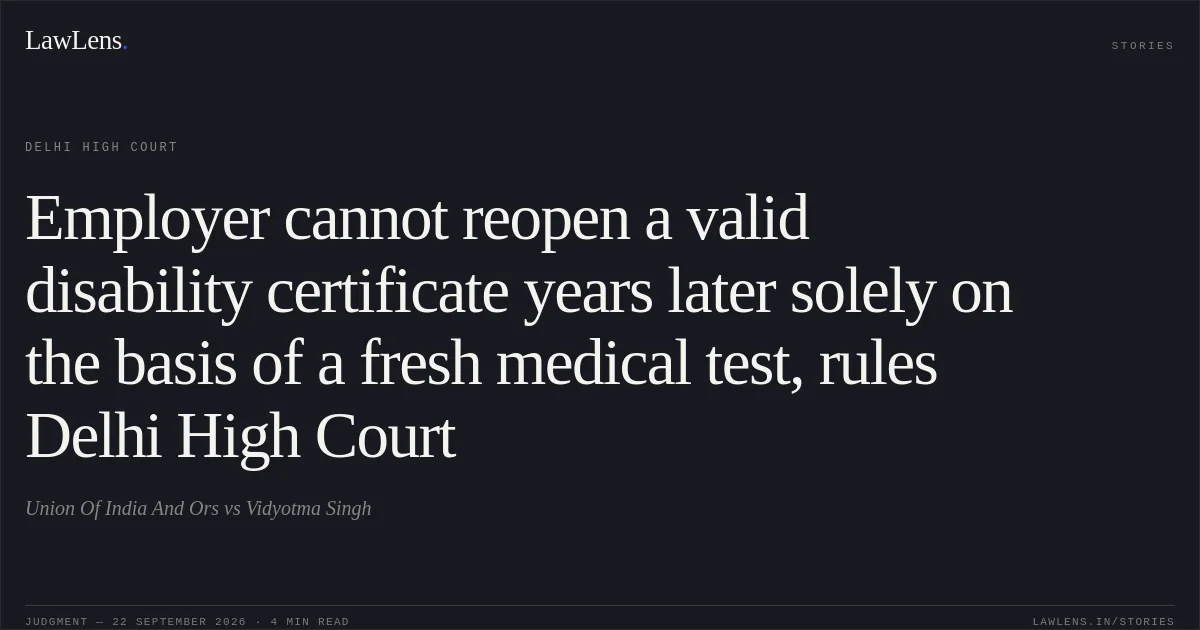
The High Court held that a subsequent medical examination showing disability below 40%, without independent material suggesting fraudulent procurement of the original certificates, could not justify issuance of a disciplinary show-cause notice against an employee appointed and promoted under the PwBD category.
The Court upheld the Tribunal’s order quashing the show-cause notice dated 4 December 2024 and found no ground for interference under Article 226 of the Constitution.
Source reference: p. 14, paras. 33–34The writ petition was accordingly dismissed in limine.
Source reference: p. 15, para. 35Acts & Sections Cited
1 provisions across 1 statute referred to in this judgment. Each provision opens on LawLens.
Rights of Persons with Disabilities Act, 2016.1
Original Court PDF
Union Of India And OrsvsVidyotma Singh
Click to open original judgment
Original judgment, available to read, download and summarize on LawLens.in