Facts
The Appellant was appointed as Senior Manager/General Manager of Hintek Electronics Pvt. Ltd. on 1 August 2016.
Source reference: p.1, para. 3His employment terms included a monthly salary, appraisal, annual increment, reimbursement of out-of-pocket expenses, and sales incentives.
Source reference: pp.1–2, paras. 3–6Alleging non-payment of salary-related dues, increments, expenses and incentives, he instituted a recovery suit for ₹14,33,073 before the Commercial Court.
Source reference: pp.1–2, paras. 3–6The Respondents appeared initially but failed to file their written statement despite repeated opportunities and costs; they were consequently proceeded against ex parte on 13 March 2024.
Source reference: p.2, paras. 7–10After the Appellant led evidence, the Commercial Court dismissed the suit on 12 September 2024, holding that an employer–employee dispute concerning salary arrears was not a “commercial dispute” under Section 2(c) of the Commercial Courts Act, 2015.
Source reference: pp.2–4, paras. 11–15The Appellant challenged the dismissal, contending that the plaint ought to have been returned for presentation before the appropriate court rather than dismissed.
Source reference: p.4, para. 16Issues
Whether a dispute between an employer and employee arising from non-payment of salary, increments, expenses and alleged sales incentives constitutes a “commercial dispute” under the Commercial Courts Act, 2015.
Source reference: pp.4–7, paras. 20–24Whether, upon finding that the suit was not a commercial dispute, the Commercial Court ought to have returned the plaint for presentation before the appropriate court instead of dismissing the suit.
Source reference: p.4, para. 16; p.8, paras. 25–28Law Applied
The Court applied Section 2(1)(c) of the Commercial Courts Act, 2015, holding that the statutory definition of “commercial dispute” does not ordinarily encompass disputes arising from contracts of personal service between employers and employees.
Source reference: pp.4–8, paras. 20–24Relying principally on M/s Ekanek Networks Private Limited v. Aditya Mertia [2024:DHC:4384] and Atmastco Ltd. v. Mandeep Kalra [2024:DHC:4830], the Court held that remuneration, service benefits, or even ancillary business-related terms in an employment contract do not convert a personal-service dispute into a commercial dispute.
Source reference: pp.5–6, para. 21The Court also followed ARM Digital Media Pvt. Ltd. v. Ritesh Singh [2025:DHC:10726], which held that employment disputes remain outside the Commercial Courts Act even where the agreement includes confidentiality, non-compete, intellectual-property or other business-related clauses.
Source reference: pp.6–7, para. 22As to procedure, the Court applied the principle that where a litigant approaches the wrong forum, the plaint should be returned for presentation before the competent court rather than dismissed, thereby avoiding fresh court fees and litigation expenses.
Source reference: p.8, para. 25Reasoning
The Court found, on a reading of the plaint, that the substance of the claim concerned alleged dues arising from the Appellant’s employment relationship, including salary and increments, and therefore constituted an intra-employment service dispute rather than a commercial dispute under Section 2(1)(c).
Source reference: p.5, para. 20The alleged sales commission did not alter this conclusion, particularly since the Trial Court had found no contractual basis for such commission in the appointment and confirmation letters.
Source reference: p.4, para. 15Applying Ekanek Networks, Atmastco and ARM Digital Media, the Court held that the personal-service character of the relationship was determinative and could not be displaced by the monetary value or incidental commercial features of the employment terms.
Source reference: pp.5–7, paras. 21–23However, although the Commercial Court correctly determined that it lacked commercial jurisdiction, dismissal of the suit was procedurally inappropriate; the plaint ought to have been returned for presentation before the competent non-commercial court.
Source reference: p.8, paras. 24–25Holding
The appeal was partly allowed.
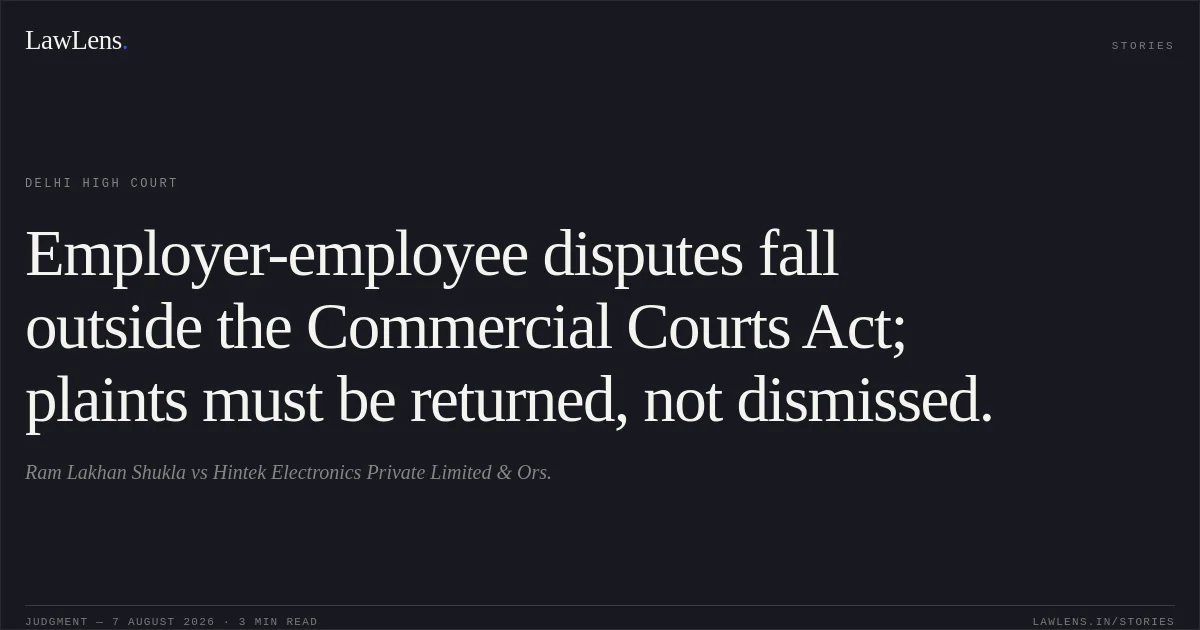
The High Court affirmed the finding that the employer–employee dispute was not a “commercial dispute” under the Commercial Courts Act, 2015, but modified the impugned order to permit presentation of the plaint before the appropriate court.
Source reference: p.8, paras. 24–26The matter was listed before the Commercial Court on 24 August 2026 for return of the plaint; upon its return, the Appellant was granted 30 days to present it before the competent court.
Source reference: p.8, paras. 27–29The appeal and pending applications were disposed of accordingly.
Source reference: no citationActs & Sections Cited
1 provisions across 1 statute referred to in this judgment. Each provision opens on LawLens.
Commercial Courts Act, 20151
Original Court PDF
Ram Lakhan ShuklavsHintek Electronics Private Limited & Ors.
Click to open original judgment
Original judgment, available to read, download and summarize on LawLens.in