Facts
The petitioners, former teaching and non-teaching employees of Shivaji College who retired between 2001 and 2011, challenged demands for repayment of amounts allegedly overpaid to them from the College Provident Fund.
Source reference: para. 1The College maintained a separate Provident Fund, invested subscribers’ contributions in fixed deposits, and credited the interest earned to individual subscriber accounts.
Source reference: para. 2Following the discovery of accounting anomalies, a Special Audit covering 1990–91 to 2009–10 was conducted and received on 6 June 2011.
Source reference: paras. 2–3The audit identified errors in fixed-deposit transactions, interest calculations, omissions, totalling, balancing, accounting entries and carry-forwards.
Source reference: para. 3After recasting the accounts, the College determined that certain retired subscribers had been overpaid and issued recovery notices in 2014, followed by reminders in 2017.
Source reference: paras. 5–6When the gratuity ceiling was enhanced, the College adjusted the alleged Provident Fund liabilities against the petitioners’ additional gratuity.
Source reference: para. 7The petitioners asserted that the accounts had been maintained, audited and settled by the College; that they had played no role in the calculations; and that there was no allegation of fraud, misrepresentation or suppression on their part.
Source reference: para. 9The petitioners relied on State of Punjab v. Rafiq Masih, Thomas Daniel v. State of Kerala and Jogeswar Sahoo v. District Judge, Cuttack.
Source reference: para. 10During the proceedings, further recovery was stayed.
Source reference: para. 8Issues
Whether the College could recover, after the petitioners’ retirement and settlement of their Provident Fund accounts, amounts subsequently found payable because of errors revealed by a retrospective Special Audit.
Source reference: para. 17Whether the College could withhold or appropriate enhanced gratuity or other retiral dues towards the disputed Provident Fund liabilities.
Source reference: paras. 17, 29–32Whether the pooled nature of the Provident Fund justified recovery from petitioners who were not responsible for the alleged overpayments.
Source reference: paras. 25–28Law Applied
The Court applied the equitable-restraint principles governing recovery of excess payments laid down in State of Punjab v. Rafiq Masih (White Washer), under which recovery is ordinarily impermissible where the employee is not at fault, particularly when the employee has retired, the excess payment continued for more than five years, or recovery would otherwise be harsh or inequitable.
Source reference: para. 18The same principle was reaffirmed in Thomas Daniel v. State of Kerala, where recovery after retirement of benefits paid without fraud or misrepresentation was held unjustified, and in Jogeswar Sahoo v. District Judge, Cuttack, which also recognised the relevance of delay and absence of procedural fairness.
Source reference: paras. 19–20The Court relied on Umesh Chand Tyagi v. Union of India to hold that this protection is not confined to salary fixation and may extend to erroneous credits in a provident fund account.
Source reference: para. 21In relation to gratuity, the Court applied the Payment of Gratuity Act, 1972: Section 4(6) permits forfeiture only in specified circumstances involving termination for misconduct; Section 7 provides the mechanism for determination of gratuity disputes; Section 13 protects gratuity from attachment; and Section 14 gives the Act overriding effect.
Source reference: para. 31A unilateral set-off must additionally be supported by a legal, statutory, contractual or other valid authority.
Source reference: paras. 29–32Reasoning
The Court held that the petitioners’ Provident Fund accounts had been maintained and calculated by the College, annual statements had been issued, and the balances had been released upon retirement after being treated as settled.
Source reference: para. 22There was no allegation that the petitioners had supplied incorrect information, committed fraud, influenced the calculations or contributed to the alleged excess credits.
Source reference: para. 22The liabilities arose only after the College reopened and reconstructed accounts covering nearly two decades; applying Rafiq Masih, Thomas Daniel, Jogeswar Sahoo and Umesh Chand Tyagi, such delayed recovery from retired, faultless employees was inequitable.
Source reference: paras. 18–22The petitioners’ participation in, or support for, the general audit process did not amount to acceptance of individual liabilities.
Source reference: para. 23A subsequent decision treating future Provident Fund settlements as provisional could not retrospectively alter settlements already made before that decision.
Source reference: para. 24Although the pooled nature of the Fund created a legitimate concern for subscribers who had allegedly been underpaid, it did not convert those subscribers’ claims into direct claims against other subscribers whose accounts had already been settled.
Source reference: paras. 25–27Finally, describing the withholding of gratuity as an “adjustment” did not change its substance: the College had appropriated an independent statutory retirement benefit towards a disputed claim, without demonstrating any legal, contractual or statutory authority for doing so.
Source reference: paras. 29–32Holding
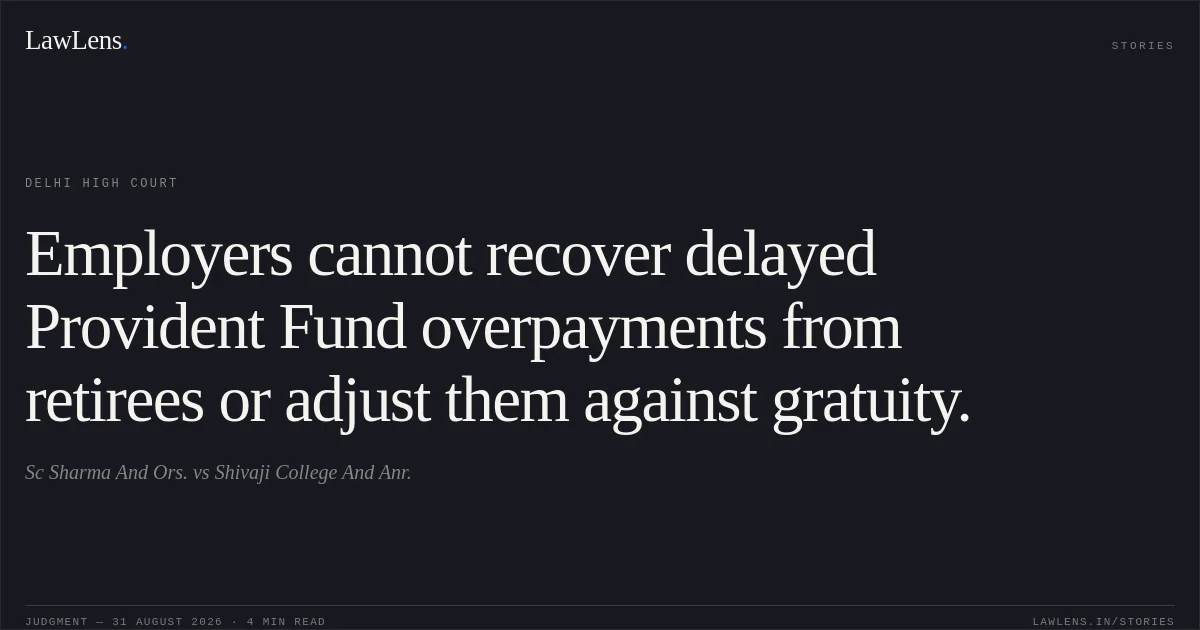
The Court allowed the writ petition and held that recovery from the petitioners, whether by direct demand or by adjustment against gratuity, was unsustainable.
The recovery notices issued pursuant to the Special Audit, together with all consequential demands and adjustments, were set aside.
Source reference: para. 33(a)The College was restrained from making any further recovery from the petitioners from gratuity or other retiral dues.
Source reference: para. 33(b)It was directed to provide each petitioner, within four weeks, a statement of amounts recovered, adjusted or withheld, and to refund or release such amounts within eight weeks thereafter, with interest at 6% per annum from the date of recovery, adjustment or withholding until payment.
Source reference: paras. 33(c)–(d)The relief was confined to the petitioners and did not reopen transactions involving subscribers who had not challenged the recoveries.
Source reference: para. 34Acts & Sections Cited
1 provisions across 1 statute referred to in this judgment. Each provision opens on LawLens.
Provident Funds Act, 19251
Original Court PDF
Sc Sharma And Ors.vsShivaji College And Anr.
Click to open original judgment
Original judgment, available to read, download and summarize on LawLens.in