01Facts
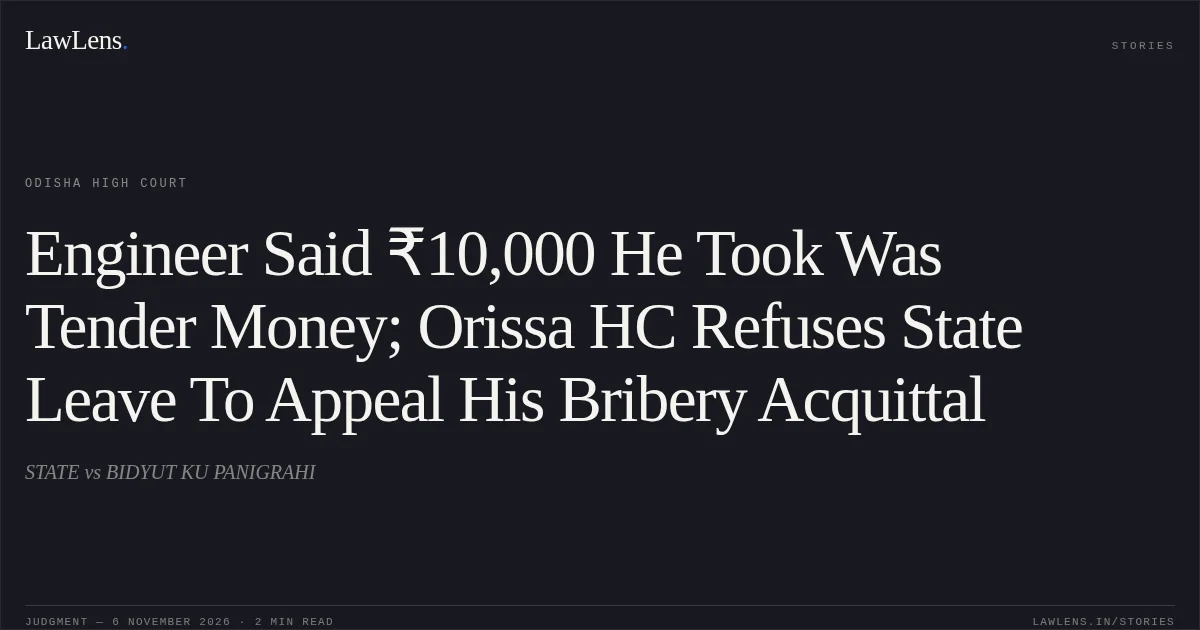
The respondent, an Assistant Engineer, was accused of demanding ₹20,000, later reduced to ₹10,000, from a contractor for processing and passing bills.
pp. 2–3A vigilance trap was conducted, and the tainted currency was recovered from the respondent; hand-wash tests were positive.
pp. 2–3The trial court acquitted him under Section 248(1) CrPC, finding that the prosecution had not proved the money was illegal gratification and that the defence explanation—that it related to tender dues—was reasonably probable in light of the parties’ admitted enmity and other circumstances.
pp. 4–5The State sought leave to appeal against the acquittal under Section 378 CrPC.
pp. 1, 5–802Issues
i.Whether the trial court’s acquittal was perverse, unreasonable, or based on a misreading or omission of material evidence so as to warrant appellate interference.
pp. 7–8, 10–11ii.Whether the recovery of tainted currency and positive chemical tests required the acquittal to be set aside, notwithstanding the trial court’s acceptance of the defence explanation as reasonably probable.
pp. 6–8, 1103Law Applied
Section 378(1) and (3) CrPC governs an appeal against acquittal and the grant of leave; Section 248(1) CrPC provides for acquittal after trial.
p. 1, 5The charges arose under Sections 7 and 13(1)(d), read with Section 13(2), of the Prevention of Corruption Act, 1988.
pp. 2–3Applying Tulasareddi @ Mudakappa v. State of Karnataka, 2026 INSC 67, the Court stated that an acquittal should not be disturbed where the trial court’s view is reasonably possible; interference is justified where the judgment is perverse, rests on misreading or omission of material evidence, or is clearly unreasonable.
pp. 7–9Relying also on Mallappa v. State of Karnataka, 2024 INSC 104, the Court held that acquittal strengthens the presumption of innocence and requires a higher threshold for appellate interference.
pp. 9–10Provisions in the judgment · 4 · Linked ones open on LawLens
Code of Criminal Procedure, 1973 Section 378Section 248
Prevention of Corruption Act, 1988 Section 7Section 13
04Reasoning
The Court considered the State’s arguments that the trial court had undervalued the trap evidence and improperly accepted the respondent’s explanation concerning tender dues.
pp. 5–8It nevertheless found the trial court’s assessment neither perverse nor wholly unreasonable: the trial court had considered the admitted enmity, the evidence concerning tender papers, the respondent’s explanation, related civil litigation, and suspicious circumstances surrounding the alleged bills.
pp. 4–5, 11Because that assessment was a possible view on the evidence, the recovery and chemical-test evidence did not establish a basis to displace the acquittal under the heightened standard governing such appeals.
pp. 8, 10–1105Holding
The Court held that no compelling or substantial ground existed to interfere with the acquittal or grant leave to appeal.
pp. 11–12The State’s leave petition, CRLLP No. 2 of 2012, was dismissed.
p. 12Original Court PDF
STATEvsBIDYUT KU PANIGRAHI
Click to open original judgment
Original judgment, available to read, download and summarize on LawLens.in