Facts
ACC Limited operates a cement and clinker manufacturing unit and a 25 MW captive power plant at Jamul, District Durg.
Source reference: paras. 3–5It used rainwater collected in naturally formed ponds/mined-out pits for industrial purposes.
Source reference: paras. 3–5In ACC Ltd. v. State of Chhattisgarh, Civil Appeal No. 316 of 2022, the Supreme Court directed reassessment of consumption and, on 11 January 2022, directed payment of outstanding water charges without imposing penalty for the disputed period up to March 2020.
Source reference: paras. 3–5, 15–16ACC had applied for allotment/permission to use surface water on 3 June 2020 and 10 March 2023, but the applications remained undecided.
Source reference: paras. 5, 21–22The Executive Engineer thereafter issued demand notices dated 13 June 2024 for the period 1 April 2020 to 31 May 2024, demanding ₹1,81,32,897 for the captive power plant and ₹1,99,26,915 for the cement plant.
Source reference: paras. 1, 5, 14The demands included charges at three times the normal rate for alleged unauthorised use and interest on the outstanding amount.
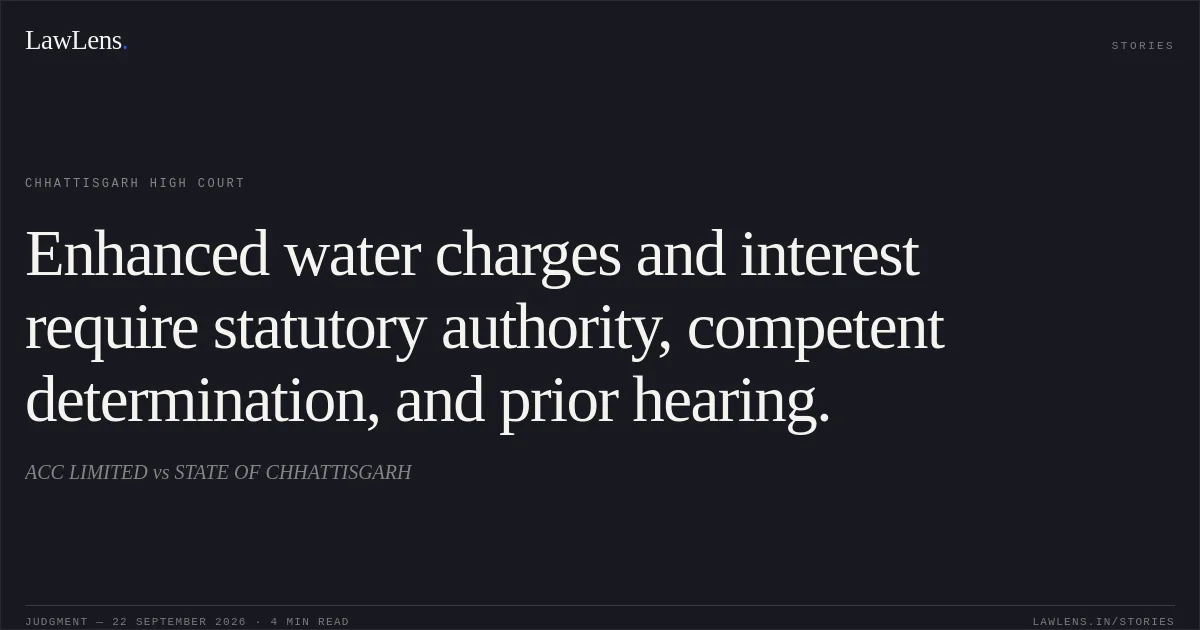
Source reference: paras. 1, 5, 14ACC challenged the enhanced charges and interest, contending that they were contrary to the Supreme Court’s order, unsupported by statutory authority, and imposed without a proper hearing.
Source reference: paras. 6–9Issues
Whether the respondents were legally entitled to levy water charges at three times the normal rate by treating ACC’s consumption as unauthorised under Rule 73(1) of the Chhattisgarh Irrigation Rules, 1974.
Source reference: paras. 17–22Whether the Supreme Court’s direction dated 11 January 2022 that no penalty be imposed restricted the respondents from imposing, for the subsequent period, a liability which was penal in substance notwithstanding its description as enhanced water charges.
Source reference: paras. 16–20, 34Whether interest could be recovered on the outstanding water charges in the absence of clear substantive statutory authority and whether the Executive Engineer was competent to impose such liability.
Source reference: paras. 23–29Whether the demand notices were vitiated for failure to provide prior notice and an effective opportunity of hearing before determining unauthorised use, applicability of the enhanced rate, and liability for interest.
Source reference: paras. 30–31Whether the respondents were required to decide ACC’s pending applications for allotment/permission to use surface water.
Source reference: paras. 21–22, 36Law Applied
The Court applied Sections 26 and 40 of the Chhattisgarh Irrigation Act, 1931, under which the State has statutory control over water in natural sources and may regulate and charge for industrial use.
Source reference: para. 18Rule 73(1) of the Chhattisgarh Irrigation Rules, 1974 permits recovery at three times the prescribed volumetric rate for water used in an unauthorised manner.
Source reference: para. 19However, a statutory authority must establish the factual and statutory basis for invoking the enhanced rate; nomenclature cannot convert a penal liability into an ordinary charge.
Source reference: paras. 18–20Relying on J.K. Synthetics Ltd. v. Commercial Taxes Officer, (1994) 4 SCC 276, India Carbon Ltd. v. State of Assam, (1997) 6 SCC 479, V.V.S. Sugars v. Government of A.P., (1999) 4 SCC 192, and Shree Bhagwati Steel Rolling Mills v. Commissioner of Central Excise, (2016) 3 SCC 643, the Court held that interest on a statutory liability can be imposed only where there is substantive statutory authority for such levy.
Source reference: paras. 23–27Rule 193 specifically identifies the competent authority for imposing penalty for non-payment of canal revenue; therefore, an Executive Engineer cannot assume that power without statutory authorization.
Source reference: para. 28Where determination of liability involves civil consequences, natural justice requires notice and an effective opportunity of hearing.
Source reference: para. 31Reasoning
The Court held that the Supreme Court’s order dated 11 January 2022 concerned the earlier disputed period and did not permanently exempt ACC from future water charges or make subsequent use automatically authorised.
Source reference: para. 16Nevertheless, the respondents could not mechanically impose the three-times rate merely by describing the amount as water charges.
Source reference: paras. 18–22, 30They were required to determine whether the particular use was unauthorised, whether Rule 73(1) was attracted, and whether the applicable notifications supported the enhanced rate.
Source reference: paras. 18–22, 30The pendency of ACC’s applications did not create deemed permission, but the respondents were equally bound to decide those applications and could not indefinitely keep them pending while treating the use as unauthorised.
Source reference: paras. 21–22, 36The interest component was also unsustainable in its existing form because the respondents had not identified a clear statutory source authorising its imposition by the Executive Engineer, particularly in light of Rule 193 and the settled law requiring substantive authority for interest.
Source reference: paras. 23–29Since the demands involved disputed questions concerning unauthorised use, the enhanced rate, interest, and the relevant period, they could not be enforced without prior hearing.
Source reference: para. 31Holding
The writ petition was disposed of by setting aside the demand notices dated 13 June 2024 to the extent that they imposed the three-times rate and interest without a proper determination of statutory liability.
ACC was not declared wholly exempt from lawful water charges for actual consumption.
Source reference: paras. 33–35, 38The competent authority was directed to reassess the quantity consumed, source of water, applicable statutory rate, applicability of Rule 73(1), effect of the Supreme Court’s direction against penalty, and legality of any interest claim, after giving ACC an opportunity of hearing.
Source reference: paras. 33–35, 38ACC was directed to file objections and supporting documents within four weeks, and the reassessment was to be completed preferably within three months thereafter.
Source reference: paras. 38–40Amounts already deposited were to be adjusted against any sum ultimately found payable.
Source reference: paras. 38–40The pending applications for allotment/permission to use surface water were also directed to be decided independently and expeditiously; no order as to costs was made.
Source reference: paras. 36, 41–42Acts & Sections Cited
2 provisions across 2 statutes referred to in this judgment. Each provision opens on LawLens.
Central Sales Tax Act, 19561
Central Excise Act, 19441
Original Court PDF
ACC LIMITEDvsSTATE OF CHHATTISGARH
Click to open original judgment
Original judgment, available to read, download and summarize on LawLens.in