Facts
An FIR was registered following the alleged dumping of acidic industrial chemicals near a public pond.
Source reference: paras. 1–2, 5–8, 16.1–16.2; pp. 1–7, 13–14The applicant, a manager at Panorama Aromatics Ltd., was not named in the FIR or found at the scene.
Source reference: paras. 1–2, 5–8, 16.1–16.2; pp. 1–7, 13–14The applicant maintained that the company had rejected and returned the chemical to its supplier; the company’s inward and outward records were collected during the investigation.
Source reference: paras. 1–2, 5–8, 16.1–16.2; pp. 1–7, 13–14The chargesheet implicated the applicant principally on the basis of a co-accused’s police statement.
Source reference: paras. 1–2, 5–8, 16.1–16.2; pp. 1–7, 13–14The applicant sought quashing under Section 482 CrPC of the FIR and consequential proceedings for offences under Sections 269, 277, 278, 284 and 120B IPC and Sections 7 and 15(1) of the Environment (Protection) Act, 1986 (“EPA”).
Source reference: paras. 1–2, 5–8, 16.1–16.2; pp. 1–7, 13–14Issues
Whether the statutory cognizance restriction in Section 19 EPA barred prosecution for the EPA offences on the basis of a police chargesheet.
Source reference: paras. 14–14.2; pp. 10–11Whether the alleged connection between the EPA and IPC offences required the IPC prosecution to be quashed under a “same transaction” or non-splitting principle.
Source reference: paras. 9, 15–15.6; pp. 8, 11–13Whether the chargesheet disclosed legally sufficient material to sustain the IPC charges against the applicant, where the principal link was a co-accused’s police statement.
Source reference: paras. 16–19; pp. 13–20Law Applied
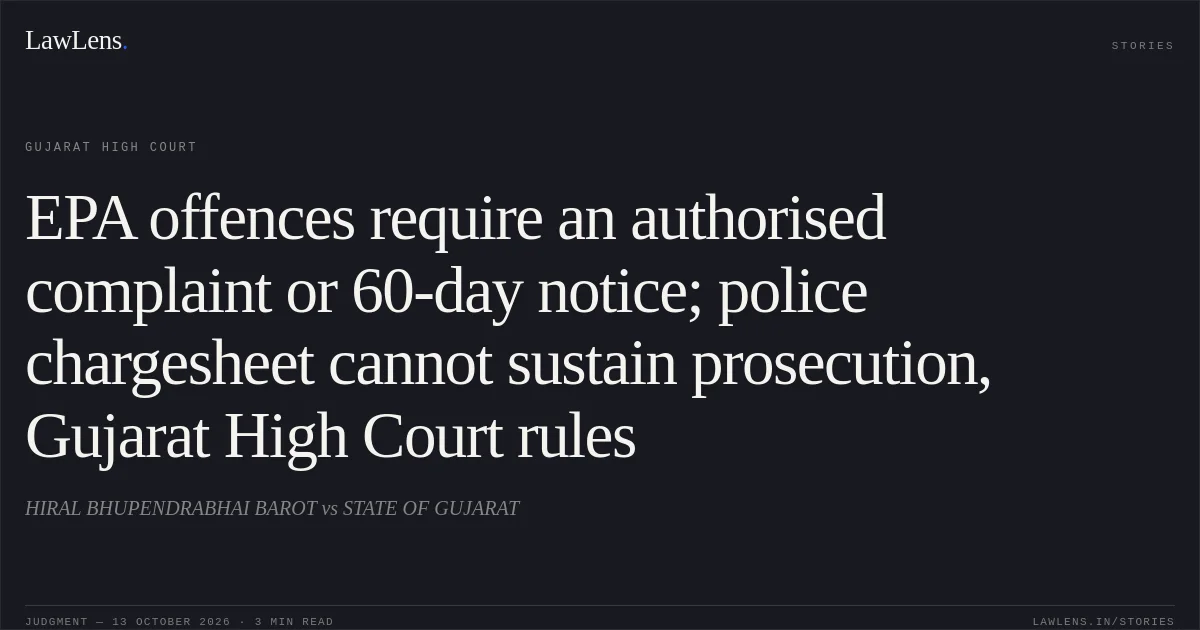
Section 19 EPA permits cognizance of an EPA offence only on a complaint by an authorised government authority or officer, or by a person who has given the prescribed 60-day notice; the judgment held that a police report under Section 173 CrPC did not satisfy that requirement.
Source reference: paras. 14–14.2; pp. 10–11Section 24(2) EPA preserves liability under another penal law where the same act constitutes offences under both the EPA and that law; accordingly, the Section 19 restriction does not itself bar prosecution for distinct IPC offences.
Source reference: paras. 15.2–15.6; pp. 11–13Relying on State (NCT of Delhi) v. Sanjay, (2014) 9 SCC 772, and Jayant v. State of M.P., (2021) 2 SCC 670, the Court held that a special-statute restriction on police prosecution does not necessarily preclude investigation and prosecution of independently constituted IPC offences.
Source reference: para. 15.5; p. 12Under the principles discussed in P. Krishna Mohan Reddy v. State of Andhra Pradesh, 2025 SCC OnLine SC 1157, a co-accused’s police statement cannot, by itself, serve as substantive evidence against another accused; Section 30 of the Evidence Act does not make an otherwise inadmissible confession admissible.
Source reference: paras. 17–18; pp. 14–20The Court also applied the quashing principles in State of Haryana v. Bhajan Lal, 1992 Supp (1) SCC 335.
Source reference: para. 19; p. 20Reasoning
The Court treated the Section 19 EPA bar as confined to prosecution under the EPA and rejected the argument that it automatically invalidated the IPC charges, given Section 24(2) EPA.
Source reference: paras. 14.2, 15.2–15.6; pp. 10–13It then assessed the IPC case against the applicant separately.
Source reference: paras. 16.1–18; pp. 13–20The applicant was absent from the scene; company records supported the claim that the material had been rejected and returned; and the bills found with the driver and cleaner were not connected to the applicant or the company.
Source reference: paras. 16.1–18; pp. 13–20The remaining link was a co-accused’s police statement, with no independent evidence or call-detail records connecting the applicant to the dumping or conspiracy.
Source reference: paras. 16.1–18; pp. 13–20The Court therefore concluded that the material did not provide a legally sufficient basis to proceed against the applicant on the IPC charges.
Source reference: paras. 16.1–18; pp. 13–20Holding
The Court held that prosecution under Sections 7 and 15(1) EPA through the police chargesheet was barred by Section 19 EPA, but rejected the contention that the IPC prosecution was barred merely because it arose from the same transaction.
It nevertheless quashed the FIR, chargesheet and consequential proceedings qua the applicant only, finding the IPC case against the applicant unsupported by admissible independent material.
Source reference: paras. 20–22; pp. 20–22Proceedings against the remaining co-accused were to continue independently and in accordance with law.
Source reference: paras. 20–22; pp. 20–22Acts & Sections Cited
17 provisions across 4 statutes referred to in this judgment. Each provision opens on LawLens.
Code of Criminal Procedure, 19738
Environment (Protection) Act, 19864
Indian Penal Code, 18604
Mines and Minerals (Development and Regulation) Act, 19571
Original Court PDF
HIRAL BHUPENDRABHAI BAROTvsSTATE OF GUJARAT
Click to open original judgment
Original judgment, available to read, download and summarize on LawLens.in