Facts
The petitioner was appointed in 2013 as “Warden-cum-Estate Incharge” at the Regional Panchayat and Rural Development Training Centre, Kurud, in the pay scale of Rs. 5,200–20,200 with Grade Pay of Rs. 2,800, pursuant to a sanctioned set-up prescribing the post of “Warden-cum-Estate Officer” in a lower scale.
Source reference: para. 2.1, 4He contended that his duties, including additional responsibilities as Training In-charge and Faculty, were comparable to those performed by Hostel Superintendents in the SC and ST Development Department and Estate Officers in the Chhattisgarh Housing Board and Dr. Shyama Prasad Mukharji International Institute of Information Technology, who received the pay scale of Rs. 15,600–39,100 with Grade Pay of Rs. 6,600.
Source reference: paras. 2.2–3On his representation, the State corrected his designation to “Warden-cum-Estate Officer” but did not revise his pay scale.
Source reference: para. 2.2His subsequent representation seeking pay parity was rejected on 22 June 2019, leading to the present writ petition under Article 226 of the Constitution.
Source reference: paras. 1–2.2Issues
1. Whether the petitioner was entitled to the pay scale of Rs. 15,600–39,100 with Grade Pay of Rs. 6,600 on the principle of “equal pay for equal work” by comparison with Hostel Superintendents and Estate Officers in other departments or institutions.
Source reference: paras. 1, 10, 162. Whether the rejection of the petitioner’s representation by order dated 22 June 2019 was arbitrary, discriminatory, or violative of Articles 14 and 16 of the Constitution.
Source reference: paras. 3, 5, 16Law Applied
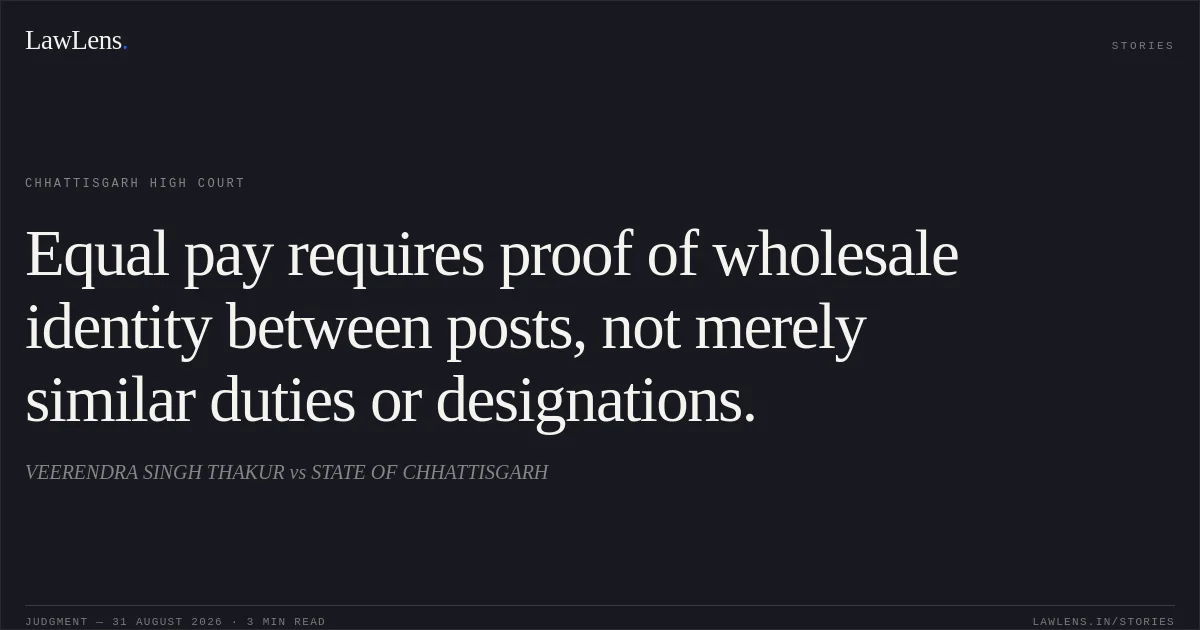
“Equal pay for equal work” is a constitutional goal under Article 39(d), read with Articles 14 and 16, rather than an independently enforceable fundamental right; however, the principle may apply where there is complete and wholesale identity between the posts.
Source reference: para. 10Mere similarity in designation, nature, or volume of work is insufficient. Relevant factors include the source and mode of recruitment, qualifications, nature and quality of work, responsibilities, reliability, experience, confidentiality, functional requirements, hierarchy, promotional avenues, territorial or administrative charge, and service conditions.
Source reference: paras. 10–15Relying on State of M.P. v. Ramesh Chandra Bajpai, (2009) 13 SCC 635; SAIL v. Dibyendu Bhattacharya, (2011) 11 SCC 122; Punjab SEB v. Thana Singh, (2019) 4 SCC 113; and Punjab State Corporation Ltd. v. Rajesh Bindal, (2019) 3 SCC 547, the Court reiterated that the burden lies on the employee claiming parity and that equation of posts and fixation of pay are primarily matters for the executive and expert bodies.
Source reference: paras. 11–14Judicial interference is justified only where the differentiation is arbitrary, irrational, or based on extraneous considerations.
Source reference: paras. 11–14Reasoning
The petitioner established only that his designation had been corrected and that certain duties were similar to those attached to posts in other establishments.
Source reference: para. 16He did not produce material demonstrating identity in recruitment method, qualifications, cadre structure, hierarchy, promotional avenues, duties, responsibilities, functional requirements, or other service conditions.
Source reference: paras. 4–8, 16The posts relied upon belonged to different departments or institutions governed by distinct recruitment rules and service structures.
Source reference: paras. 4–8, 16The Court therefore found that the correction of nomenclature did not confer entitlement to the higher pay scale and that the petitioner failed to discharge the burden of proving wholesale identity between the posts.
Source reference: paras. 15–16In the absence of proof of arbitrary or irrational discrimination, the Court declined to interfere with the executive determination of pay.
Source reference: paras. 15–16Holding
The Court answered the issues against the petitioner. It held that the petitioner was not entitled to the higher pay scale merely because his designation and some duties resembled those of employees in other departments or institutions.
The order dated 22 June 2019 rejecting his representation was upheld as lawful and non-arbitrary.
Source reference: para. 16The writ petition was dismissed as meritless, with the parties left to bear their own costs.
Source reference: para. 16Original Court PDF
VEERENDRA SINGH THAKURvsSTATE OF CHHATTISGARH
Click to open original judgment
Original judgment, available to read, download and summarize on LawLens.in