Facts
AMD India filed its return for AY 2013–14, reporting international transactions with its associated enterprise. The Transfer Pricing Officer (TPO) made adjustments concerning software-development services and receivables; the Assessing Officer (AO) also added ₹7,73,50,917 under Section 28(iv) of the Income-tax Act, 1961, for equipment received from the associated enterprise without charge.
Source reference: p. 4–5, para. 5The Commissioner of Income-tax (Appeals) (CIT(A)) partly allowed the assessee’s appeal, including by applying a ₹200-crore turnover filter, directing that depreciation be excluded in computing the profit-level indicator (PLI), and treating bad-debt provision as operating expenditure. The CIT(A) also limited the Section 28(iv) addition to 12% of the equipment’s value.
Source reference: p. 6–8, paras. 6–8The Income Tax Appellate Tribunal (ITAT) partly allowed the assessee’s appeal and dismissed the Revenue’s appeal. The Revenue challenged the ITAT’s order under Section 260A.
Source reference: p. 3–4, paras. 1, 9Issues
1. Whether the ITAT erred in excluding certain companies as comparables by applying a ₹200-crore upper turnover filter?
Source reference: p. 9, para. 122. Whether the ITAT erred in directing that depreciation be excluded in computing the PLI, thereby adopting a “cash PLI”?
Source reference: p. 7, 10, paras. 7, 153. Whether provision for bad and doubtful debts should be treated as operating expenditure when computing the PLI?
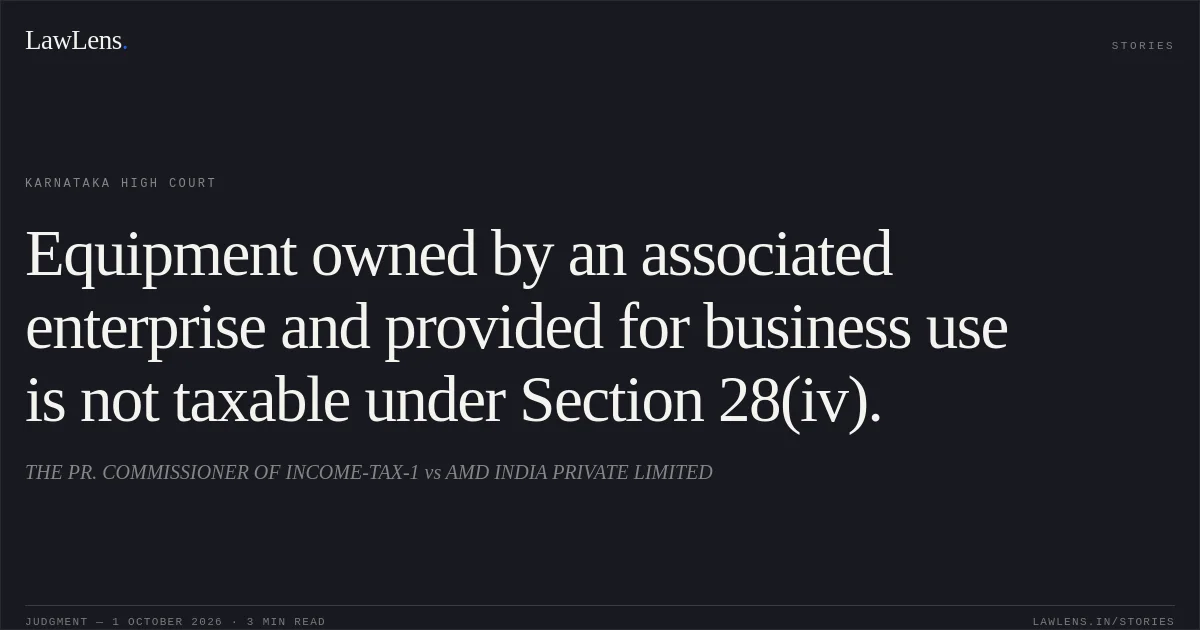
Source reference: p. 11–12, paras. 17–184. Whether equipment provided by the associated enterprise without charge gave rise to taxable income under Section 28(iv)?
Source reference: p. 5, 13–14, paras. 5, 195. Whether any of these issues raised a substantial question of law warranting interference under Section 260A?
Source reference: p. 10–14, paras. 16, 18–22Law Applied
Section 260A of the Income-tax Act permits a High Court to hear an appeal only where a substantial question of law arises. Sections 92B and 92CA govern international transactions and their reference to the TPO; Rule 10B(1)(e) governs the transactional net margin method and computation of the net operating profit margin.
Source reference: no citationThe Court applied the principle that, although the Act and Rules do not prescribe a turnover filter, company size may be relevant to comparability under the functions, assets and risks (FAR) analysis. It followed Sap Labs India Pvt. Ltd. v. Income Tax Officer on the turnover-filter issue and PCIT v. Novell Software Development India (P) Ltd. on excluding depreciation where differences in depreciation materially affect comparability.
Source reference: p. 9–10, paras. 12, 15–16It further relied on Principal CIT v. Business Process Outsourcing India Private Limited for treating ordinary bad-debt provision as operating expenditure, and Principal Commissioner of Income-tax v. Sony India Software Centre (P) Ltd. concerning equipment supplied by an associated enterprise.
Source reference: p. 12–14, paras. 17, 19Reasoning
The Court held that turnover is relevant to selecting comparable companies and found no error in excluding companies exceeding the ₹200-crore filter, an issue already covered against the Revenue by Sap Labs.
Source reference: p. 10, paras. 12–13It rejected the Revenue’s challenge to excluding depreciation from the PLI because the ITAT had found material differences in depreciation costs attributable to asset types, technology and investment levels, and the issue was covered by Novell Software.
Source reference: p. 10–11, paras. 15–16As there was no material showing that the bad-debt provision was extraordinary, the Court found no basis to disturb the ITAT’s treatment of it as a normal operating expense.
Source reference: p. 11–12, paras. 17–18On the equipment, the assessee’s case was that it neither owned the assets nor claimed depreciation, and that they were used to test software for the associated enterprise; the Court considered the issue covered by Sony India Software Centre.
Source reference: p. 13–14, para. 19The Court accordingly found no substantial question of law on the issues raised.
Source reference: p. 10–14, paras. 16, 18–21Holding
The High Court held that the Revenue’s questions did not give rise to a substantial question of law under Section 260A.
It dismissed both appeals, leaving the ITAT’s order undisturbed, including its deletion of the 12% addition sustained by the CIT(A) in the assessee’s appeal.
Source reference: p. 14–15, paras. 20–22Acts & Sections Cited
9 provisions across 1 statute referred to in this judgment. Linked provisions open on LawLens.
Income Tax Act, 1961
Original Court PDF
THE PR. COMMISSIONER OF INCOME-TAX-1vsAMD INDIA PRIVATE LIMITED
Click to open original judgment
Original judgment, available to read, download and summarize on LawLens.in