Facts
The petitioners challenged FIR No. 05/2021 dated 3 February 2021, registered by the Anti-Corruption Bureau, Jammu, under Section 5(1)(d) read with Section 5(2) of the J&K Prevention of Corruption Act, Samvat 2006, and Section 120-B RPC, together with the consequential charge-sheet.
Source reference: paras. 1–2, 13–15The prosecution alleged that Revenue Officers, including the Settlement Officer, in conspiracy with the petitioners, illegally attested Mutation Nos. 558, 559 and 564 in 2011 under Section 121 of the J&K Land Revenue Act, thereby conferring ownership rights over 116 kanals and 12 marlas of land and causing loss of stamp duty to the State.
Source reference: paras. 1–2, 13–15The petitioners contended that the mutations were attested during duly authorised settlement operations by competent statutory officers.
Source reference: paras. 3, 7–8, 20–23They asserted that they had been in possession since 1987 and that the transactions involved oral gifts recognised under the Hidayat Bundobust, 2005.
Source reference: paras. 3, 7–8, 20–23They further relied on the Divisional Commissioner’s order dated 22 May 2025, which did not annul the mutations but directed recovery of deficient stamp duty and related charges.
Source reference: paras. 3, 7–8, 20–23The prosecution maintained that the transfers were barred by Section 28-A of the Agrarian Reforms Act and Government Order No. S-432 of 1996, and that Section 121 of the Land Revenue Act could not be used to confer ownership on the petitioners.
Source reference: paras. 9–11, 19Issues
Whether the attestation of Mutation Nos. 558, 559 and 564 under Section 121 of the J&K Land Revenue Act, allegedly contrary to Section 28-A of the Agrarian Reforms Act and Government Order No. S-432 of 1996, disclosed criminal misconduct under Section 5(1)(d) read with Section 5(2) of the J&K Prevention of Corruption Act
Source reference: paras. 4–6, 13–19Whether an allegedly erroneous or irregular exercise of statutory or quasi-judicial revenue jurisdiction, resulting in benefit to private parties, could by itself establish dishonest abuse of official position or criminal conspiracy under Section 120-B RPC
Source reference: paras. 5–6, 24–29, 41Whether the filing of the charge-sheet during the pendency of the petitions barred the High Court from exercising its jurisdiction to quash the criminal proceedings
Source reference: paras. 39–41, 46Law Applied
The Court applied Sections 22 and 121 of the J&K Land Revenue Act, holding that Section 121 authorises the Collector or competent Settlement Officer, during duly notified settlement proceedings, to summarily determine questions of title, subject to statutory appellate remedies and later civil adjudication.
Source reference: paras. 18, 22–24It considered Section 28-A of the Agrarian Reforms Act, Government Order No. S-432 of 1996 and the Hidayat Bundobust, 2005, including its recognition of oral gifts, exchanges and Shariya Bay where possession is established.
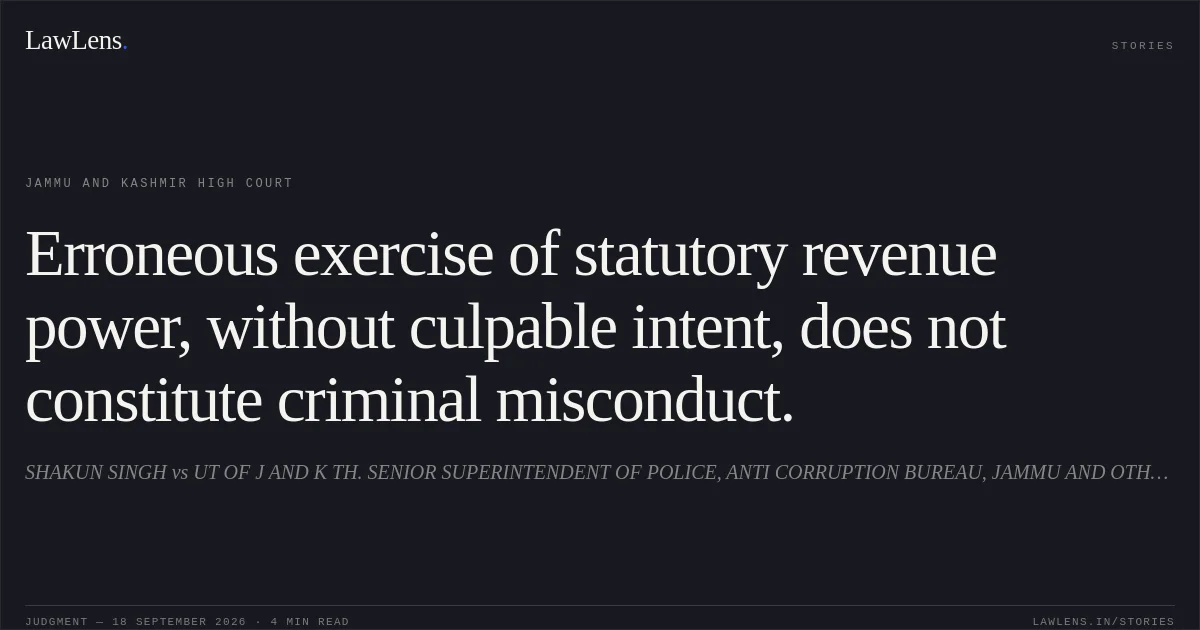
Source reference: paras. 18–19, 23The Court held that an erroneous exercise of statutory or quasi-judicial power does not, without independent material showing bribery, dishonest intention, corrupt design or conspiracy, constitute criminal misconduct under the Prevention of Corruption Act.
Source reference: paras. 25, 28–32, 40–41Relying on the principles in C.K. Jaffer Sharief v. State (Through CBI) , (2013) 1 SCC 205, it held that procedural violation or resulting pecuniary advantage, without dishonest intent, is insufficient for criminal liability.
Source reference: para. 40It also applied the settled rule that mutation entries do not create or extinguish title and are principally fiscal in character, as recognised in (1996) 6 SCC 223 and (2015) 14 SCC 784.
Source reference: paras. 33–34Finally, the Court applied the principle that the filing of a charge-sheet does not prevent quashing where the allegations, taken at face value, fail to disclose the essential ingredients of the offences.
Source reference: paras. 39, 46–50Reasoning
The Court found that the mutations were attested by officers vested with statutory authority during duly authorised settlement proceedings; therefore, the case did not involve an inherent lack of jurisdiction but principally a dispute about the scope and correctness of the power exercised under Section 121.
Source reference: paras. 17, 22–24The prosecution had assumed that possession could only have passed after the 1992 mutation under Section 8 of the Agrarian Reforms Act, although the petitioners claimed possession from 1987; the investigating agency had not independently established the date of transfer.
Source reference: para. 20The competent Divisional Commissioner had examined the mutations, declined to set them aside, and treated the defect as one involving recovery of stamp duty and charges.
Source reference: paras. 21, 27, 38, 44The Court held that the prosecution material contained no allegation of illegal gratification, no independent evidence of dishonest abuse of office, and no material showing a prior meeting of minds between the petitioners and Revenue Officers.
Source reference: paras. 25–29, 41–45, 50The mere benefit derived from statutory orders, or the investigating agency’s contrary interpretation of revenue law, could not substitute for proof of the culpable intent required under the Prevention of Corruption Act and Section 120-B RPC.
Source reference: paras. 25–29, 41–45, 50Since mutation entries themselves do not confer title, the allegation that the officers criminally “conferred ownership” merely by attesting the mutations was also legally insufficient.
Source reference: paras. 33–34Holding
The Court held that the material collected by the prosecution, even if accepted in its entirety, disclosed at most an alleged legal or procedural irregularity in the exercise of statutory revenue powers, coupled with a fiscal issue concerning stamp duty.
It did not disclose bribery, dishonest abuse of official position, criminal intent or a prior conspiracy sufficient to constitute offences under Section 5(1)(d) read with Section 5(2) of the J&K Prevention of Corruption Act or Section 120-B RPC.
Source reference: paras. 43–50The connected petitions were accordingly allowed, and the criminal proceedings arising from FIR No. 05/2021 dated 3 February 2021 were quashed insofar as they related to the petitioners.
Source reference: para. 50Acts & Sections Cited
2 provisions across 2 statutes referred to in this judgment. Each provision opens on LawLens.
Judges (Protection) Act, 19851
Code of Criminal Procedure, 19731
Original Court PDF
SHAKUN SINGHvsUT OF J AND K TH. SENIOR SUPERINTENDENT OF POLICE, ANTI CORRUPTION BUREAU, JAMMU AND OTHERS
Click to open original judgment
Original judgment, available to read, download and summarize on LawLens.in