Facts
The 32 petitioners claimed long-standing occupation of different parcels of Government land in 9/6 Koilamari Revenue Village and Borbil Revenue Village under North Lakhimpur Revenue Circle, Lakhimpur District.
Source reference: paras. 2, 5The Circle Officer issued similar notices dated 06.08.2026 under Rules 18(2) and 18(3) of the Settlement Rules framed under the Assam Land and Revenue Regulation, 1886, alleging unauthorised occupation and requiring the petitioners to submit supporting documents and appear for hearing on 24.08.2026.
Source reference: pp. 4–6; paras. 4–6The notices stated that, if the petitioners were found to be encroachers, they would have to remove their structures or crops and vacate the land, failing which eviction action would follow; absence from the hearing could result in an ex parte decision.
Source reference: pp. 5–6The petitioners challenged the notices, contending that their individual claims and long, continuous possession had not been separately considered.
Source reference: para. 7During the proceedings, the petitioners submitted that they had already filed individual representations with supporting documents and that a hearing had taken place.
Source reference: para. 12Issues
1. Whether the notices dated 06.08.2026 issued under Rules 18(2) and 18(3) of the Settlement Rules were invalid for failure to individually determine the petitioners’ claims before initiating eviction proceedings.
Source reference: paras. 7–112. Whether the revenue authority was required to consider each petitioner’s representation and supporting documents and pass an individual speaking order before taking further steps for eviction.
Source reference: paras. 13–163. Whether further eviction action could be undertaken without first determining, in accordance with due process, whether each petitioner had a bona fide claim of right over the concerned parcel of land.
Source reference: paras. 9–10, 15–16Law Applied
The Court applied Rule 18 of the Settlement Rules under the Assam Land and Revenue Regulation, 1886. Rule 18(2) permits removal of persons entering Government khas land, waste land, reserved land, or land meant for public purposes where no bona fide claim of right is involved, while Rule 18(3)(a) prescribes the procedure for ejectment in other cases, including notice to vacate and removal of structures or crops.
Source reference: para. 9Relying on Jagpal Singh v. State of Punjab, (2011) 11 SCC 396, the Court recognised the settled principle that common or community Government land cannot be unlawfully occupied.
Source reference: para. 10Following the Division Bench decision in Md. Salak Uddin v. State of Assam, [2024] 4 GLT 857, the Court held that the authority cannot unilaterally decide whether a bona fide claim of right exists; prior notice and an effective opportunity to submit a representation and receive a hearing are necessary to satisfy Articles 14, 19 and 21 of the Constitution.
Source reference: para. 10The Court also relied on Abdul Khaleque v. State of Assam, 2026 INSC 140, for the requirement of a fair and reasonable process, including scrutiny of documents, a speaking order, service of that order, and a further period to vacate before removal.
Source reference: paras. 13–14Reasoning
The Court found no procedural infirmity in the notices because they identified the alleged unauthorised occupation, invited the petitioners to submit documents and explanations, and provided for a personal hearing, thereby complying with the prior-notice and opportunity requirements recognised in Salak Uddin.
Source reference: para. 11However, the existence of a notice and hearing did not authorise automatic eviction.
Source reference: no citationSince the petitioners claimed long-standing occupation and asserted individual rights or circumstances concerning separate parcels of land, the authority was required to assess each claim and the accompanying documents separately.
Source reference: paras. 10, 12, 15Determining whether a bona fide claim of right existed involved questions of law and fact that could not be conclusively decided without considering the petitioners’ representations.
Source reference: paras. 10, 12, 15Accordingly, the authority had to pass an individual speaking order determining each petitioner’s status before initiating any further eviction action.
Source reference: paras. 15–16Holding
The writ petition was disposed of without quashing the notices dated 06.08.2026.
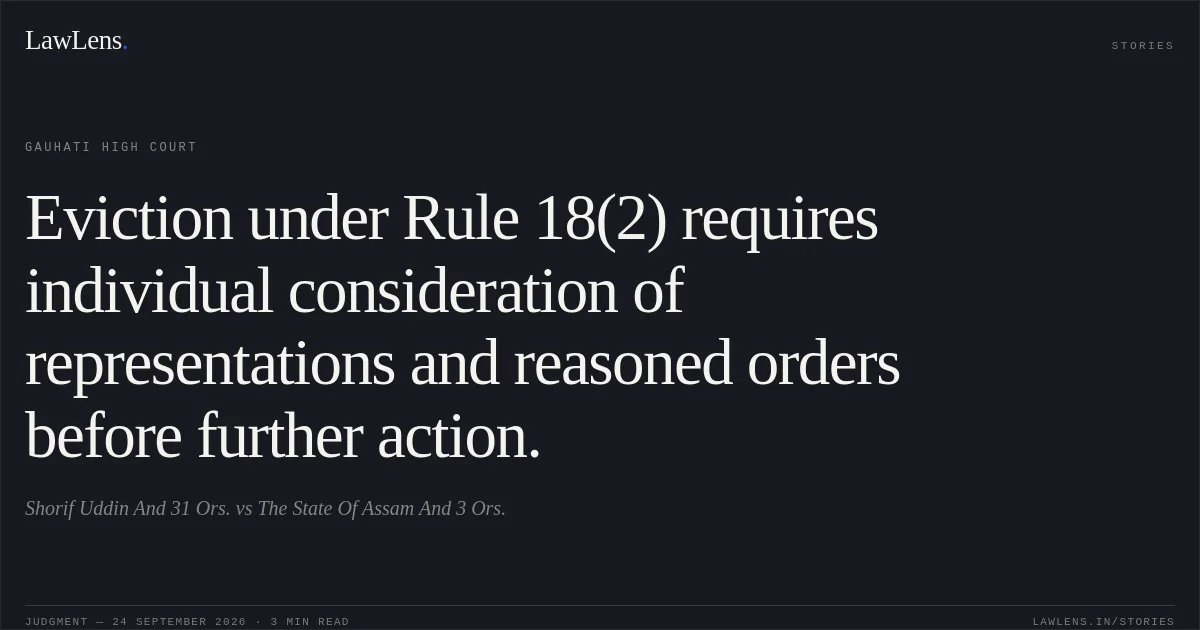
The Court directed the Circle Officer to consider and dispose of each petitioner’s representation individually by passing a reasoned and speaking order, and to communicate the order to the concerned petitioner.
Source reference: para. 16To facilitate this exercise, the petitioners were directed to submit, within seven days, a certified copy of the judgment, a copy of the writ petition with annexures, and copies of the representations allegedly already filed.
Source reference: para. 17Further eviction action could be taken only after determining each petitioner’s status in this manner and by following due procedure.
Source reference: para. 16No order as to costs was made.
Source reference: para. 18Original Court PDF
Shorif Uddin And 31 Ors.vsThe State Of Assam And 3 Ors.
Click to open original judgment
Original judgment, available to read, download and summarize on LawLens.in