Facts
The Petitioner, a Constable in the Railway Protection Force (“RPF”), sought an inter-zonal transfer on grounds including his daughter’s medical condition.
Source reference: paras. 4(v), 9–10, 11; pp. 4, 9–17After his transfer request was rejected, he allegedly consumed rat poison while on duty on 25 July 2020 and later sent an e-mail to the Director General threatening suicide and alleging that a Head Constable had demanded ₹1,50,000 for processing his transfer.
Source reference: paras. 4(v), 9–10, 11; pp. 4, 9–17He also visited the office of the Principal Chief Security Commissioner without prior permission and submitted a medical certificate which the Department subsequently treated as invalid.
Source reference: paras. 4(v), 9–10, 11; pp. 4, 9–17A departmental charge-sheet dated 24 October 2020 alleged violations of the RPF Rules, 1987 and the Railway Services (Conduct) Rules, 1966.
Source reference: paras. 4(v), 9–10, 11; pp. 4, 9–17The Enquiry Officer found all five charges proved.
Source reference: paras. 4(v), 9–10, 11; pp. 4, 9–17The Disciplinary Authority consequently imposed reduction to the lowest stage of Level-3, at ₹21,700, for five years with cumulative effect, under Rule 148.2(d) of the RPF Rules.
Source reference: paras. 4(v), 9–10, 11; pp. 4, 9–17The statutory appeal and revision were dismissed on 16 August 2021 and 27 December 2021 respectively.
Source reference: paras. 4(vi)–(vii), 11; pp. 4–5, 22The Petitioner challenged the charge-sheet, disciplinary order, appellate order and revisional order under Article 226 of the Constitution, alleging procedural irregularity, improper constitution of the enquiry, mala fides, victimisation for making a bribery complaint, and disproportionality of punishment.
Source reference: paras. 2–6; pp. 2–7Issues
1. Whether the departmental enquiry and the orders finding the Petitioner guilty of the charges were vitiated by procedural illegality, bias, mala fides, or absence of evidence.
Source reference: paras. 6, 12–13; pp. 6–7, 22–232. Whether the findings that the Petitioner’s conduct violated the RPF Rules, 1987 and the Railway Services (Conduct) Rules, 1966 were sustainable on the evidence and the applicable standard of proof.
Source reference: paras. 9–10, 12–13; pp. 9–17, 22–233. Whether reduction of the Petitioner to the lowest stage of Level-3 for five years with cumulative effect was disproportionate and warranted interference under Article 226.
Source reference: paras. 3, 8, 13–16; pp. 2, 8, 23–25Law Applied
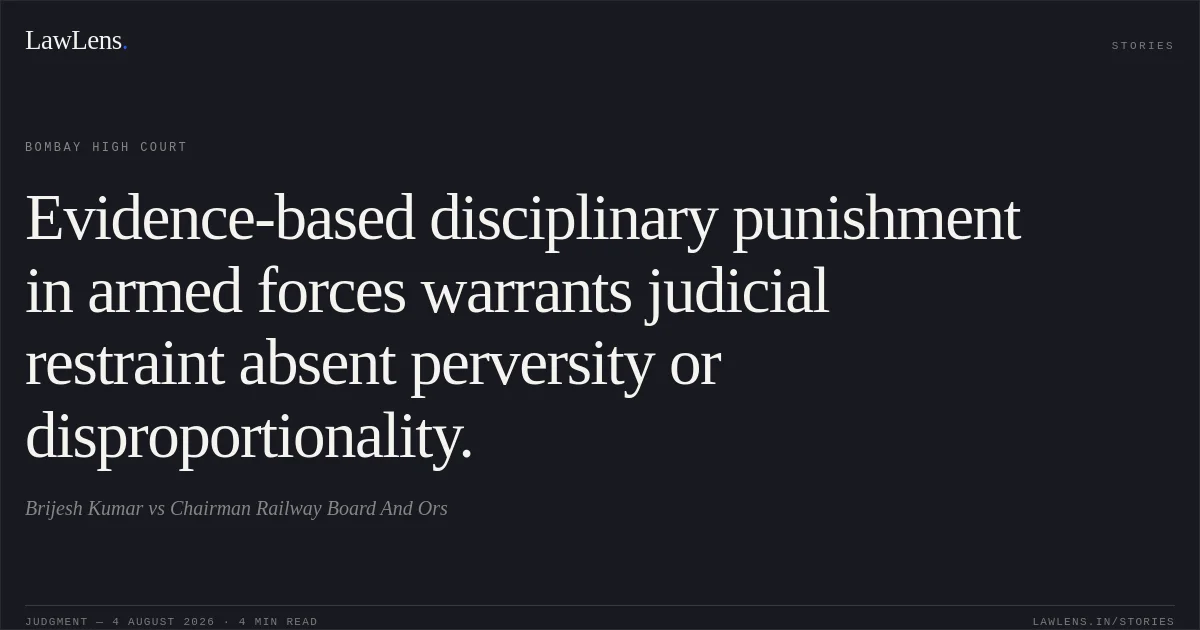
The Court applied Article 226 principles governing judicial review of disciplinary proceedings, under which the High Court does not re-appreciate evidence or substitute its own factual or disciplinary assessment where the findings are supported by evidence and represent a plausible view.
Source reference: paras. 12–13; pp. 22–23The Court relied on Rules 146 and 147 of the RPF Rules, 1987, which require members of the Force to maintain discipline, proper conduct, responsibility and the dignity of the Force, and on Rule 148.2(d), under which reduction to the lowest stage of the pay level may be imposed as a penalty.
Source reference: paras. 9, 11; pp. 9, 17–18It also referred to the appellate and revisional framework under Rules 212 and 219 of the RPF Rules.
Source reference: para. 11; pp. 18, 21–22The Court held that departmental findings are tested on the basis of preponderance of probabilities rather than proof beyond reasonable doubt.
Source reference: para. 13; p. 23Relying on Union of India v. Diler Singh, (2016) 13 SCC 71, and State of U.P. v. Ashok Kumar Singh, (1996) 1 SCC 302, the Court reiterated that members of disciplined and armed forces are held to a higher standard of discipline and that courts should exercise restraint in interfering with punishment where the misconduct and findings are established.
Source reference: paras. 14–15; pp. 23–25Reasoning
The Court found that the Enquiry Officer had examined eight prosecution witnesses, one defence witness and the relevant documents, and had recorded findings that all five charges were proved.
Source reference: para. 10; pp. 12–17The evidence was considered sufficient to establish that the Petitioner consumed poison while on duty, visited the superior office without permission, submitted an invalid medical certificate, used a suicide note as pressure against the administration, and made an unsubstantiated bribery complaint.
Source reference: paras. 8–9, 14–15; pp. 8–9, 23–25The Court treated this conduct as particularly serious because the Petitioner was a member of an armed and disciplined force, for whom discipline, mental fitness and conduct maintaining public confidence were considered essential.
Source reference: paras. 8–9, 14–15; pp. 8–9, 23–25It held that the Petitioner had not demonstrated that the findings were based on no evidence; rather, the disciplinary, appellate and revisional authorities had reached concurrent findings supported by material on record.
Source reference: paras. 11–13; pp. 17–23Since the authorities’ view was not impossible or perverse, the Court declined to re-weigh the evidence.
Source reference: paras. 11–13; pp. 17–23Applying the heightened disciplinary standard applicable to police and armed forces, it further held that the punishment was not shocking or disproportionate.
Source reference: paras. 8, 13–15; pp. 8, 23–25Holding
The Court answered the issues against the Petitioner.
It held that the departmental enquiry and the orders dated 30 April 2021, 16 August 2021 and 27 December 2021 were supported by evidence, were not shown to be procedurally illegal or mala fide, and disclosed no ground for interference under Article 226.
Source reference: paras. 12–13, 16; pp. 22–25The punishment of reduction to the lowest stage of Level-3 at ₹21,700 for five years with cumulative effect was upheld as neither arbitrary nor disproportionate.
Source reference: paras. 11, 13–16; pp. 17–18, 23–25The writ petition was dismissed, the Rule was discharged, and no order as to costs was made.
Source reference: para. 16; p. 25Original Court PDF
Brijesh KumarvsChairman Railway Board And Ors
Click to open original judgment
Original judgment, available to read, download and summarize on LawLens.in