Facts
The petitioners were arrested in connection with FIR No. 02/2020 for the murder of Mohammad Syed Abasi.
Source reference: p. 1-3The prosecution alleges that the petitioners, along with co-accused, conspired to kill the deceased by poisoning him with rodent killer mixed in tea, following a dispute regarding a love affair with the co-accused's sister.
Source reference: p. 4-5Investigations revealed a recorded phone conversation between the deceased and a witness (PW-20) shortly before his death, wherein the deceased named the petitioners as the persons who tricked and poisoned him.
Source reference: p. 5While female co-accused were granted bail in 2023, the petitioners’ previous bail applications were rejected by the trial court.
Source reference: p. 6The petitioners moved the High Court seeking bail on grounds of prolonged incarceration (over five years), lack of direct evidence, and discrepancies in forensic reports.
Source reference: p. 2Issues
1. Whether there are reasonable grounds to believe the petitioners are guilty of an offence punishable with death or life imprisonment to warrant the denial of bail.
Source reference: p. 8-92. Whether the petitioners’ right to a speedy trial under Article 21 has been violated due to their long pre-trial incarceration.
Source reference: p. 12-13Law Applied
The court primarily applied Section 302 (murder) and Section 120-B (criminal conspiracy) of the Indian Penal Code.
Source reference: p. 1The criteria for bail in heinous crimes established in Kalyan Chandra Sarkar v. Rajesh Ranjan alias Pappu Yadav (2004) mandates judicial discretion based on the nature of the accusation, severity of punishment, and the requirement of "reasonable grounds" under Section 437(1)(i) CrPC.
Source reference: p. 7-8Reliance on State of UP v. Amaramani Tripathi (2005), affirming that while a detailed examination of evidence is avoided at the bail stage, a brief examination to satisfy the existence of a prima facie case is necessary.
Source reference: p. 9-10Reasoning
The court found that a prima facie case exists against the petitioners based on the dying declaration recorded via telephone, which is admissible under law.
Source reference: p. 10-11The court held that minute details and contradictions in witness statements (PW-20 and PW-21) and the forensic report mismatch between Organo Phosphorus and Zinc Phosphide cannot be critically analyzed at the bail stage.
Source reference: p. 11The court noted that the first year of incarceration was impacted by the COVID-19 pandemic, which hampered proceedings; however, as the trial progressed at a reasonable pace post-pandemic and material witnesses were examined, there was no systemic delay violating Article 21.
Source reference: p. 12-13Holding
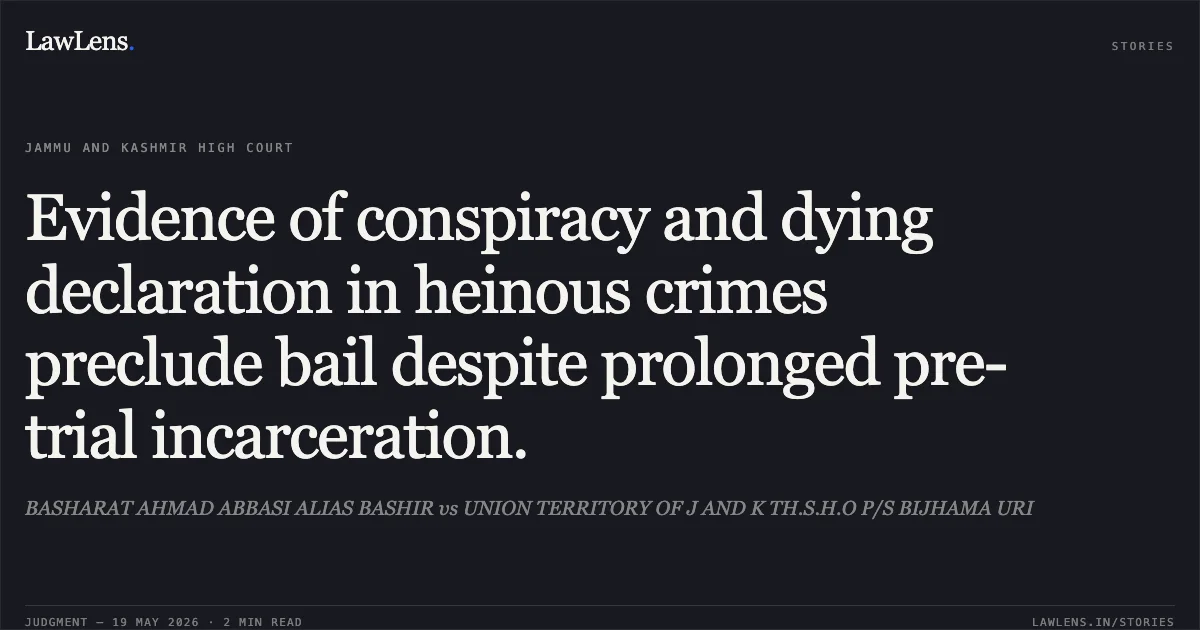
The court answered both issues in the negative and held that because the petitioners are charged with a heinous crime (murder) and there is sufficient prima facie evidence connecting them to the conspiracy, they do not deserve the concession of bail.
The court dismissed the bail application and directed the trial court to expedite the remaining proceedings to ensure the trial concludes at the earliest.
Source reference: p. 13Acts & Sections Cited
4 provisions across 2 statutes referred to in this judgment. Each provision opens on LawLens.
Indian Penal Code, 18601
Code of Criminal Procedure, 19733
Original Court PDF
BASHARAT AHMAD ABBASI ALIAS BASHIRvsUNION TERRITORY OF J AND K TH.S.H.O P/S BIJHAMA URI
Click to open original judgment
Original judgment, available to read, download and summarize on LawLens.in