Facts
On 20.07.2002, four members of a family (Rajesh, Madhu, Prabhanshu, and Vinita Shukla) were found murdered in their home in Satna
Source reference: para. 2The prosecution alleged that the appellant, Upendra Khare, along with co-accused Devendra Singh and others, entered the house, administered "Calmpose" (Diazepam) injections to the victims, and then killed them using sharp weapons and firearms
Source reference: paras. 3-4The investigation led to the recovery of empty phials of Calmpose, used syringes, a cotton rope, and blood-stained clothes at the instance of the appellant
Source reference: para. 4The Trial Court convicted the appellant under Section 302 read with Section 149 IPC, sentencing him to life imprisonment
Source reference: paras. 1, 7The High Court of Madhya Pradesh upheld the conviction
Source reference: para. 8The appellant challenged the judgment on the grounds of a broken chain of circumstantial evidence, hostile panch witnesses, and faulty investigation
Source reference: paras. 9.1-9.4Issues
1. Whether the conviction based on circumstantial evidence is sustainable despite panch witnesses to the recovery memos turning hostile
Source reference: paras. 11, 182. Whether the recovery of incriminating articles at the instance of the appellant constitutes sufficient legal evidence to link him to the commission of the murder
Source reference: paras. 15, 20Law Applied
The Court applied Section 302 (Punishment for murder) and Section 149 (Every member of unlawful assembly guilty of offence committed in prosecution of common object) of the IPC
Source reference: paras. 6-7It relied on the evidentiary principle under Section 27 of the Indian Evidence Act, 1872, regarding the discovery of facts based on information received from an accused in custody
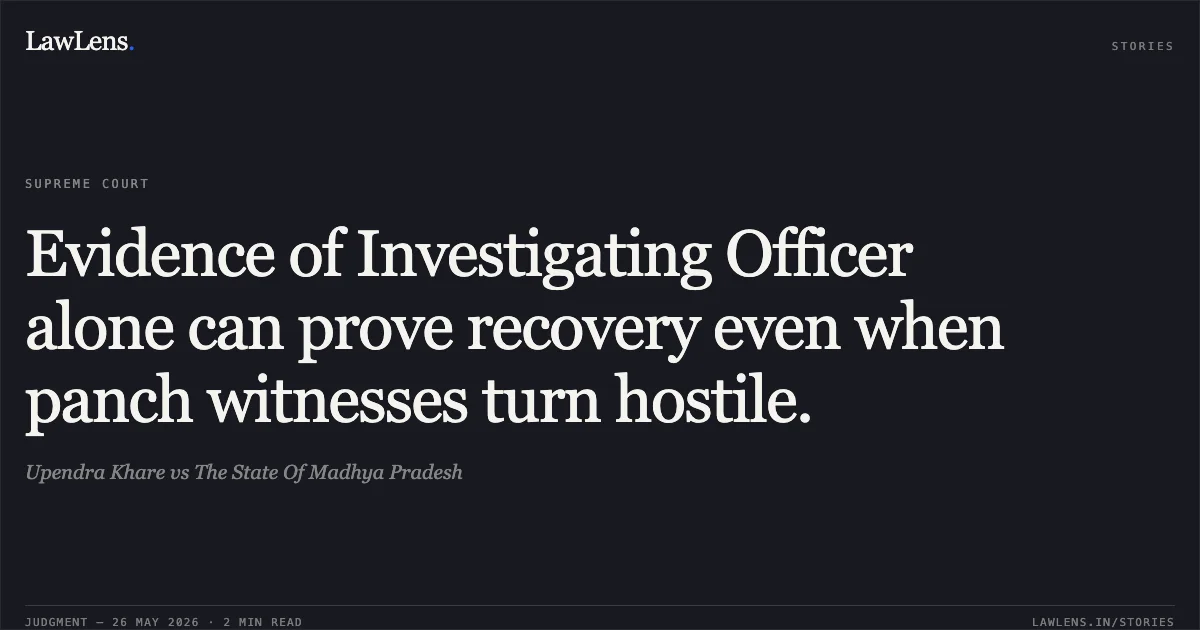
Source reference: para. 9.4Procedurally, it applied the established precedent from Modan Singh v. State of Rajasthan and Mallikarjun v. State of Karnataka, which holds that the testimony of an Investigating Officer (IO) is sufficient to prove recovery under Section 27 even if independent panch witnesses turn hostile
Source reference: paras. 18-19Reasoning
The Court noted that while the case rested on circumstantial evidence, the recovery of Calmpose phials and syringes at the appellant's instance was a "glaring circumstance"
Source reference: para. 15The Court rejected the appellant's contention that hostile panch witnesses vitiated the recovery, ruling that the Investigating Officer’s (PW24) testimony was convincing and sufficient to prove the seizure memos
Source reference: paras. 18, 20The Court linked these recoveries to the medical evidence provided by PW17 and the FSL report (Exh. P-52), which confirmed the presence of Diazepam in the victims' viscera
Source reference: paras. 16-17Although the Court acknowledged that the investigation was "not up to the mark," it held that the specific link between the sedative administered to the victims and the items recovered from the appellant provided a complete chain of evidence
Source reference: para. 20Holding
The Supreme Court answered the issues in the affirmative, holding that through the testimony of the IO and the corroborative medical reports, the prosecution successfully established the appellant's involvement in the crime.
The Court held that a faulty investigation or hostile witnesses do not mandate an acquittal if other material evidence is credible. The appeal was dismissed, and the judgments of the Trial Court and High Court convicting the appellant under Section 302 IPC were upheld.
Source reference: paras. 20, 21Acts & Sections Cited
9 provisions across 3 statutes referred to in this judgment. Each provision opens on LawLens.
Indian Penal Code, 18606
Code of Criminal Procedure, 19731
Arms Act, 19592
Original Court PDF
Upendra KharevsThe State Of Madhya Pradesh
Click to open original judgment
Original judgment, available to read, download and summarize on LawLens.in