Facts
The petitioner, Sarabjit Singh, sought regular bail under Section 483 of the Bharatiya Nagarik Suraksha Sanhita, 2023 (corresponding to Section 439 CrPC), in FIR No. 56 dated 15 May 2013, Police Station Banur, District Mohali, registered under Sections 379, 411, 468, 471, 473 and 120-B IPC, Sections 21, 22, 25, 25-A and 29 of the NDPS Act, and Sections 25/54/59 of the Arms Act.
Source reference: p.1, para.1The FIR arose from the alleged trafficking of methamphetamine, pseudoephedrine and other narcotic substances through an organised syndicate, together with the theft and forgery of luxury-vehicle documents and registration plates.
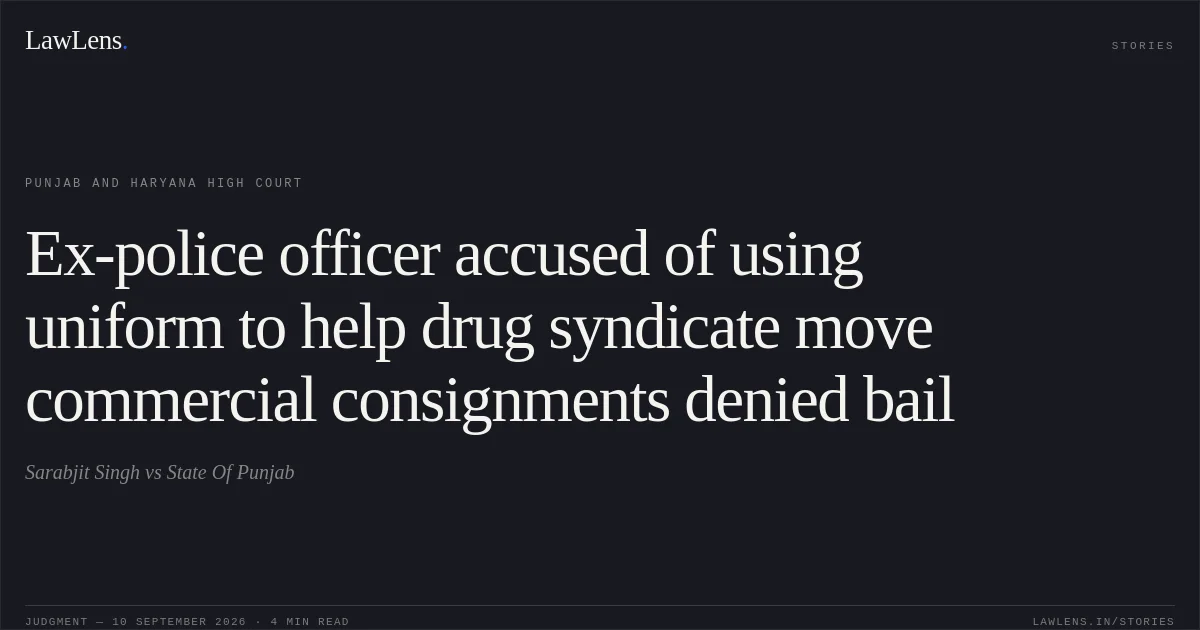
Source reference: p.2, para.5The petitioner, formerly a Sub-Inspector in the Punjab Police, was allegedly associated with the syndicate and misused his official position by wearing police uniform and facilitating the passage of vehicles carrying narcotic substances through police checkpoints.
Source reference: p.2, paras.6–8; p.8, paras.19–21He was nominated as an accused during investigation, absconded, was declared a proclaimed offender on 4 October 2013, and was formally arrested on 9 February 2022; a supplementary challan was subsequently filed against him.
Source reference: p.2, para.7; p.4, para.10As of 31 August 2026, he had undergone 4 years, 6 months and 13 days of custody in the present case.
Source reference: p.1, para.3He claimed bail primarily on the grounds of parity with co-accused Deep Singh, who had been acquitted, prolonged custody, and delay in trial.
Source reference: p.7, paras.17–20; p.9, para.24Issues
1. Whether the petitioner satisfied the twin conditions under Section 37(1)(b) of the NDPS Act for release on bail in a case involving commercial quantities of narcotic and psychotropic substances.
Source reference: p.6, paras.13–152. Whether the petitioner was entitled to bail on the ground of parity with co-accused Deep Singh, who had been acquitted in a separate trial.
Source reference: p.7, paras.17–213. Whether the petitioner’s prolonged pre-trial custody and alleged delay in conclusion of trial justified bail under Article 21 of the Constitution.
Source reference: p.9, paras.24–29Law Applied
Section 37(1)(b) of the NDPS Act imposes an additional restriction on bail in cases involving commercial quantities: the Public Prosecutor must have an opportunity to oppose bail, and the Court must be satisfied that there are reasonable grounds for believing that the accused is not guilty and is unlikely to commit an offence while on bail.
Source reference: p.6, para.14The expression “reasonable grounds” requires more than a prima facie view and mandates a meaningful assessment of the prosecution material.
Source reference: p.6, para.15The Court also applied the principle that parity is available only where the accused persons have substantially similar roles and evidence.
Source reference: p.7, paras.17–21Prolonged custody and trial delay are relevant considerations under Article 21, but they are not, by themselves, determinative and must be balanced against the gravity of the offence, the statutory sentence, the accused’s role and antecedents.
Source reference: p.9, paras.27–29The Court relied, inter alia, on Vaman Narain Ghiya v. State of Rajasthan, State of Kerala v. Raneef, Siddharam Satlingappa Mhetre v. State of Maharashtra, Babu Singh v. State of U.P., Sanjay Chandra v. CBI, Union of India (NCB) v. Khalil Uddin, Narayan Takri v. State of Odisha, and High Court Bar Association, Allahabad v. State of U.P.
Source reference: pp.9–11, fn.3–7 and paras.30–32Reasoning
The Court found that the alleged quantities of methamphetamine and pseudoephedrine were commercial quantities, thereby attracting the strict requirements of Section 37 of the NDPS Act.
Source reference: p.6, paras.11–15The prosecution material prima facie attributed a particularly serious role to the petitioner: unlike an ordinary participant, he was alleged to have used his position as a police officer and his official uniform to protect the syndicate and ensure that drug-laden vehicles crossed police nakas without interception.
Source reference: p.8, paras.19–21Consequently, the Court held that the petitioner had not shown reasonable grounds to believe that he was not guilty, nor had he satisfied the statutory requirement concerning likelihood of reoffending.
Source reference: p.8, para.23Parity with Deep Singh was rejected because Deep Singh’s role was materially different and did not involve misuse of police authority; his acquittal therefore did not automatically satisfy Section 37 in the petitioner’s case.
Source reference: p.8, paras.19–21Although the custody of more than four years and six months was acknowledged as substantial, the Court considered it against the alleged trafficking of massive quantities, the petitioner’s role, the maximum sentence of twenty years, and his status as a proclaimed offender.
Source reference: p.9, paras.24–26Article 21 concerns were addressed by directing the trial Court to expedite the proceedings, but the delay was not considered sufficient to overcome the statutory embargo under Section 37.
Source reference: p.10, paras.27–34Holding
The Court held that the petitioner failed to satisfy the twin conditions under Section 37(1)(b) of the NDPS Act and was not entitled to bail either on parity, prolonged custody, or trial delay.
The regular bail petition was accordingly dismissed.
Source reference: p.11, paras.34–35The trial Court was requested to take up and expedite the trial on a top-priority basis, with the clarification that the observations made in the bail order were tentative and would not prejudice the petitioner, the co-accused, or the trial proceedings.
Source reference: p.11, paras.34–35Acts & Sections Cited
20 provisions across 6 statutes referred to in this judgment. Each provision opens on LawLens.
Bharatiya Nyaya Sanhita, 20236
Narcotic Drugs and Psychotropic Substances Act, 19858
Arms Act, 19593
Bharatiya Nagarik Suraksha Sanhita, 20231
Code of Criminal Procedure, 19731
Prevention of Money-Laundering Act, 20021
Original Court PDF
Sarabjit SinghvsState Of Punjab
Click to open original judgment
Original judgment, available to read, download and summarize on LawLens.in