Facts
Hindustan Zinc Limited’s mining unit manufactured lead and zinc concentrate, much of which was captively consumed by the company’s smelting units.
Source reference: no citationBecause the assessable value depended on annual production costs and laboratory testing, the unit paid duty provisionally.
Source reference: no citationOn finalisation of the provisional assessment for financial year 2004–05, the Deputy Commissioner fixed total duty liability at Rs. 33,65,43,811, while the appellant had paid Rs. 34,19,68,596; nevertheless, the authority demanded Rs. 1,16,53,609 as short-paid duty for 1 April to 19 December 2004, while recognising excess payment for the remainder of the year.
Source reference: para. 2.1–2.2, 10The Commissioner (Appeals) and the CESTAT dismissed the appellant’s challenges, relying, among other things, on the passing-on of duty and the recipient units’ CENVAT credit.
Source reference: para. 2.3–2.4, 4–4.1The appellant sought adjustment of the excess payment against the demand, not a cash refund.
Source reference: para. 3.2, 15.1Issues
Whether, upon finalisation of provisional assessment based on annual costing, the financial year could be divided into periods of short-payment and excess payment without considering the overall duty position.
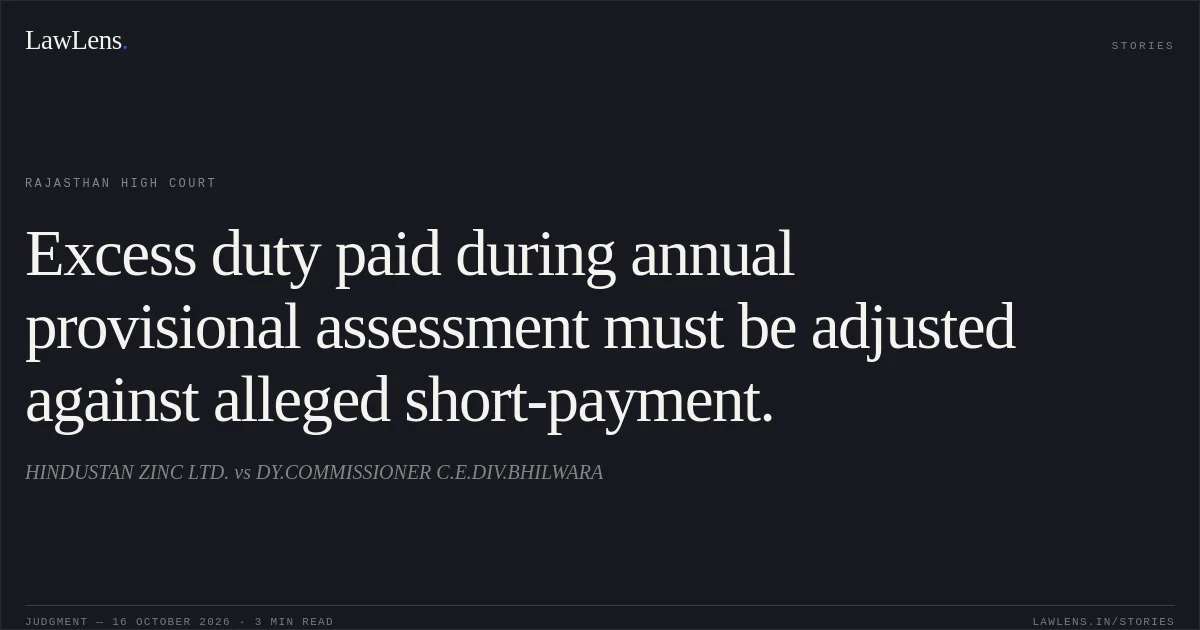
Source reference: para. 6(i), 7–12Whether excess duty paid during the relevant year could be adjusted against the alleged short-payment, notwithstanding the rules governing refunds and unjust enrichment.
Source reference: para. 6(ii), 13–16Whether the appellant was entitled to interest on the excess duty, and whether the Department could demand interest on the alleged short-payment before giving effect to the adjustment.
Source reference: para. 6(iii), 17–20Law Applied
Rule 7(3) of the Central Excise Rules, 2002 requires final assessment once the relevant information is available; Rules 7(4) and 7(5) address interest on amounts payable and refunds, while Rule 7(6) governs the treatment of refunds and the unjust-enrichment exceptions.
Source reference: para. 8Where provisional assessment is finalised using annual cost of production, the corresponding duty liability must be determined consistently by accounting for duty already paid during the relevant assessment period; a refund restriction does not require the Department to disregard payments when calculating net liability.
Source reference: para. 9–9.3, 14–15The Court relied on Toyota Kirloskar Auto Parts Pvt. Ltd. v. C.C.E., LTU, Bangalore and Godrej Consumer Products Ltd., which support considering the overall duty position where annual costing is used.
Source reference: para. 9.1–9.3, 14.2–14.3It also applied the principle in Associated Cement Co. Ltd. v. Commercial Tax Officer, Kota that machinery provisions of a taxing statute should be interpreted to give effect to the statutory scheme and its purpose.
Source reference: para. 14.1No interest is payable to the appellant where no refund is ordered; conversely, interest on an alleged short-payment cannot be demanded without first determining whether any net amount remains payable after adjustment.
Source reference: para. 18–20Reasoning
The final assessable value was determined through annual costing, and the final assessment recorded that the appellant’s payments for the year exceeded its total annual duty liability.
Source reference: para. 7, 10The Department could not rely on that annual costing to determine value while isolating an earlier period’s alleged shortfall and ignoring excess duty paid later in the same year; no statutory provision authorising that approach was identified.
Source reference: para. 10.1–11The appellant sought only an accounting adjustment, not a cash refund, so the refund restrictions and the recipient units’ CENVAT credit did not justify excluding the excess payment when calculating net duty liability.
Source reference: para. 14–15.3Since no refund was being ordered, the appellant was not entitled to interest on the excess; any departmental interest on short-payment depended on the outcome of the adjustment.
Source reference: para. 18–20Holding
The Court answered the first two issues in the appellant’s favour: the short- and excess-payment amounts could not be treated independently, and the excess duty paid during 2004–05 had to be taken into account in determining net liability.
It held that the appellant was not entitled to interest on the excess duty, but the Department could not demand interest on an alleged short-payment without first giving effect to the adjustment.
Source reference: para. 20The appeal was allowed; the CESTAT order and the demand of Rs. 1,16,53,609, together with consequential interest, were set aside to the extent they denied the adjustment.
Source reference: para. 21–25No cash refund or interest on the excess duty was ordered, and the Department was directed to carry out the consequential exercise in accordance with the recorded annual liability and payments.
Source reference: para. 21–25Acts & Sections Cited
1 provisions across 1 statute referred to in this judgment. Each provision opens on LawLens.
Central Excise Act, 19441
Original Court PDF
HINDUSTAN ZINC LTD.vsDY.COMMISSIONER C.E.DIV.BHILWARA
Click to open original judgment
Original judgment, available to read, download and summarize on LawLens.in