Facts
The petitioner filed its return for Assessment Year 2014–15 declaring income of ₹22,84,090.
Source reference: paras. 2–2.3During scrutiny, the Assessing Officer issued a notice under Section 142(1) seeking details of an immovable property sold during the relevant financial year.
Source reference: paras. 2–2.3The petitioner disclosed the sale consideration as ₹24,50,000 and explained that the additional amount of ₹23,57,605 reflected in the stamp-duty/DLC valuation arose from the change in the company’s name and was not consideration received on sale.
Source reference: paras. 2–2.3, 6–7Supporting material, including the Sub-Registrar’s communication, was furnished.
Source reference: paras. 2–2.3, 6–7The assessment was completed under Section 143(3) at the returned income on 30.12.2016.
Source reference: para. 2.4On 26.03.2021, beyond four years from the end of the relevant assessment year, the Assessing Officer issued a notice under Section 148, alleging that the DLC value of ₹48,65,652 ought to have been treated as sale consideration under Section 50C, resulting in escapement of income of ₹24,15,652.
Source reference: paras. 2.5–2.6, 8The petitioner’s objections were rejected on 01.09.2021, leading to the writ petition.
Source reference: paras. 2.7–2.8Issues
1. Whether the reassessment notice issued under Section 148 beyond four years from the end of Assessment Year 2014–15 was barred by the first proviso to Section 147 in the absence of any failure by the petitioner to disclose fully and truly all material facts necessary for assessment.
Source reference: paras. 3.1–3.2, 6, 10–112. Whether the reassessment proceedings constituted an impermissible change of opinion based on the same transaction and material examined during the original scrutiny assessment.
Source reference: paras. 3.5, 9, 12–133. Whether the Assessing Officer’s invocation of Section 50C, based on the difference between the declared sale consideration and the DLC value, could sustain the reopening of the completed assessment.
Source reference: paras. 2.6, 4.2, 8–10Law Applied
The Court applied Sections 147 and 148 of the Income-tax Act, 1961, particularly the first proviso to Section 147, under which an assessment completed under Section 143(3) cannot be reopened after four years from the end of the relevant assessment year unless the escapement of income resulted from the assessee’s failure to disclose fully and truly all material facts necessary for assessment.
Source reference: paras. 3.1–3.2, 10Section 50C permits substitution of the stamp-duty valuation for the declared sale consideration in computing capital gains, but its applicability does not dispense with the limitation and jurisdictional requirements under Section 147.
Source reference: paras. 2.6, 8–10The Court relied on the principle that reassessment cannot be initiated merely on a change of opinion or by reappraising material already available during the original assessment, as reiterated in Assistant Commissioner of Income Tax v. CEAT Ltd., CEAT Ltd. v. Assistant Commissioner of Income Tax, Saroj Chhabra v. Principal Commissioner of Income Tax, Rajasthan Marudhara Gramin Bank v. Union of India, and Shiv Lal Soni v. Union of India.
Source reference: paras. 3.7–3.11, 13Reasoning
The Court found that the reassessment was initiated beyond four years from the end of Assessment Year 2014–15.
Source reference: para. 11The property transaction, declared consideration, computation of capital gains, and explanation regarding the additional stamp-duty component had been specifically sought during the original scrutiny and fully disclosed by the petitioner along with supporting documents.
Source reference: paras. 6–7, 9Therefore, the foundational facts were already before the Assessing Officer.
Source reference: paras. 6–7, 9The reasons recorded merely asserted, without identifying any particular withheld fact, that the petitioner had failed to make full and true disclosure.
Source reference: para. 11Whether the petitioner’s explanation was legally acceptable, or whether Section 50C applied, concerned the merits of the original assessment and could not retrospectively satisfy the mandatory jurisdictional condition for reopening after four years.
Source reference: para. 10Since the proposed reassessment was based on reconsideration of the same transaction and material, it amounted to a change of opinion and was not legally sustainable.
Source reference: paras. 12–14Holding
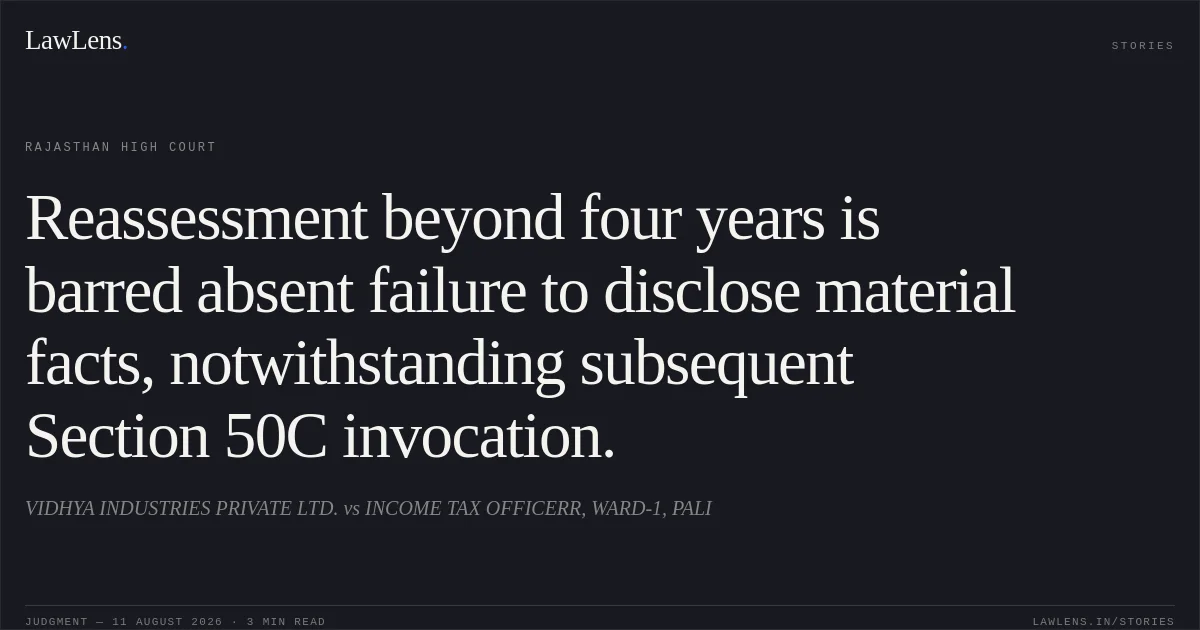
The Court held that the first proviso to Section 147 was not satisfied because the petitioner had disclosed all primary and material facts during the original scrutiny assessment and the reasons for reopening identified no specific failure of disclosure.
The reassessment proceedings were consequently held to be barred by limitation and founded on an impermissible change of opinion.
Source reference: paras. 11, 14The writ petition was allowed, and the notice dated 26.03.2021 under Section 148 and the consequential order dated 01.09.2021 rejecting the petitioner’s objections were quashed and set aside.
Source reference: paras. 15–17Acts & Sections Cited
10 provisions across 2 statutes referred to in this judgment. Linked provisions open on LawLens.
Income Tax Act, 1961
Indian Income Tax Act, 19221
Original Court PDF
VIDHYA INDUSTRIES PRIVATE LTD.vsINCOME TAX OFFICERR, WARD-1, PALI
Click to open original judgment
Original judgment, available to read, download and summarize on LawLens.in