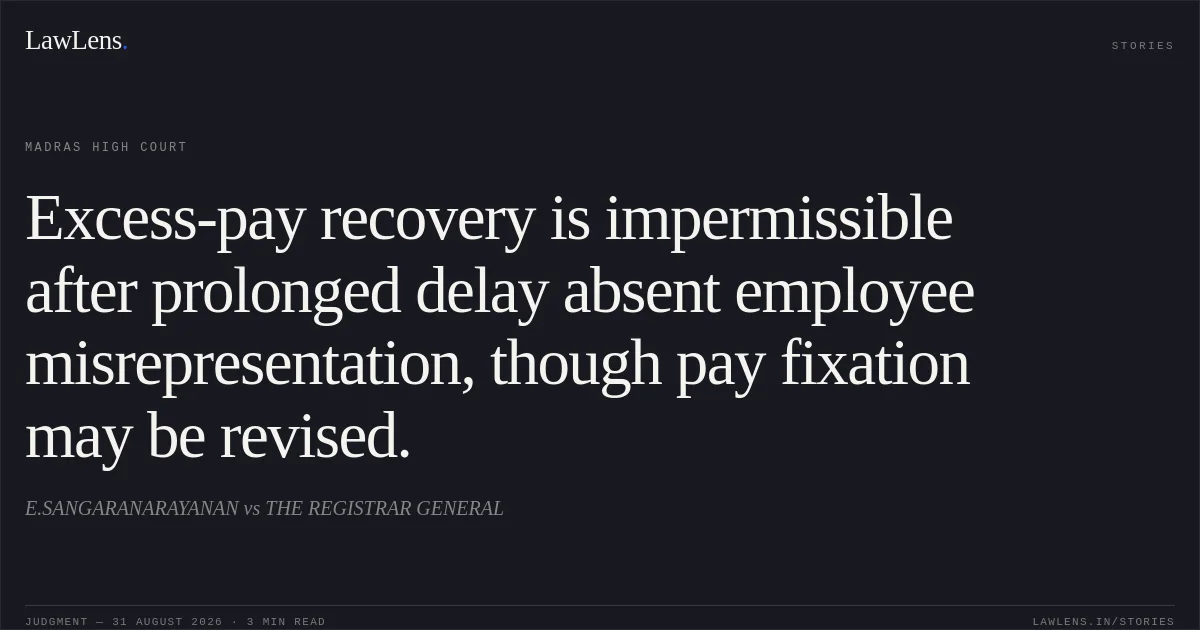
Facts
The petitioner, a person with 70% disability, was appointed as an Office Assistant on compassionate grounds and thereafter served in various posts in the judicial department.
Source reference: p.2, para.2An increment was sanctioned with effect from 9 December 2010 under the applicable Government Orders, and his pay was fixed accordingly.
Source reference: p.2, para.2During an internal audit in November 2021, the authorities found that the increment had allegedly been sanctioned erroneously, resulting in excess payment of salary.
Source reference: p.2, para.2The petitioner submitted representations seeking waiver of recovery, citing financial hardship and family circumstances, but recovery proceedings were initiated while those representations remained pending.
Source reference: p.2, para.2By order dated 26 November 2025, the third respondent revised the petitioner’s pay to Rs.29,500/- with effect from 1 January 2026 and directed recovery of the alleged excess payment—recorded in the body of the judgment as Rs.28,035/-—for the period from 9 December 2010 to 30 November 2025 in 101 monthly instalments.
Source reference: p.2, para.2The writ petition challenged the recovery and sought continuation of the petitioner’s unrevised salary.
Source reference: p.1; p.2, para.1Issues
1. Whether the respondents were legally entitled to revise the petitioner’s pay upon finding an erroneous increment sanctioned by the Establishment?
Source reference: p.3, para.3; p.6, para.62. Whether recovery of the alleged excess salary paid over a period exceeding five years, in the absence of any misrepresentation by the petitioner, was permissible in law?
Source reference: p.3, para.4; p.4, para.53. Whether the recovery would be inequitable, harsh or arbitrary in the circumstances of the petitioner’s case?
Source reference: p.4, para.5Law Applied
The Court applied the principle that public money paid in excess of an employee’s lawful entitlement cannot ordinarily be retained, and that competent authorities may correct erroneous pay fixation in accordance with the applicable Pay Rules and Government Orders.
Source reference: p.3, para.3However, it relied on State of Punjab v. Rafiq Masih (Whitewasher), (2015) 4 SCC 334, which identifies circumstances in which recovery of excess payment is impermissible, including recovery from employees in Class III/Class IV or Group C/Group D service, recovery from retired or imminently retiring employees, recovery of payments made for a period exceeding five years before the recovery order, and recovery which is otherwise inequitable, harsh or arbitrary.
Source reference: pp.3–4, paras.4–5The governing distinction was therefore between correction of an erroneous pay fixation, which is permissible, and recovery of past excess payments where the employee was not responsible for the error and recovery would cause undue hardship.
Source reference: pp.3–4, paras.3–5Reasoning
The Court held that the respondents had established an error in the petitioner’s pay fixation and were consequently competent to revise his pay in accordance with the applicable rules and Government Orders.
Source reference: p.3, para.3The revised pay fixation was therefore not interfered with.
Source reference: p.6, para.6However, the error was attributable to the Establishment, and the respondents were unable to show that the petitioner had made any misrepresentation during the fixation of his pay.
Source reference: p.3, para.4The alleged excess payments had continued for nearly fifteen years, substantially exceeding the five-year period identified in Rafiq Masih, and recovery at that stage would cause extreme hardship to the petitioner, particularly in light of his disability and stated financial circumstances.
Source reference: pp.2–3, paras.2, 4Applying the principles governing impermissible recovery, the Court balanced the respondents’ right to correct the pay against the inequity of recovering long-standing payments made due to administrative error.
Source reference: pp.3–4, paras.3–5Holding
The writ petition was partly allowed.
The Court confirmed the revision of the petitioner’s pay pursuant to the audit objection but set aside the recovery of the alleged excess salary.
Source reference: p.6, para.6Any amount already recovered pursuant to the impugned order was directed to be repaid to the petitioner within twelve weeks from the date of receipt of a copy of the judgment.
Source reference: p.6, para.6The impugned order was set aside only to the extent that it directed recovery; there was no order as to costs, and the connected miscellaneous petition was closed.
Source reference: p.6, para.7Original Court PDF
E.SANGARANARAYANANvsTHE REGISTRAR GENERAL
Click to open original judgment
Original judgment, available to read, download and summarize on LawLens.in

![Disciplinary proceedings must be stayed and a bias objection against the Inquiry Officer decided first.. Mahesh Kumar vs Delhi Jal Board, Govt. Of Nctd. CAT - ['Delhi']. LawLens](/stories/thumbnails/disciplinary-proceedings-must-be-stayed-and-a-bias-objection-against-the-inquiry-officer-d-dc61ff989b874f3bbeb00a6e2a7f219e.webp)