Facts
The petitioners were employees of the Police Transport Workshop-cum-Training School, Avadi, who had retired from service.
Source reference: paras. 4–5They had been granted 5% personal pay under G.O.Ms.No.664, Finance (Pay and Cell) Department, dated 24 August 1992, and the benefit was paid to them until retirement.
Source reference: paras. 4–5The respondents subsequently took the view that the petitioners’ pay scale—particularly the scale of Rs.555–990—was not one of the pay scales expressly specified in the Government Order and that the personal pay had therefore been wrongly granted.
Source reference: paras. 8–10, 16After retirement, the respondents ordered recovery of the alleged excess payment from the petitioners’ Death-cum-Retirement Gratuity (DCRG); in the case of S. Ravikumar, the amount sought to be recovered was Rs.1,35,782.
Source reference: para. 5The petitioners challenged the respective recovery orders and sought refund of the amounts deducted from their DCRG, relying principally on the absence of any misrepresentation on their part and the Supreme Court’s decision in State of Punjab v. Rafiq Masih.
Source reference: paras. 6–7Issues
1. Whether employees drawing the pay scale of Rs.555–990 were entitled to 5% personal pay under G.O.Ms.No.664 dated 24 August 1992, even though that precise scale was not expressly mentioned in the Government Order?
Source reference: paras. 8–10, 13–162. Whether the respondents could recover the personal pay already paid to the petitioners from their DCRG after retirement, in the absence of fraud or misrepresentation by the petitioners?
Source reference: paras. 5–7, 17–19Law Applied
The Court applied G.O.Ms.No.664, Finance (Pay and Cell) Department, dated 24 August 1992, governing the grant of 5% personal pay.
Source reference: paras. 4, 13Relying on the Division Bench decision in V. Rathinagiri v. State of Tamil Nadu, W.P.Nos.20156 and 13143 of 2000, dated 10 March 2006, the Court held that the benefit could extend to pay scales higher or lower than, and revised scales falling between, the scales specified in the Government Order.
Source reference: para. 13The Court followed that view in preference to the contrary approach in Y. Immanuel v. Government of Tamil Nadu, W.P.No.6754 of 2015, dated 7 March 2017, noting that subsequent coordinate Benches and another Division Bench had followed Rathinagiri.
Source reference: paras. 14–15On recovery, the Court applied the principle in State of Punjab v. Rafiq Masih, (2015) 4 SCC 334, that recovery of excess payments is impermissible in specified equitable circumstances, particularly where the employee was not responsible for the erroneous payment; this principle was stated to have been reiterated in High Court of Punjab and Haryana v. Jagdev Singh, (2016) 14 SCC 267, and Union of India v. N.M. Raut, 2024 SCC OnLine SC 3873.
Source reference: para. 19Reasoning
The Court held that the petitioners’ pay scale of Rs.555–990 fell between the scales referred to in G.O.Ms.No.664 and was therefore eligible for the 5% personal-pay benefit under the interpretation adopted in Rathinagiri and followed by later Benches.
Source reference: paras. 13–16Consequently, the premise that the personal pay was unauthorised was unsustainable.
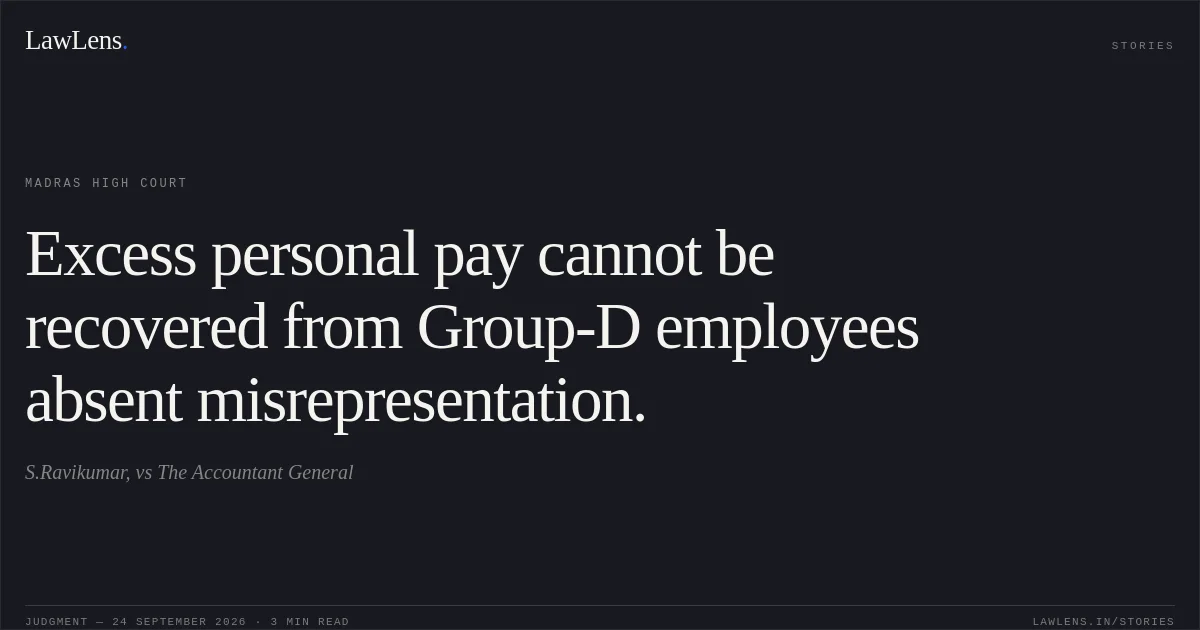
Source reference: para. 17Independently, the Court found that the petitioners, being Group-D employees, had not made any misrepresentation or played any role in securing the benefit; it was granted and continued by the respondents themselves over several years.
Source reference: paras. 6, 18–19Applying the equitable bar against recovery of excess payments in such circumstances, especially recovery from retirement benefits after retirement, the Court concluded that the deductions from DCRG could not be sustained.
Source reference: para. 19Holding
The writ petitions were allowed and the impugned recovery proceedings were quashed.
The respondents were directed to refund the amounts deducted from the petitioners’ DCRG within four weeks from receipt of the order.
Source reference: para. 20If the refund was not made within that period, the respondents were directed to pay interest at 8% per annum on the deducted amounts until actual payment.
Source reference: para. 21No order was made as to costs, and the connected miscellaneous petitions were closed.
Source reference: para. 21Original Court PDF
S.Ravikumar,vsThe Accountant General
Click to open original judgment
Original judgment, available to read, download and summarize on LawLens.in