Facts
The appellant is a construction contractor that imports pre-coated Aluminium Composite Panels (ACPs) from foreign manufacturers in standard sizes.
Source reference: p. 2-3To install these on building facades, the appellant cuts the panels into specific rectangular or square sizes and performs "routing/grooving" (making grooves on the back) to allow them to be affixed to frames using clamps and sealants.
Source reference: p. 3From April 2002, the appellant stopped paying excise duty, believing this process did not amount to "manufacture."
Source reference: p. 4The Revenue issued a Show Cause Notice in 2004, demanding duty; the Commissioner (Appeals) upheld the demand.
Source reference: p. 4The CESTAT reversed this, holding that the Revenue failed to prove marketability and that no new product emerged.
Source reference: p. 5The Revenue appealed to the High Court of Karnataka under Section 35G, which restored the demand.
Source reference: p. 7Issues
1. Whether the High Court had the jurisdiction under Section 35G of the Central Excise Act, 1944, to decide the issue of excisability.
Source reference: p. 10 / para 172. Whether the process of cutting and grooving/routing ACPs as per desired measurements amounts to "manufacture" under Section 2(f) of the Act.
Source reference: p. 10 / para 17Law Applied
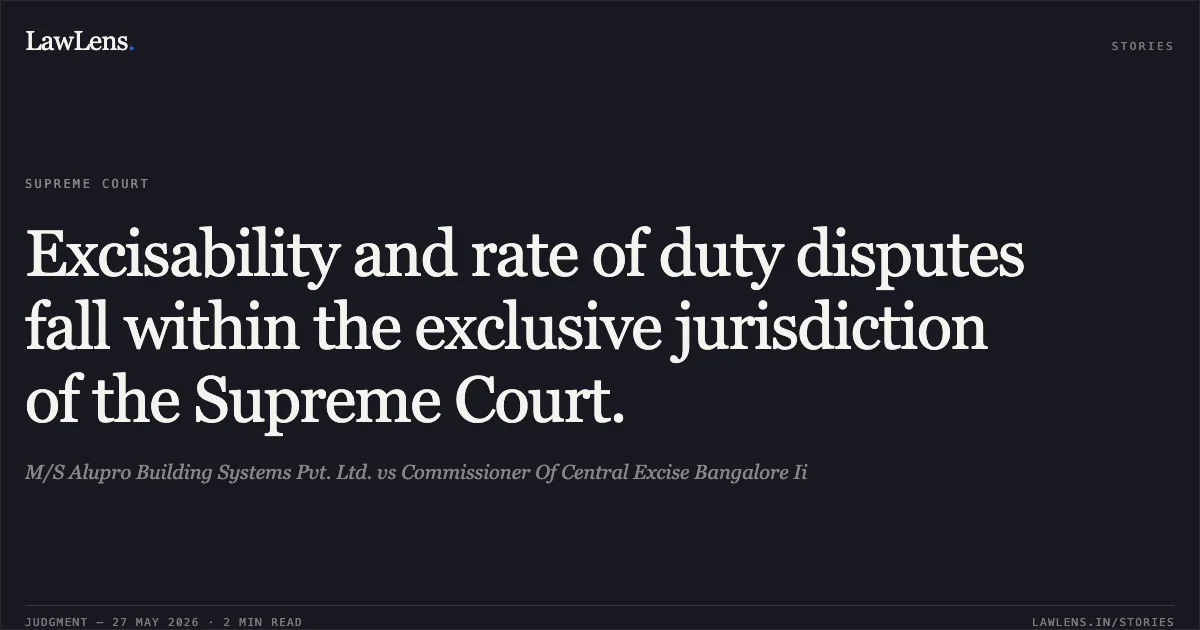
Orders relating to the "rate of duty" or "value of goods for purposes of assessment" fall under the exclusive appellate jurisdiction of the Supreme Court, not the High Court under Section 35G and 35L of the Central Excise Act, 1944.
Source reference: p. 10Section 35L(2) (inserted in 2014) clarifies that "rate of duty" includes the determination of "taxability or excisability".
Source reference: p. 11, 25The two-fold test for manufacture (Transformation Test and Marketability Test) as established in Union of India v. J.G. Glass Industries Ltd. and Servo-Med Industries (P) Ltd. v. CCE.
Source reference: p. 35-37Mere change in a substance is not manufacture as established in Union of India v. Delhi Cloth & General Mills Co. Ltd.
Source reference: p. 37Reasoning
The Court reasoned that "excisability" is a precursor to assessment and thus intrinsically linked to the "rate of duty"; therefore, the Revenue should have appealed the CESTAT order directly to the Supreme Court under Section 35L.
Source reference: p. 13-14, 23The Court held that the 2014 amendment to Section 35L (sub-section 2) was clarificatory and retrospective because it merely made explicit what was already implicit in the statutory scheme.
Source reference: p. 26, 33The Court found that cutting and grooving ACPs does not constitute "manufacture" as the ACPs retained their essential character and properties and the process merely adapted their dimensions for installation.
Source reference: p. 38-39Following CCE v. S.R. Tissues (P) Ltd. and Aman Marble Industries (P) Ltd. v. CCE, the Court noted that cutting to size or shape for convenience/use does not create a new commercial product.
Source reference: p. 40-42The Court reiterated that the burden of proving a product is "commercially known" for sale lies strictly with the Revenue, which failed to discharge it here.
Source reference: p. 54, 58, 61Holding
The Court answered the first issue in the negative, holding the High Court lacked jurisdiction as the matter related to excisability.
The Court held that the process of cutting and grooving does not amount to "manufacture".
Source reference: para 98The Court allowed the appeal, set aside the High Court's judgment, and restored the CESTAT's order in favor of the appellant.
Source reference: p. 63Acts & Sections Cited
7 provisions across 3 statutes referred to in this judgment. Each provision opens on LawLens.
Central Excise Act, 19444
Customs Act,19621
Customs Tariff Act, 19752
Original Court PDF
M/S Alupro Building Systems Pvt. Ltd.vsCommissioner Of Central Excise Bangalore Ii
Click to open original judgment
Original judgment, available to read, download and summarize on LawLens.in