Facts
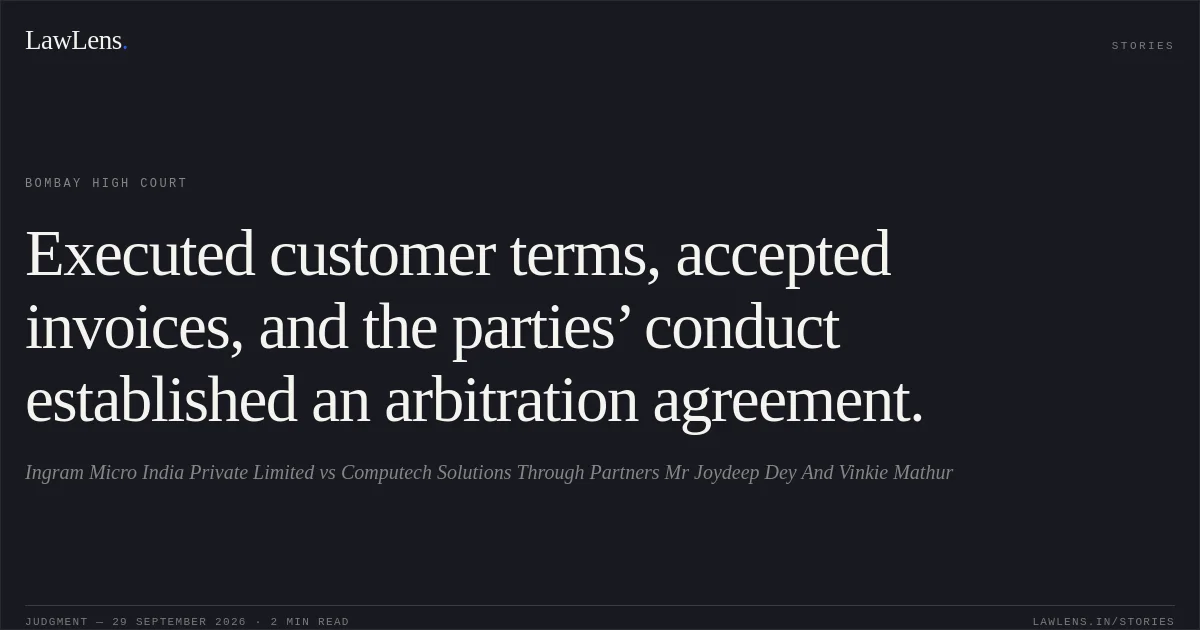
The Applicant claimed that the Respondent’s unpaid dues arose from product-supply transactions under invoices containing arbitration clauses.
Source reference: paras. 2–3, 8–10, 16–21; pp. 1–6, 8–12The Applicant relied on a KYC Form and Sales Terms and Conditions executed by the Respondent on 6 July 2016, the invoice terms, a cheque for ₹4,05,68,061 that was dishonoured, and a subsequent part-payment of ₹10,00,000.
Source reference: paras. 2–3, 8–10, 16–21; pp. 1–6, 8–12After the Respondent did not agree to an arbitrator proposed in the Applicant’s notice invoking arbitration, the Applicant applied under Section 11 of the Arbitration and Conciliation Act, 1996.
Source reference: paras. 2–3, 8–10, 16–21; pp. 1–6, 8–12The Respondent filed no reply to the notice or the application.
Source reference: paras. 2–3, 8–10, 16–21; pp. 1–6, 8–12Issues
1. Whether the material on record sufficiently established an arbitration agreement between the parties covering the disputes arising from the transactions.
Source reference: paras. 10–15, 19–24; pp. 6–8, 9–132. Whether, following the Respondent’s failure to agree to an arbitrator, the Court should appoint a sole arbitrator under Section 11.
Source reference: paras. 24–26; pp. 13–16Law Applied
The Court applied Section 11 of the Arbitration and Conciliation Act, 1996, to consider whether an arbitration agreement and disputes requiring reference were established and whether court intervention for appointment was warranted.
Source reference: para. 26(c); p. 16It also referred to Section 11(8) read with Section 12(1) in directing the appointed arbitrator to provide the statutory disclosure.
Source reference: para. 26(c); p. 16The Court stated that a contractual provision allowing one party to appoint the sole arbitrator cannot simply be given effect if it conflicts with the Act or the law laid down by the Supreme Court; no specific precedent was identified in the judgment.
Source reference: para. 24; p. 13Reasoning
The Court found that the invoice clauses expressly referred disputes arising out of or pertaining to the transactions to arbitration, while the executed KYC Form and Sales Terms and Conditions, the parties’ course of dealing, the dishonoured cheque and the part-payment supported the existence of their contractual relationship and the Respondent’s acceptance of the transactions.
Source reference: paras. 12–17, 20–23; pp. 7–8, 10–13Although the Respondent’s silence did not itself prove every assertion, it left the Applicant’s documentary material undisputed; the Court considered that material sufficient to establish an arbitration agreement and disputes within its scope.
Source reference: paras. 10, 20–24; pp. 6, 10–13As the Respondent neither concurred in the proposed appointment nor appointed an arbitrator, the agreed appointment process had not resulted in constitution of the tribunal, warranting court intervention under the Act.
Source reference: paras. 24–25; pp. 13–14Holding
The Court held that an arbitration agreement existed and covered the disputes arising from the transactions.
It appointed Mr. Tushad Kakalia as sole arbitrator and issued directions concerning communication of the order, statutory disclosure, appearances, service and arbitral costs.
Source reference: paras. 26–29; pp. 15–17The application was disposed of, with all questions on the merits left open to the arbitrator.
Source reference: paras. 26–29; pp. 15–17Acts & Sections Cited
3 provisions across 2 statutes referred to in this judgment. Each provision opens on LawLens.
Arbitration and Conciliation Act, 19962
Negotiable Instruments Act, 18811
Original Court PDF
Ingram Micro India Private LimitedvsComputech Solutions Through Partners Mr Joydeep Dey And Vinkie Mathur
Click to open original judgment
Original judgment, available to read, download and summarize on LawLens.in