Facts
The complainant alleged that land comprising Khesra No. 23, Khata No. 218, measuring 41 decimals in village Mahuyariya, was initially recorded incorrectly in the name of Thakur Rambahadur Singh, but was subsequently corrected in the names of the complainant, Kritnarayan Singh—father of the petitioner—and Ramashish Singh
Source reference: pp. 2–3After the deaths of Kritnarayan Singh and Ramashish Singh, the petitioner allegedly, in conspiracy and collusion with revenue officials, caused the land to be mutated in the names of his father and uncle and thereafter sold portions of it through four sale deeds dated 9 February 2011
Source reference: pp. 2–3The Chief Judicial Magistrate, Sheohar, took cognizance against the petitioner for offences under Sections 468, 471, 420 and 120-B of the Indian Penal Code by order dated 5 May 2016 in Complaint Case No. C-1/52 of 2016
Source reference: p. 2The petitioner sought quashing of the cognizance order, contending that the dispute was civil in nature and that the complainant had already pursued civil and revenue remedies
Source reference: p. 3Issues
Whether the allegations concerning mutation of the disputed land and execution of sale deeds disclosed the ingredients of offences under Sections 468, 471, 420 and 120-B of the IPC, or were essentially civil in nature?
Source reference: pp. 2–6Whether continuation of the criminal proceedings and the cognizance order dated 5 May 2016 amounted to an abuse of the process of the Court warranting exercise of the High Court’s quashing jurisdiction?
Source reference: p. 6Law Applied
The Court applied the principle that criminal proceedings should not be permitted to continue where the dispute is predominantly civil and the allegations, even if accepted at face value, do not disclose the essential ingredients of the alleged offences.
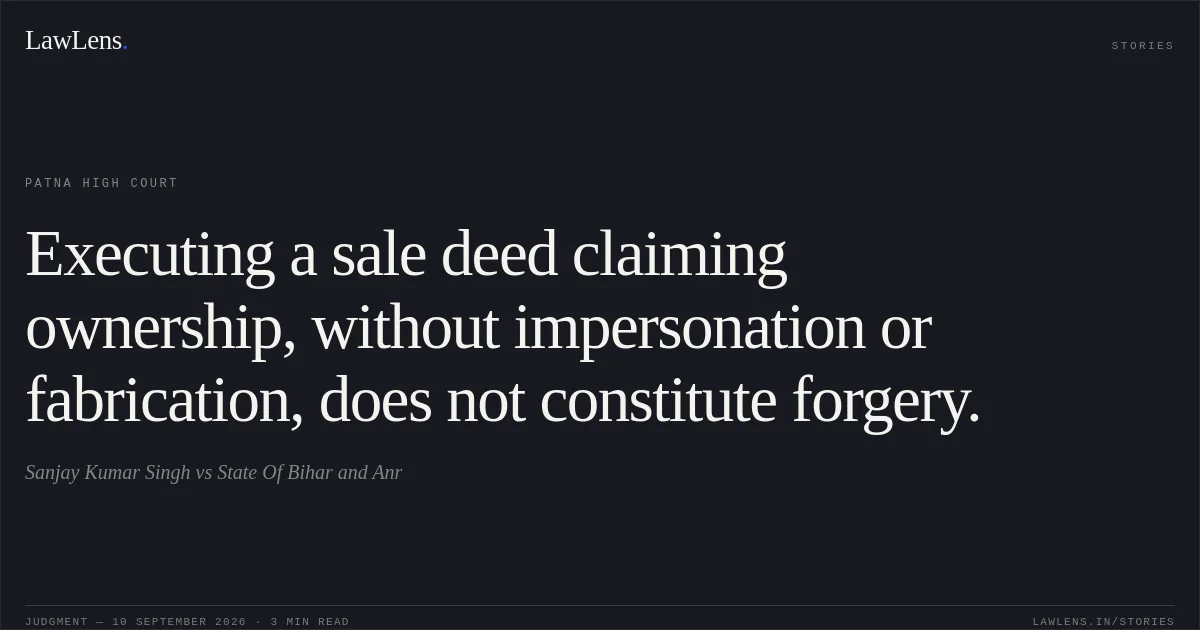
Source reference: pp. 3–6Relying on Md. Ibrahim & Sons v. State of Bihar, 2009 (4) PLJR (SC) 99, the Court noted that execution of a sale deed by a person claiming ownership of property does not, without more, constitute creation of a “false document” under Section 464 IPC and consequently does not attract forgery or use of forged document under Sections 467 or 471 IPC.
Source reference: pp. 3–6The Court also relied on Mamidi Anil Kumar Reddy v. State of Andhra Pradesh, 2024 INSC 101, regarding the impermissibility of giving a criminal colour to essentially civil property disputes, and Pepsi Foods Ltd. v. Special Judicial Magistrate, (1998) 5 SCC 749, which requires the Magistrate to apply judicial mind and determine whether the complaint and supporting material make out a prima facie case before issuing process
Source reference: pp. 3–6Reasoning
The allegations principally concerned title, mutation, succession to the interests of co-sharers, and the validity of the sale deeds executed in respect of the disputed property
Source reference: pp. 2–3The petitioner relied on existing civil and revenue remedies, including a title suit for cancellation of the sale deeds and proceedings relating to the disputed jamabandi
Source reference: p. 3Applying the principles in Md. Ibrahim, the Court found that the alleged execution of sale deeds claiming ownership did not, on the facts presented, establish forgery or the making of a false document.
Source reference: pp. 3–6The dispute was therefore predominantly civil, and continuation of the prosecution for cheating, forgery-related offences and conspiracy was held to constitute an abuse of the process of the Court
Source reference: pp. 3–6The Court accordingly accepted the petitioner’s challenge to the cognizance order
Source reference: p. 6Holding
The Patna High Court held that continuation of the criminal prosecution against the petitioner amounted to an abuse of the process of the Court.
It quashed the order dated 5 May 2016 passed by the Chief Judicial Magistrate, Sheohar, in Complaint Case No. C-1/52 of 2016, whereby cognizance had been taken under Sections 468, 471, 420 and 120-B IPC.
Source reference: p. 6The criminal miscellaneous application was allowed
Source reference: p. 6Acts & Sections Cited
5 provisions across 1 statute referred to in this judgment. Each provision opens on LawLens.
Indian Penal Code, 18605
Original Court PDF
Sanjay Kumar SinghvsState Of Bihar and Anr
Click to open original judgment
Original judgment, available to read, download and summarize on LawLens.in