Facts
The applicant served as a Gramin Dak Sevak (GDS) from 10.02.1972 until his promotion to a regular Group ‘D’ post on 06.02.1997
Source reference: p. 2He retired on 31.10.2006, having completed 9 years, 8 months, and 21 days of regular service
Source reference: p. 3Under the CCS (Pension) Rules, 1972, a minimum of 10 years of qualifying service is mandatory for pension
Source reference: p. 3Even after applying a permissible 3-month relaxation under Rule 49(3), the applicant’s service totaled 9 years, 11 months, and 21 days, falling short by 9 days
Source reference: p. 3/5Following a 2019 Supreme Court directive in UOI v. Gandiba Behera, the Postal Services Board (PSB) issued a policy decision on 25.09.2020 stating that no further relaxation under Rule 88 would be granted beyond the inbuilt 3-month relaxation provided under Rule 49
Source reference: p. 6/7Consequently, the respondents rejected the applicant's claim for pension via an order dated 17.07.2023
Source reference: p. 2The applicant challenged this rejection and the underlying PSB policy
Source reference: p. 2Issues
1. Whether the service rendered as a GDS can be counted toward the qualifying service required for regular pension
Source reference: p. 52. Whether the Tribunal can quash the Postal Services Board's policy decision to restrict the exercise of discretionary power under Rule 88 of the CCS (Pension) Rules, 1972
Source reference: p. 7/8Law Applied
The court primarily applied the CCS (Pension) Rules, 1972, specifically Rule 49 (qualifying service and standard relaxation) and Rule 88 (power of the Ministry to relax rules in cases of "undue hardship")
Source reference: p. 6The court relied on the Supreme Court precedent in Union of India v. Gandiba Behera (SLP (C) No. 13042/2014), which established that GDS service is non-pensionable and cannot be added to regular service for pension purposes
Source reference: p. 5The court applied the principles of judicial restraint in policy matters as laid down in Directorate of Film Festivals v. Gaurav Ashwin Jain (2007), Premium Granites v. State of T.N. (1994), and Balco Employees Union v. Union of India (2001), which hold that courts should not interfere with executive policy decisions unless they are unconstitutional, statutory violations, or manifestly arbitrary
Source reference: p. 8/9Reasoning
The Tribunal observed that the applicant’s regular Group ‘D’ service was mathematically insufficient to meet the 10-year requirement, even with the Rule 49 relaxation
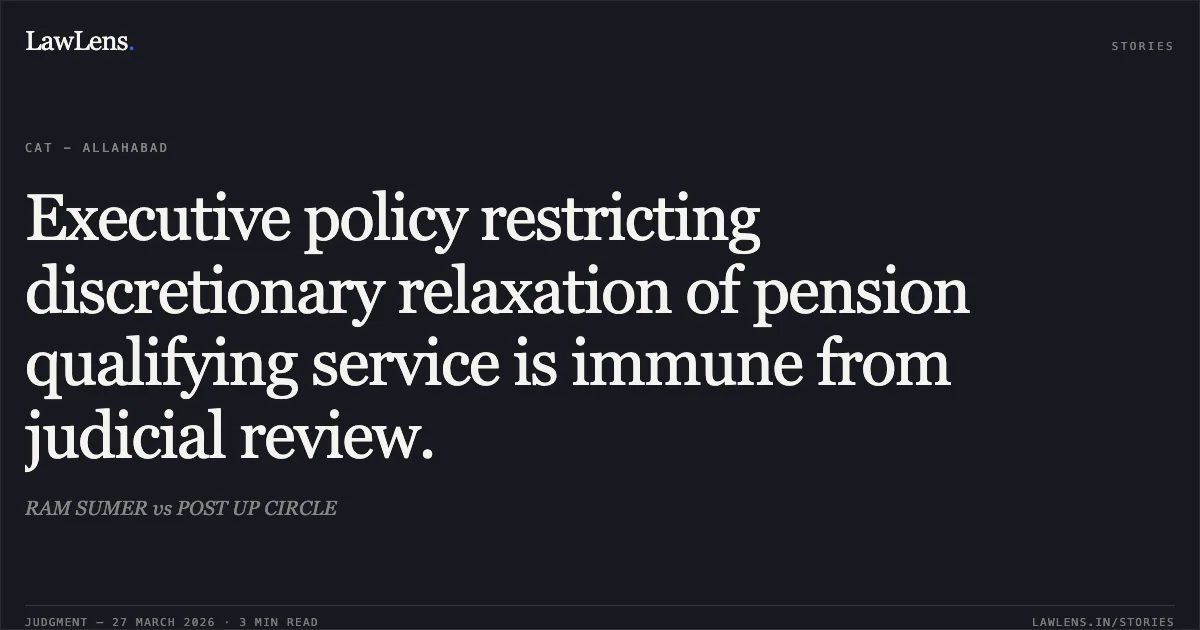
Source reference: p. 5Regarding the applicant's argument that Rule 88 should be invoked for a 9-day shortfall, the court noted that the Supreme Court in Gandiba Behera explicitly categorized the "Power to Relax" as being within the "decision-making domain of the Executive"
Source reference: p. 8The Postal Services Board, after due deliberation, formulated a policy to limit such relaxations to the three months already provided for in Rule 49 to maintain administrative consistency
Source reference: p. 6/7The Tribunal reasoned that it cannot act as an appellate authority over the wisdom or suitability of an executive policy
Source reference: p. 8Since the PSB's decision was taken after considering the relevant Supreme Court judgment and statutory rules, it did not suffer from non-application of mind or arbitrariness
Source reference: p. 7/10Holding
The Tribunal answered both issues in the negative. It held that GDS service cannot be counted toward regular pension and that the court cannot interfere with the executive's policy decision regarding the limits of relaxation under Rule 88
The Original Application was dismissed, and the applicant was advised to seek GDS-specific gratuity benefits through a separate proceeding. No order as to costs
Source reference: p. 10Original Court PDF
RAM SUMERvsPOST UP CIRCLE
Click to open original judgment
Original judgment, available to read, download and summarize on LawLens.in