Facts
The complainant purchased Plot No. 17/25, Khasra No. 559/1/थ/6, admeasuring 1,500 sq. ft., at Village Khamtarai, Bilaspur, for ₹18,75,000 on 30 March 2022. His application for mutation was rejected because the land was recorded in the revenue records as “Chote-Bade Jhad Ka Jangal,” allegedly constituting Government land that could not be sold without the Collector’s permission. The complainant alleged that the vendors and their associates misrepresented the Government land as privately owned and executed the sale deed to cheat him.
Source reference: para. 1–4An FIR was registered at Police Station Sarkanda, Bilaspur, for offences under Sections 420, 467, 468, 471 and 120-B read with Section 34 IPC, followed by a charge-sheet. The petitioner sought quashing of the FIR and charge-sheet, contending that he was merely an attesting witness to the sale deed and had no substantive role in the alleged offence. The State opposed the petition, asserting that the petitioner was a partner of S.N. Group, which executed the sale deed, and that the material collected disclosed his prima facie involvement.
Source reference: para. 1–5Issues
Whether the FIR and consequential charge-sheet disclosed a prima facie case against the petitioner for offences under Sections 420, 467, 468, 471 and 120-B read with Section 34 IPC, warranting continuation of the criminal proceedings.
Source reference: para. 7–9Whether the petitioner’s alleged role as an attesting witness, and the asserted civil nature of the dispute, justified quashing of the proceedings in the High Court’s inherent jurisdiction.
Source reference: para. 3–4, 8–9Law Applied
The Court applied Sections 420, 467, 468, 471 and 120-B read with Section 34 IPC, concerning cheating, forgery, use of forged documents, criminal conspiracy and acts done in furtherance of common intention.
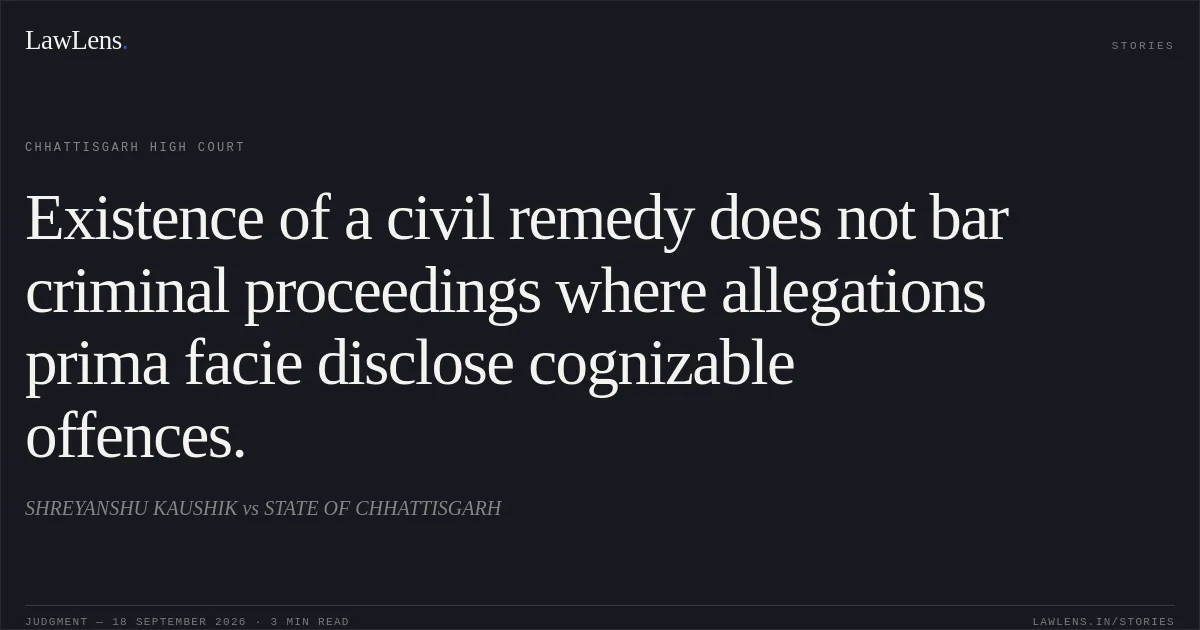
Source reference: para. 1It applied the principles governing exercise of inherent jurisdiction under Section 482 CrPC, namely that the Court should not conduct a mini-trial or determine disputed questions of fact at the threshold, and should interfere only where the allegations and materials fail to disclose an offence or the proceedings suffer from legal perversity. Relying on Accamma Sam Jacob v. State of Karnataka & Another, 2026 INSC 362, the Court held that the mere availability of a civil remedy does not bar criminal proceedings where the allegations prima facie disclose a cognizable offence, and that defence documents or disputed title claims ordinarily cannot be conclusively evaluated at the quashing stage.
Source reference: para. 8The petitioner’s reliance on Nishant Agrawal v. State of Chhattisgarh was based on the principle that attestation alone ordinarily establishes witnessing of execution and does not necessarily establish knowledge of the document’s contents.
Source reference: para. 3Reasoning
The Court found from the FIR, sale deed and charge-sheet materials that the land was recorded as “Bade Jhad Ka Jangal” and was allegedly represented as privately owned despite its purported Government character. The sale deed itself represented the land as belonging to the vendors. The Court held that, in light of the allegation that the petitioner was associated with the entity executing the sale deed and was aware of the land’s status, his signing as an attesting witness could not, at the preliminary stage, be treated as innocuous or exclude his possible participation in the alleged conspiracy and cheating.
Source reference: para. 5, 7Whether he actually possessed the requisite knowledge or criminal intent was a matter for investigation and trial, not adjudication under Section 482 CrPC. The existence of a possible civil remedy concerning title or the sale transaction did not negate the prima facie criminal allegations.
Source reference: para. 8–9Holding
The Court answered both issues against the petitioner. It held that the FIR and charge-sheet disclosed a prima facie case indicating the petitioner’s involvement in the alleged offences, and that neither his claimed status as a mere attesting witness nor the civil character of the underlying land dispute justified quashing the proceedings.
Accordingly, CRMP No. 2412 of 2026 was dismissed, and the FIR and consequential charge-sheet were allowed to proceed.
Source reference: para. 10Acts & Sections Cited
7 provisions across 2 statutes referred to in this judgment. Each provision opens on LawLens.
Indian Penal Code, 18605
Code of Criminal Procedure, 19732
Original Court PDF
SHREYANSHU KAUSHIKvsSTATE OF CHHATTISGARH
Click to open original judgment
Original judgment, available to read, download and summarize on LawLens.in