Facts
The Petitioner (Midpoint) filed a petition under Section 9 of the Arbitration and Conciliation Act, 1996 (“A&C Act”), seeking an interim order for the Respondents to deposit ₹15.30 crore or, alternatively, an injunction against alienating land in Gurugram.
Source reference: para. 1-2The Petitioner claimed the amount was infused as an unsecured loan and share purchase consideration based on draft Share Purchase Agreements (SPA) and Shareholders’ Agreements (SHA) exchanged in August 2024.
Source reference: para. 8f-8iWhile the draft SHA contained an arbitration clause, none of the definitive documents were ever signed.
Source reference: para. 8j, 13Respondents contested maintainability, arguing that the funds were part of a different transaction and that no concluded contract or arbitration agreement ever existed.
Source reference: para. 9-14Issues
1. Whether the Petitioner established the existence of a valid and binding arbitration agreement under Section 7 of the A&C Act as a prerequisite for seeking interim measures under Section 9.
Source reference: para. 30-312. Whether an arbitration agreement can be inferred from unexecuted drafts and WhatsApp communications where commercial negotiations are ongoing.
Source reference: para. 34, 40Law Applied
The court primarily applied Section 7 of the A&C Act, which requires an arbitration agreement to be in writing and reflects a record of agreement.
Source reference: para. 35It integrated principles from the Indian Contract Act, 1872, specifically Section 2 (proposal and acceptance) and Section 10/13 regarding consensus ad idem (meeting of minds) as the bedrock of any enforceable agreement.
Source reference: para. 36-38The court relied on Kuber Mart Global Hub (P) Ltd. v. Kuber Mart Industries (P) Ltd. to establish that Section 9 jurisdiction is ancillary to a valid arbitration agreement.
Source reference: para. 33It further distinguished Trimex International v. Vedanta and Glencore International AG v. Shree Ganesh Metals, noting that while signatures aren't mandatory, there must be unequivocal conduct signifying acceptance of terms.
Source reference: para. 45, 65-67Reasoning
The court reasoned that for Section 9 jurisdiction to be invoked, a prima facie existence of an arbitration agreement must be shown.
Source reference: para. 32In this case, the Petitioner’s own pleadings admitted that negotiations were ongoing as late as September/October 2025, with the Petitioner still requesting the "execution" of the SPA and SHA.
Source reference: para. 49-51The court found that mere exchange of drafts—where modifications were still being suggested—does not constitute a concluded contract.
Source reference: para. 43It rejected the Petitioner’s argument that the arbitration clause in the SHA survived independently, noting that the doctrine of separability cannot create an agreement where consensus ad idem on the substantive transaction (and the documents containing the clause) was never reached.
Source reference: para. 60-63Unlike Glencore, where parties performed duties under a finalized contract, here the transfer of funds occurred before the drafts were even circulated, indicating the money was not moved pursuant to the disputed arbitration clause.
Source reference: para. 68-72Holding
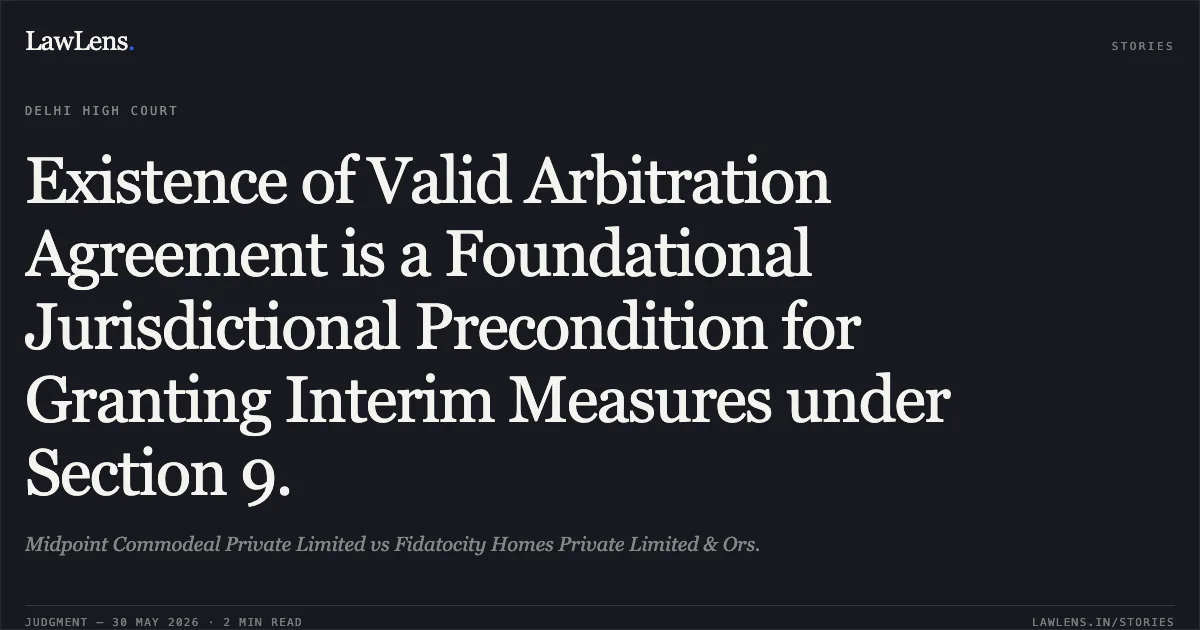
The Court held that the Petitioner failed to establish a valid, concluded, and enforceable arbitration agreement under Section 7 of the A&C Act.
Consequently, the petition under Section 9 was held to be not maintainable and was dismissed.
Source reference: para. 78-79The court clarified that the Petitioner remains at liberty to pursue other civil or monetary remedies, as no opinion was expressed on the merits of the underlying financial claim.
Source reference: para. 80Acts & Sections Cited
7 provisions across 2 statutes referred to in this judgment. Each provision opens on LawLens.
Arbitration and Conciliation Act, 19964
Indian Contract Act, 18723
Original Court PDF
Midpoint Commodeal Private LimitedvsFidatocity Homes Private Limited & Ors.
Click to open original judgment
Original judgment, available to read, download and summarize on LawLens.in