Facts
The Appellant applied for the post of Assistant Electric Fitter under an advertisement dated 10.11.2023 issued by Respondent No. 3.
Source reference: p. 2, para 7.1The essential qualification required was either a diploma in Electrical Engineering or an ITI qualification with two years of "professional experience".
Source reference: p. 2, para 7.1The Appellant submitted an experience certificate from Primaeval Solutions Pvt. Ltd. for the period 2019–2022.
Source reference: p. 2, para 7.1Upon verification, the former employer informed Respondent No. 1 that the Appellant worked on a temporary basis for a sub-contractor as a supervisor to "get training and learn," without any salary, receiving only food and lodging.
Source reference: p. 3, para 7.4Consequently, Respondent No. 1 cancelled the Appellant’s candidature on 26.02.2026 due to lack of documentary evidence (EPF, salary slips) to support the experience.
Source reference: p. 3-4, para 7.6The Appellant challenged this via a Writ Petition, which was dismissed by the learned Single Judge.
Source reference: p. 4, para 7.8Issues
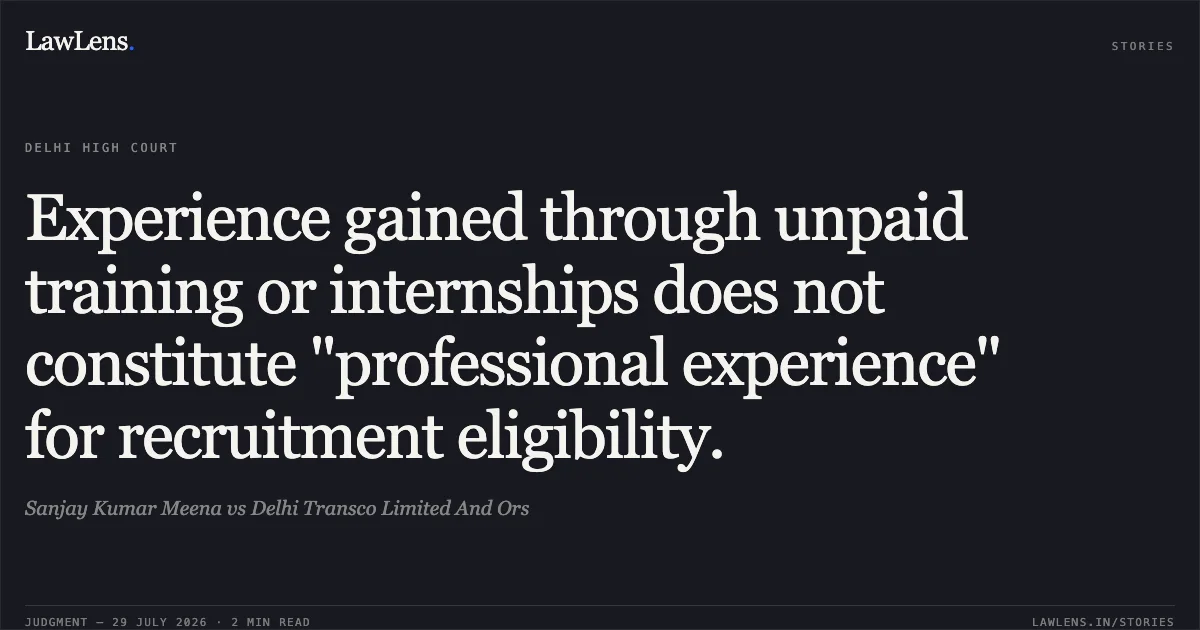
1. Whether the experience gained as a trainee/intern without monetary salary satisfies the requirement of "professional experience" as prescribed in the recruitment advertisement.
Source reference: p. 6, para 122. Whether the employer can insist on secondary documentary evidence (EPF, salary slips) during verification if such documents were not explicitly mentioned as eligibility requirements in the advertisement.
Source reference: p. 6, para 13Law Applied
The Court emphasized that the term "professional experience" in a recruitment context implies a formal employer-employee relationship or substantive professional engagement rather than mere exposure or training.
Source reference: p. 4, para 7.8It distinguished the precedent Chaudhary Charan Singh Haryana Agricultural University v. Monika, 2024 INSC 911, noting that while the mode of employment (e.g., outsourcing) might be flexible, the nature and genuineness of the work performed remain the primary considerations for eligibility.
Source reference: p. 7, para 16Reasoning
The Court rejected the Appellant’s argument that the demand for salary slips or EPF records constituted a new eligibility condition. It held that requesting such documents is a legitimate part of the verification process to ascertain the "genuineness" of the claimed professional experience.
Source reference: p. 6, para 13Reviewing the employer's communications, the Court found that the Appellant’s engagement was essentially a "form of training or internship" rather than professional employment.
Source reference: p. 7, para 15The Court observed that because the Appellant was not paid a salary and worked primarily to "learn the things for his own work," the engagement lacked the necessary characteristics of "professional experience" required for the technical post.
Source reference: p. 7, para 17The Court distinguished Monika (supra) by noting that in this case, the rejection was not based on the method of hiring, but on the fact that the verification process failed to establish a substantive professional relationship.
Source reference: p. 7, para 17Holding
The Court held that the Appellant failed to satisfy the "professional experience" requirement as the evidence indicated a training/learning engagement rather than professional service.
The Court affirmed the Single Judge's order, ruling that Respondent No. 1 was justified in rejecting the candidature after the verification process failed to substantiate the experience certificate. The Appeal was dismissed with no order as to costs.
Source reference: p. 7, para 18; p. 8, para 19Acts & Sections Cited
1 provisions across 1 statute referred to in this judgment. Each provision opens on LawLens.
Code of Civil Procedure, 19081
Original Court PDF
Sanjay Kumar MeenavsDelhi Transco Limited And Ors
Click to open original judgment
Original judgment, available to read, download and summarize on LawLens.in