Facts
The petitioner, plaintiff in O.S. No. 223/2015 for specific performance, sought through a memo dated 20 March 2024 to have the trial court first hear and consider a Commissioner’s report concerning the genuineness of signatures on the agreement for sale.
Source reference: p. 4The trial court rejected the memo by a speaking order dated 4 June 2024, reasoning that the expert report should be evaluated with the other evidence at the merits stage and that objections to the investigation could also be considered then.
Source reference: pp. 7–8The plaintiff challenged that order under Article 227 of the Constitution.
Source reference: p. 3Issues
Whether the trial court’s rejection of the memo was an order warranting interference under Article 227.
Source reference: pp. 3, 8–9Whether the Commissioner’s expert report had to be heard and considered independently before the other evidence in the suit.
Source reference: pp. 4, 7–8Law Applied
The Court applied the supervisory jurisdiction under Article 227 of the Constitution, finding no infirmity in the trial court’s order that required interference.
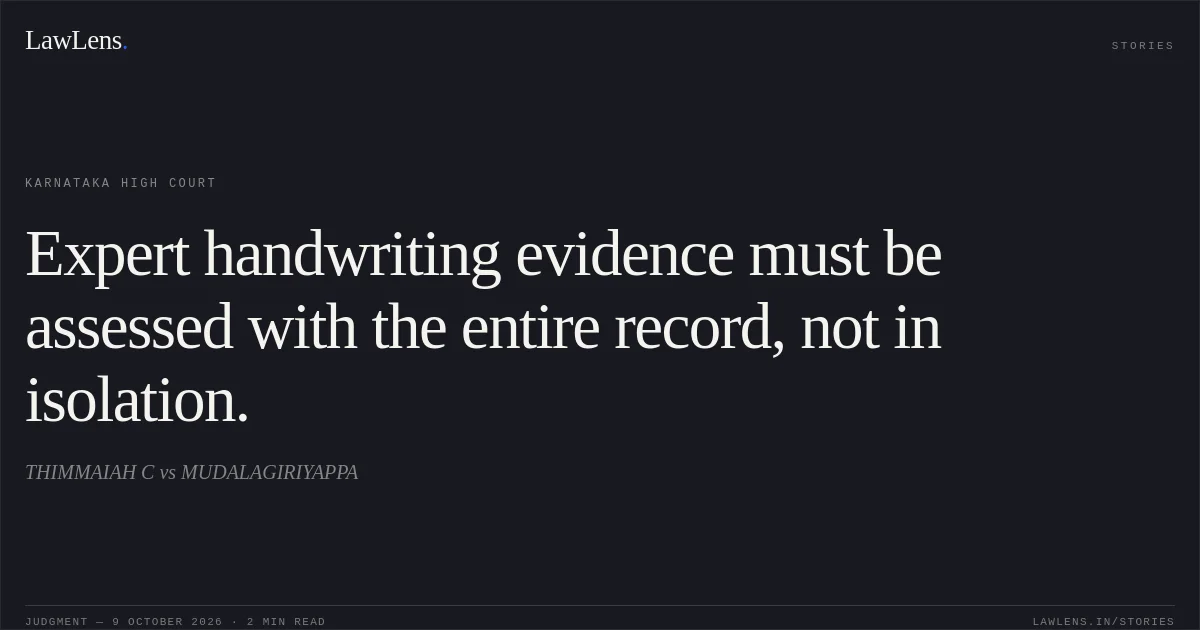
Source reference: pp. 3, 8–9The trial court stated that expert evidence on handwriting is not conclusive and ordinarily requires corroboration; it should be assessed cautiously and together with the other evidence on record, rather than in isolation.
Source reference: p. 8It also noted that the decision cited by the plaintiff, Parvathamma v. Shivamma, 1977(2) KLJ 40, did not apply in the circumstances, including because the Commissioner had been appointed at the plaintiff’s instance and the instructions did not require notice to both parties during the commission work.
Source reference: pp. 7–8Reasoning
The High Court considered the trial court’s reasons for declining to assess the report separately at that stage. The report concerned the genuineness of signatures, but its evidentiary value and the plaintiff’s procedural objections could be evaluated alongside the other evidence when the suit was decided on its merits.
Source reference: pp. 7–8As the trial court had not foreclosed those contentions and had explained why the report should not be considered in isolation, the High Court found no ground for supervisory interference.
Source reference: p. 8Holding
The High Court dismissed the writ petition and declined to interfere with the order dated 4 June 2024.
It permitted the plaintiff to raise contentions concerning the admission of the expert evidence before the trial court in accordance with law, leaving the parties’ rights and contentions open.
Source reference: p. 9Original Court PDF
THIMMAIAH CvsMUDALAGIRIYAPPA
Click to open original judgment
Original judgment, available to read, download and summarize on LawLens.in