Facts
The Appellants were convicted by the Trial Court under Sections 302/34 and 328/34 of the IPC for allegedly murdering Jagdish (Gyanmati’s husband) by administering Aluminium Phosphide in his food on July 20, 2013.
Source reference: p. 3The prosecution alleged an illicit relationship between the Appellants as the motive.
Source reference: p. 3While the FIR was lodged with a two-day delay on July 22, 2013, the medical records (Ex. Ka-4) showed Gyanmati herself admitted the deceased to the hospital.
Source reference: p. 5, 8, 16The post-mortem could not ascertain the cause of death, but a subsequent Forensic Science Laboratory (FSL) report found traces of poison in the viscera.
Source reference: p. 8-9The Appellants contended they were falsely implicated and had actually provided prompt medical care.
Source reference: p. 10-11Issues
1. Whether the delay in lodging the FIR and the inconsistencies in the testimonies of PW-1 and PW-2 render the prosecution story unreliable?
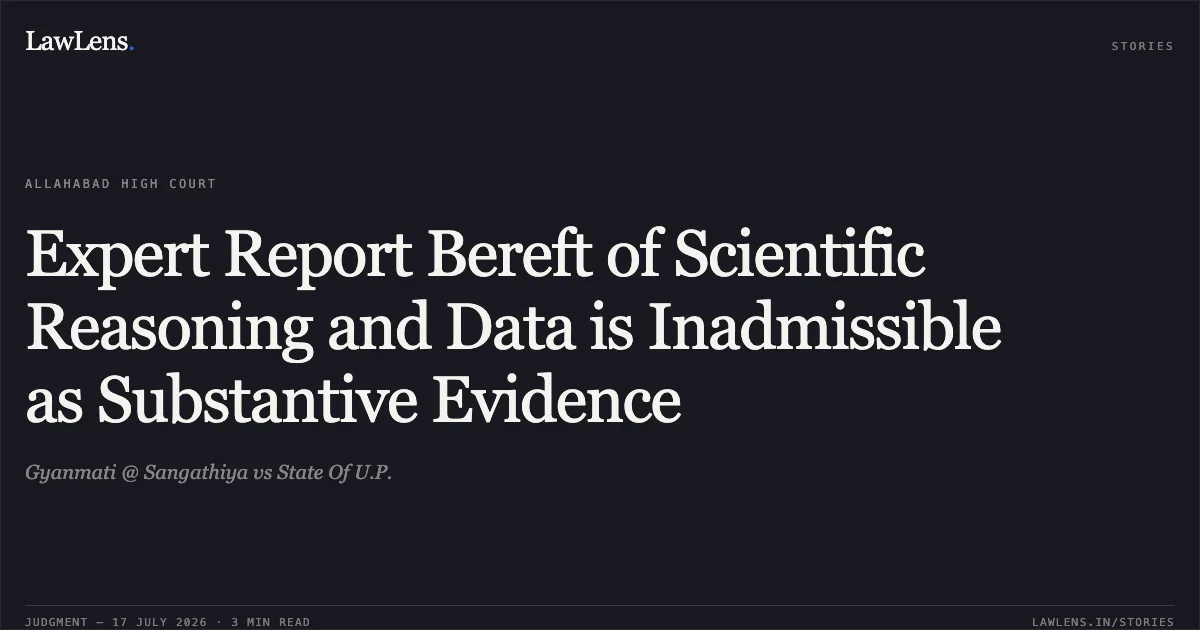
Source reference: p. 14-172. Whether an FSL report lacking scientific data, reasons, or testing protocols is admissible as expert evidence under Section 45 of the Evidence Act?
Source reference: p. 17-223. Whether the prosecution discharged its burden of proving safe preservation of the viscera sample and the specific cause of death?
Source reference: p. 34-36Law Applied
The court applied Section 302 (Murder) and Section 328 (Causing hurt by poison) of the IPC.
Source reference: p. 2The court relied on Section 45 of the Indian Evidence Act regarding expert opinions and Section 293 of the CrPC regarding reports of Government scientific experts.
Source reference: p. 17-18The court strictly applied the principles from Madan Gopal Kakkar v. Naval Dubey and Ramesh Chandra Agrawal v. Regency Hospital Ltd., which mandate that an expert opinion must be supported by "data and material" and "reasons" to enable the court to form an independent judgment.
Source reference: p. 20-21The court noted the nature of Aluminium Phosphide as established in Jaipal v. State of Haryana, observing it is rarely accidental/homicidal due to its pungent odor.
Source reference: p. 32-33Reasoning
The Court found the testimonies of PW-1 and PW-2 (father and Pradhan) regarding the "dying declaration" and hospitalization to be "entirely false," as hospital records proved the wife (Appellant) brought the deceased to the hospital, contradicting the witnesses’ claims.
Source reference: p. 16-17The Court rejected the FSL report (Ex. Ka-14) because it merely stated a conclusion (identifying poison) without disclosing any tests, scientific criteria, or raw data, rendering it inadmissible.
Source reference: p. 22The Court also highlighted the prosecution's failure to prove the integrity of the "chain of custody," noting that the viscera was tested over a year after collection without evidence of safe lab storage.
Source reference: p. 35-36The doctor (PW-4) was never confronted with the FSL findings to confirm if internal symptoms matched the alleged poison.
Source reference: p. 34The Court concluded that the Appellant's conduct—immediately seeking medical help—was inconsistent with a homicidal intent.
Source reference: p. 36Holding
The Court held that the prosecution failed to prove the charges beyond a reasonable doubt due to the inadmissible FSL report, unreliable witnesses, and lack of motive.
The High Court allowed the appeals and set aside the Trial Court's judgment dated June 27, 2016; the Appellants were honorably acquitted and ordered to be released forthwith.
Source reference: p. 37The Court further issued systemic "Suggestions" for mandatory SOPs, requiring FSL experts to include qualifications, scientific reasons, and storage conditions in future reports.
Source reference: p. 38Acts & Sections Cited
5 provisions across 2 statutes referred to in this judgment. Each provision opens on LawLens.
Indian Penal Code, 18603
Code of Criminal Procedure, 19732
Original Court PDF
Gyanmati @ SangathiyavsState Of U.P.
Click to open original judgment
Original judgment, available to read, download and summarize on LawLens.in