Facts
On 19.03.2019, the deceased, husband of Respondent No. 1 and father of Respondents Nos. 2 and 3, died in a motor-vehicle accident allegedly caused by the rash and negligent driving of Tata truck No. TR-01-X-1805.
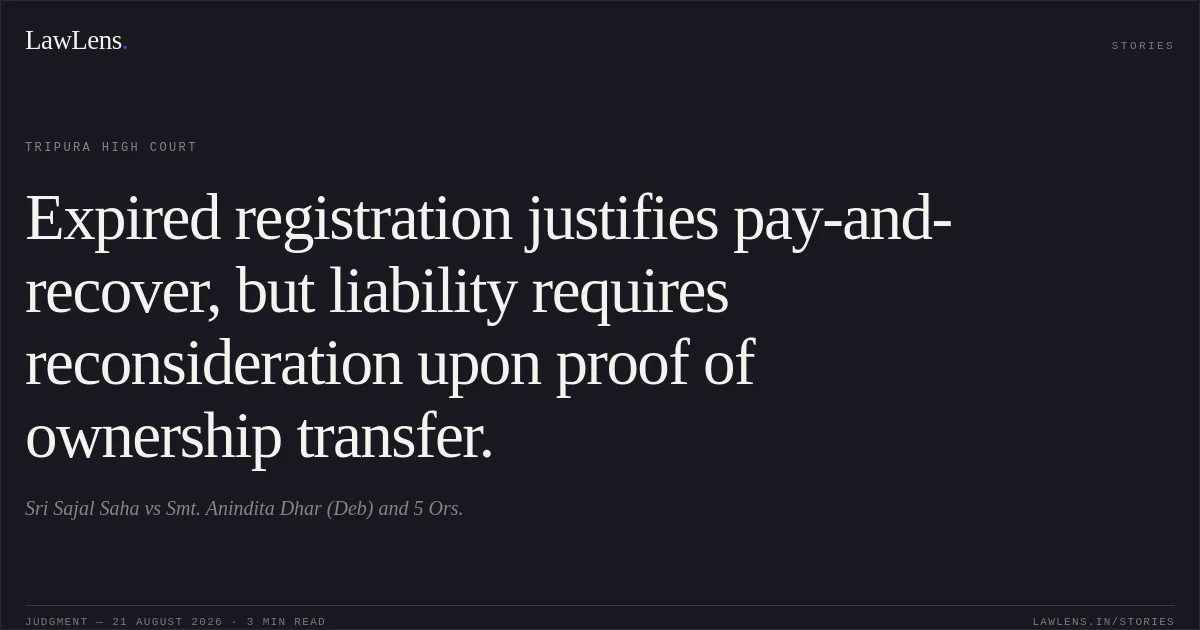
Source reference: p. 2–3The Motor Accident Claims Tribunal, Court No. 2, West Tripura, awarded compensation of ₹46,92,384 with interest at 8% per annum and directed the New India Assurance Company Ltd. to satisfy the award initially and recover it from the vehicle owner under the “pay and recover” principle.
Source reference: p. 2–3The Tribunal found that the truck had a valid fitness certificate, road permit, insurance policy, and driving licence on the date of the accident, but that its registration certificate had expired in 2015.
Source reference: p. 4Relying on the unchallenged AIR/DAR, marked as Exhibit C, the Tribunal held that the expired registration constituted a breach and imposed liability on the owner, while directing the insurer to pay the claimants first and recover the amount from him.
Source reference: p. 4–5The owner appealed, contending that he had sold the vehicle after the accident and surrendered the original registration certificate for transfer of ownership.
Source reference: p. 3–4He also filed an application under Order XLI Rule 27 CPC seeking to adduce additional evidence regarding the sale and transfer of the vehicle.
Source reference: p. 6–7Issues
Whether the expiry of the offending vehicle’s registration certificate constituted a fundamental breach of the insurance policy warranting application of the “pay and recover” principle
Source reference: p. 4–6Whether the appellant-owner should be given an opportunity to produce additional evidence concerning the alleged sale of the vehicle and surrender of the original registration certificate
Source reference: p. 6–7Whether the Tribunal’s award should be sustained or the matter remanded for reconsideration in light of the proposed additional evidence
Source reference: p. 7Law Applied
The Court applied Section 39 of the Motor Vehicles Act, 1988, which prohibits driving or permitting a motor vehicle to be driven in a public place without valid registration and a valid registration mark.
Source reference: p. 5–6It recognised the principle that driving a vehicle with an expired registration may constitute a fundamental breach of the policy conditions as between the insurer and the insured; however, the insurer remains liable to satisfy a third-party award in the first instance and may thereafter recover the amount from the owner under the “pay and recover” doctrine.
Source reference: p. 5–6The Court referred to National Insurance Co. Ltd. v. Swaran Singh, (2004) 3 SCC 297, and Shamanna v. Divisional Manager, Oriental Insurance Co. Ltd., (2018) 9 SCC 650, concerning protection of third-party rights and recovery by the insurer.
Source reference: p. 5–6The Court further invoked Order XLI Rule 27 CPC to permit consideration of material additional evidence where necessary for a just adjudication.
Source reference: p. 3–4, 6–7Reasoning
The Court found that the accident resulted from the rash and negligent driving of the offending truck and that the AIR/DAR, which recorded that the registration certificate was valid only until 2015, had been admitted without objection and remained unrebutted.
Source reference: p. 4On the existing record, the Tribunal was therefore justified in treating the absence of valid registration on the accident date as a policy breach and in directing the insurer to pay the claimants first and recover the amount from the owner.
Source reference: p. 4–6However, the appellant asserted that he had sold the vehicle and surrendered the original registration certificate, and sought to produce documentary material supporting that contention.
Source reference: p. 6–7Since the proposed evidence could bear directly on whether the appellant continued to be the legally responsible owner at the relevant time, the Court held that an opportunity to present and test that evidence was necessary in the interests of justice.
Source reference: p. 6–7Holding
The Court did not finally determine the appellant’s liability.
It set aside the Tribunal’s order and remanded the matter for reconsideration after giving the appellant an opportunity to produce the additional documents and allowing both sides to be heard.
Source reference: p. 7The appeal was accordingly disposed of, and pending applications were also disposed of.
Source reference: p. 7Acts & Sections Cited
3 provisions across 1 statute referred to in this judgment. Each provision opens on LawLens.
Motor Vehicles Act, 19883
Original Court PDF
Sri Sajal SahavsSmt. Anindita Dhar (Deb) and 5 Ors.
Click to open original judgment
Original judgment, available to read, download and summarize on LawLens.in