Facts
Imperial Fibres Pvt. Ltd. imported and traded polyester knitted fabrics from China and Malaysia, claiming preferential customs-duty treatment under Notification No. 46/2011-Cus dated 1 June 2011 on the basis of AIFTA Certificates of Origin (“COOs”) showing Malaysia as the country of origin.
Source reference: pp. 2–3DRI alleged that the goods were actually of Chinese origin and that the Malaysian COOs had been fabricated or manipulated to obtain the preferential tariff benefit.
Source reference: pp. 2, 9–10The goods covered by Bill of Entry No. 8606858 dated 16 March 2015 were examined, samples were drawn, and searches were conducted at the importer’s premises.
Source reference: p. 2Verification was sought from the Malaysian authorities, but the response was received only on 14 October 2016, well after the prescribed period. The response stated that 15 of the referred COOs were “not authentic” and that the actual COOs bearing those reference numbers belonged to another company.
Source reference: pp. 2–3, 21–22A show-cause notice dated 15 January 2018 was issued, invoking the extended limitation period under Section 28(4) of the Customs Act, 1962. The Commissioner confirmed differential duty of approximately ₹2,29,01,929 with interest and imposed penalties under Sections 112(a), 114A and 114AA of the Customs Act.
Source reference: pp. 13–15Issues
1. Whether the Department could reject the AIFTA COOs and deny preferential tariff treatment without complying with the verification procedure and time limits prescribed under Rule 7(c) and Rule 7(d) of the Customs Tariff (Determination of Origin of Goods under the Preferential Trade Agreement between ASEAN Member States and India) Rules, 2009?
Source reference: pp. 19–232. Whether the available evidence established that the imported goods were of Chinese origin and that the COOs were fabricated or otherwise inauthentic?
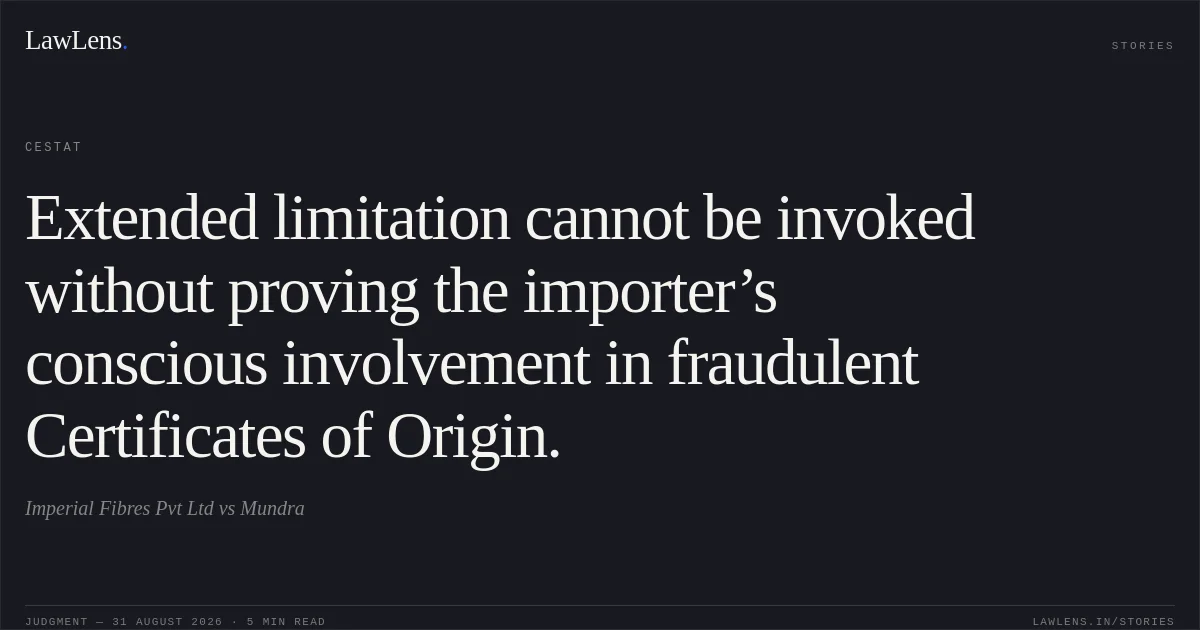
Source reference: pp. 21–24, 30–363. Whether the extended limitation period under Section 28(4) of the Customs Act, 1962 could be invoked in the absence of proof of the importer’s collusion, wilful misstatement, suppression of facts, or conscious knowledge of the alleged falsity?
Source reference: pp. 25–304. Whether the consequential demand, interest, confiscation-related findings and penalties imposed on the importer and its director were sustainable?
Source reference: pp. 13–15, 36–37Law Applied
The Tribunal applied Notification No. 189/2009-Cus (NT) and, in particular, Rule 7(c) and Rule 7(d) of the 2009 Origin Rules, which require a rejected AIFTA Certificate of Origin to be returned to the issuing authority within a reasonable period not exceeding two months, with the grounds of denial communicated, followed by detailed clarification from the issuing authority.
Source reference: pp. 19–21Rule 23 requires cooperation between the relevant governmental authorities and legal sanctions against established fraudulent acts connected with AIFTA COOs; it does not dispense with the procedural safeguards in Rule 7.
Source reference: pp. 20–21Under Section 28(4) of the Customs Act, the extended five-year limitation period is available only where non-levy or short-levy results from collusion, wilful misstatement or suppression of facts by the person liable to pay duty.
Source reference: pp. 25–30The Tribunal relied on Uniworth Textiles Ltd. v. CCE, 2013 (288) E.L.T. 161 (S.C.), and Kapadia Enterprises v. Union of India, 2013 (287) E.L.T. 255 (Guj.), for the proposition that mala fide conduct and the relevant ingredients must be specifically alleged and proved against the importer.
Source reference: pp. 25–30It also relied on Mahadev Metaliks Pvt. Ltd. v. Union of India, 2016 (331) E.L.T. 424 (A.P.), regarding the time-bound nature of retroactive verification.
Source reference: pp. 23–24The Tribunal further applied the evidentiary principle that unauthenticated foreign documents, uncorroborated intelligence and unverified reports are insufficient by themselves to establish misdeclaration, as reflected in Findoc Impex, Shakti Traders, Truwoods Pvt. Ltd., and related authorities.
Source reference: pp. 30–36Reasoning
The Tribunal held that Trafigura did not justify disregarding Rules 7(c) and 7(d), because the present dispute concerned provisions expressly incorporated into Indian law rather than an unincorporated treaty mechanism.
Source reference: pp. 18–21Rule 23 likewise could not be treated as overriding the prescribed verification process; fraud had first to be established through a legally reliable inquiry.
Source reference: pp. 20–21The Department had obtained verification for only 15 of the 29 COOs, after substantial delay, and the response merely stated that the certificates were not authentic and belonged to another company. It did not provide the underlying documents, identify the actual certificate holders, address the signature issue, or otherwise furnish the detailed clarification contemplated by the Rules.
Source reference: pp. 21–24, 36–37The Tribunal also noted that the samples drawn from the goods were not supported by any test report on record or supplied to the appellants, and therefore could not establish Chinese origin.
Source reference: pp. 21–24The alleged signature mismatch had not been supported by expert handwriting evidence, while the Malaysian verification did not specifically address the signatures.
Source reference: p. 22The invoice similarities and the director’s statements were considered insufficient: the Tribunal found that Varun Goyal had consistently denied knowledge of any wrongdoing and that his later observation that the signatures appeared different was merely an opinion, not a culpatory admission or expert conclusion.
Source reference: pp. 25–30Since the Department failed to establish a positive act, conscious knowledge or collusion by the importer in obtaining or using allegedly fabricated COOs, the statutory ingredients for Section 28(4) were absent.
Source reference: pp. 25–30The show-cause notice consequently could not sustain the extended limitation period. In view of the limitation bar and the inadequacy of the evidence establishing fraud or Chinese origin, the demand and penalties could not survive.
Source reference: pp. 25–30, 36–37Holding
The Tribunal answered the issues in favour of the appellants.
It held that the Department had not followed the mandatory and time-bound COO verification procedure, had not conclusively established that the goods were of Chinese origin or that the COOs were fabricated, and had failed to prove collusion, wilful misstatement, suppression or conscious knowledge necessary to invoke Section 28(4).
Source reference: pp. 23–24, 36–37Accordingly, the extended-period demand of differential customs duty, interest and penalties imposed on Imperial Fibres Pvt. Ltd. and Varun Goyal were set aside. Both appeals were allowed with consequential relief to the appellants.
Source reference: p. 37Acts & Sections Cited
11 provisions across 3 statutes referred to in this judgment. Each provision opens on LawLens.
Customs Act,1962
Central Excise Act, 19441
Diplomatic and Consular Officers (Oaths and Fees) Act, 19481
Original Court PDF
Imperial Fibres Pvt LtdvsMundra
Click to open original judgment
Original judgment, available to read, download and summarize on LawLens.in