Facts
The claimant, a tempo-traveller driver employed by respondent No. 1, was injured in an accident during the course of employment on 19 May 2017.
Source reference: pp. 3–5He claimed compensation, alleging a monthly salary of ₹15,000 plus daily batta.
Source reference: pp. 3–5The Commissioner awarded ₹1,90,753 with interest at 12% per annum, assessing whole-body disability at 20% and monthly wages at ₹8,000.
Source reference: pp. 17, 22–25The claimant appealed under Section 30(1) of the Employees’ Compensation Act, 1923, seeking enhancement based on a higher disability assessment and income.
Source reference: pp. 3–5, 17, 22–25Issues
1. Whether the Commissioner’s assessment of the claimant’s disability raised a substantial question of law warranting interference under Section 30(1).
Source reference: pp. 5, 12–172. Whether the Commissioner’s assessment of the claimant’s monthly wages at ₹8,000, rather than the alleged actual wages, raised a substantial question of law.
Source reference: pp. 5–8, 23–26Law Applied
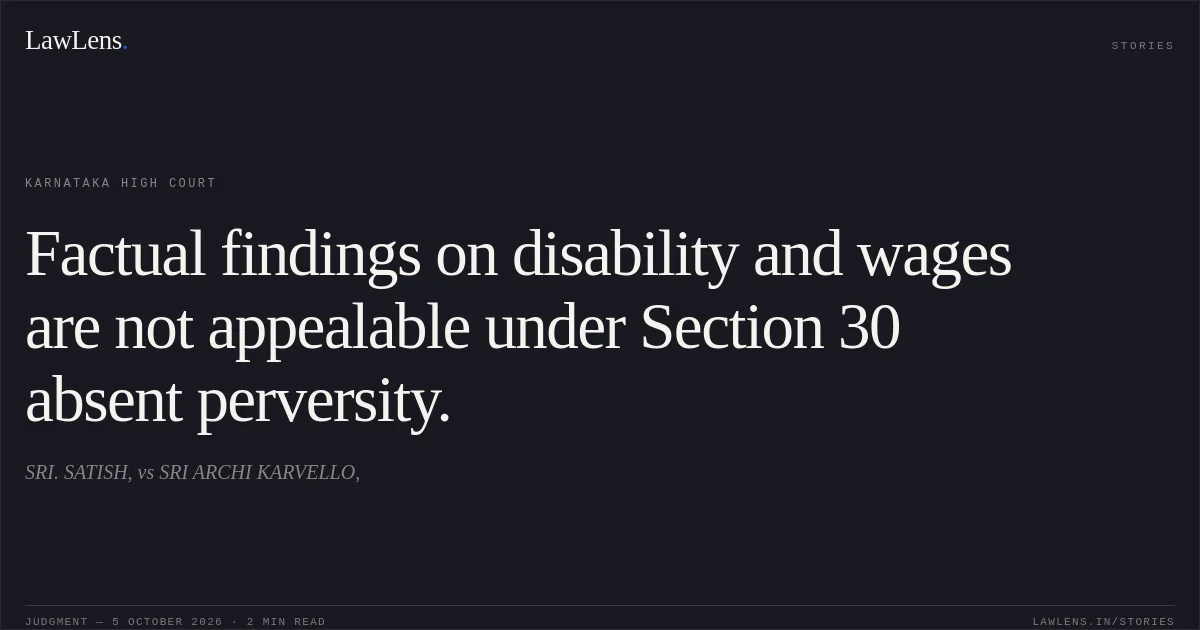
Section 30(1) of the Employees’ Compensation Act permits an appeal only against the specified orders and only where a substantial question of law is involved.
Source reference: pp. 9–11Under Golla Rajanna v. Divisional Manager, United India Insurance Co. Ltd., the Commissioner is the final fact-finding authority, and findings on disability ordinarily cannot be reappreciated on appeal absent perversity or lack of evidence.
Source reference: pp. 13–14North East Karnataka Road Transport Corporation v. Sujatha similarly treats matters such as disability and wages as questions of fact, subject to the substantial-question-of-law requirement.
Source reference: pp. 14–15Under Shakuntala Chandrakant Shreshti v. Prabhakar Maruti Garvali, a question of law may arise where a finding is perverse—for example, where it rests on no legal evidence or jurisdictional facts are absent.
Source reference: p. 16The court also considered Section 4(1)(b) in relation to the applicable wage figure and the principle, discussed in The Managing Director v. Nirupama, that proved actual wages may be used where established by evidence.
Source reference: pp. 23–26Reasoning
The court held that the disability and wage assessments were factual findings and would not justify appellate intervention unless shown to be perverse or contrary to law.
Source reference: pp. 17–26The disability certificate recorded limb-specific disability and contained an unexplained overwriting; the Commissioner’s assessment of 20% whole-body disability was based on the evidence and was not shown to be perverse.
Source reference: pp. 17–22As to wages, although the employer testified that the claimant received ₹15,000 per month plus batta, he also stated that the claimant was a temporary driver, had no appointment letter, and that no wage-payment records existed.
Source reference: pp. 23–26The claimant produced no documentary evidence substantiating the alleged wages.
Source reference: pp. 23–26The court therefore found no perversity in the Commissioner’s use of ₹8,000 per month.
Source reference: pp. 23–26Holding
The High Court answered both issues against the claimant, holding that neither the disability assessment nor the wage assessment disclosed perversity or a substantial question of law warranting interference.
The appeal was dismissed.
Source reference: pp. 22–26Acts & Sections Cited
10 provisions across 2 statutes referred to in this judgment. Linked provisions open on LawLens.
Employee
Indian Evidence Act, 18721
Original Court PDF
SRI. SATISH,vsSRI ARCHI KARVELLO,
Click to open original judgment
Original judgment, available to read, download and summarize on LawLens.in