Facts
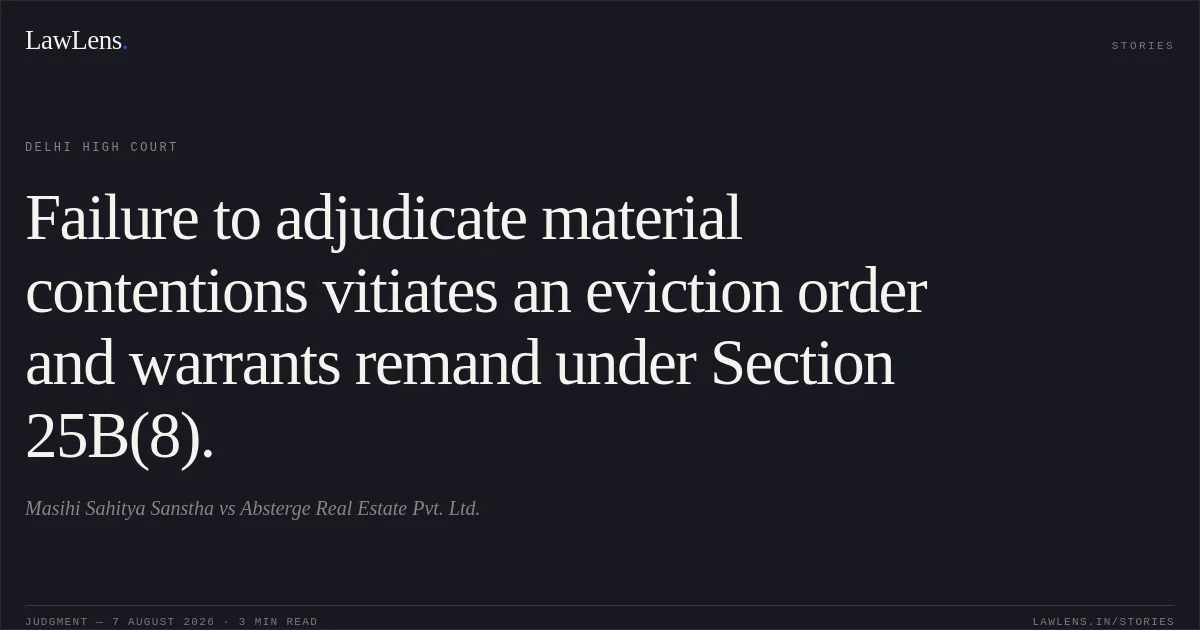
Absterge Real Estate Pvt. Ltd. initiated an eviction petition under Section 14(1)(e) of the Delhi Rent Control Act, 1958, against Masihi Sahitya Sanstha concerning the tenanted premises.
Source reference: pp. 2–3, paras. 2–8The learned Additional Rent Controller (“ARC”) passed an order dated 24.12.2024 in favour of the respondent-landlord.
Source reference: pp. 2–3, paras. 2–8The petitioner-tenant challenged the order under the proviso to Section 25B(8) of the Act, contending that the ARC had failed to consider: (i) the genuineness and evidentiary value of the respondent’s work order dated 03.04.2023; (ii) the alleged availability of the second floor of the same property as alternate suitable accommodation; and (iii) whether the second floor was residential and consequently unsuitable for commercial use.
Source reference: pp. 2–3, paras. 2–8The respondent argued that the ARC had sufficiently dealt with bona fide requirement and alternate accommodation in paragraph 11.2 of the impugned order.
Source reference: p. 3, para. 9The High Court examined whether the ARC’s decision-making process adequately addressed the petitioner’s material objections.
Source reference: pp. 5–8, paras. 18–22Issues
Whether the ARC failed to adjudicate upon the petitioner’s specific challenge to the genuineness and evidentiary value of the work order dated 03.04.2023 relied upon to establish bona fide requirement.
Source reference: pp. 2–3, paras. 4, 19–22Whether the ARC failed to consider the petitioner’s plea that the second floor of the subject property constituted alternate suitable accommodation for the respondent.
Source reference: pp. 2–3, paras. 5–7, 19–22Whether such non-consideration constituted an error apparent on the face of the record or a material infirmity warranting interference under the proviso to Section 25B(8) of the Delhi Rent Control Act.
Source reference: pp. 3–6, paras. 11–17, 21–23Law Applied
The Court applied Section 25B(8) of the Delhi Rent Control Act, 1958, under which the High Court exercises limited supervisory and revisional jurisdiction over the ARC’s decision-making process, rather than appellate jurisdiction.
Source reference: pp. 3–6, paras. 11–17Relying on Sarla Ahuja v. United India Insurance Co. Ltd. , (1998) 8 SCC 119, Hindustan Petroleum Corporation Ltd. v. Dilbahar Singh , (2014) 9 SCC 78, and Abid-Ul-Islam v. Inder Sain Dua , (2022) 6 SCC 30, the Court held that interference is justified where there is an error apparent on the face of the record, jurisdictional error, material irregularity, perversity, or absence of adjudication, but not merely because another view is possible.
Source reference: pp. 3–5, paras. 12–16The Court also applied Section 14(1)(e) of the Act, which requires consideration of the landlord’s bona fide requirement and the availability of reasonably suitable alternative accommodation.
Source reference: pp. 6–8, para. 18While Abid-Ul-Islam characterises alternative accommodation as incidental to the principal question of bona fide requirement, it does not dispense with adjudication of material pleas concerning the suitability and availability of alternative premises.
Source reference: pp. 6–8, para. 18The Court further relied on the principle that judicial and quasi-judicial authorities must deal with material contentions and give reasons for accepting or rejecting them.
Source reference: p. 8, paras. 20–22Reasoning
The High Court held that paragraph 11.2 of the ARC’s order merely recorded conclusions favourable to the respondent and relied generally on the respondent’s asserted need and the alleged absence of supporting documents from the petitioner.
Source reference: pp. 6–8, para. 18It did not individually examine the petitioner’s specific objections regarding the authenticity and evidentiary value of the 03.04.2023 work order, nor did it determine whether the second floor was available, whether it was residential in nature, and whether it was suitable for the respondent’s claimed commercial requirement.
Source reference: pp. 8–9, paras. 19–22These objections were material because they directly concerned the statutory requirements under Section 14(1)(e).
Source reference: pp. 8–9, paras. 19–22The Court emphasised that it was not re-appreciating evidence or substituting its own view; it was only reviewing whether the ARC had followed a lawful and reasoned decision-making process.
Source reference: p. 9, para. 22The failure to adjudicate these material contentions therefore constituted an error apparent on the face of the record and a material infirmity in the exercise of the ARC’s jurisdiction.
Source reference: pp. 8–9, paras. 21–23Holding
The High Court answered the issues in favour of the petitioner and held that the ARC had failed to consider material and specific objections concerning the work order and the availability, nature, and suitability of the second floor as alternate accommodation.
Exercising its limited revisional jurisdiction under Section 25B(8), the Court set aside the impugned order dated 24.12.2024 and remanded the matter to the ARC for fresh consideration on the basis of the existing pleadings, documents, and record.
Source reference: p. 9, paras. 23–24The Court expressed no opinion on the merits of the rival contentions, left all rights open, and directed that the matter be listed before the ARC on 21.08.2026.
Source reference: p. 10, paras. 25–28Acts & Sections Cited
1 provisions across 1 statute referred to in this judgment. Each provision opens on LawLens.
delhi rent control act, 19581
Original Court PDF
Masihi Sahitya SansthavsAbsterge Real Estate Pvt. Ltd.
Click to open original judgment
Original judgment, available to read, download and summarize on LawLens.in