Facts
The petitioner, while serving as a Dairy Development Officer, was placed under suspension in 2013 and subjected to a departmental proceeding involving six charges related to alleged misappropriation of funds and unauthorized absence.
Source reference: paras. 3-4The Inquiry Officer found most charges not proved and suggested that charge No. 4 (regarding unadjusted advances) simply required the recovery of any balance upon completion of the scheme.
Source reference: para. 4The petitioner retired on 31.10.2013, after which the proceedings were converted into a pension-related inquiry under Rule 43(b) of the Bihar Pension Rules.
Source reference: para. 16Despite a prior High Court order setting aside a previous punishment for violation of natural justice, the Disciplinary Authority issued a fresh order on 13.08.2024, forfeiting 100% of the petitioner’s pension and directing the recovery of ₹3,89,500 from his gratuity, labeling the unadjusted amount as "defalcation".
Source reference: paras. 7-10, 17Issues
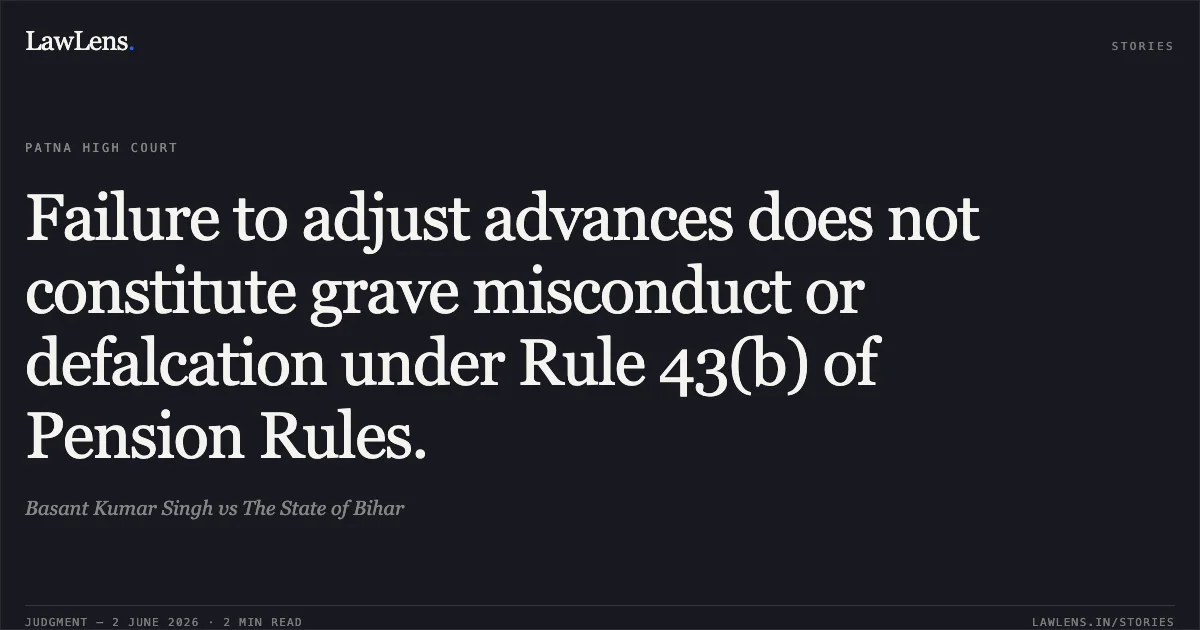
1. Whether the failure to adjust government advances amounts to "grave misconduct" or "defalcation" under Rule 43(b) of the Bihar Pension Rules.
Source reference: para. 12 / para. 182. Whether the Disciplinary Authority was legally justified in forfeiting 100% of the petitioner’s pension when the recovery of the unadjusted amount was already secured through his gratuity.
Source reference: para. 17 / para. 20Law Applied
Rule 43(b) of the Bihar Pension Rules, which empowers the government to withhold or withdraw pension only if the pensioner is found guilty of "grave misconduct" or caused "pecuniary loss" to the government in a departmental or judicial proceeding.
Source reference: para. 12The principles established in Ganesh Prasad Yadav v. State of Bihar & Ors (2021), which incorporated the Supreme Court’s definitions from Union of India v. J. Ahmed and State of Punjab v. Ram Singh, clarifying that misconduct implies a "wrongful intention" or "unlawful behavior" and specifically excludes mere errors of judgment, negligence, or carelessness.
Source reference: paras. 19-20Reasoning
The court found that the Disciplinary Authority’s conclusion of "defalcation" was factually and legally unsupported. It noted that the Inquiry Officer had categorized the matter as one of "adjustment of accounts" rather than misappropriation, stating that any unadjusted amount should simply be recoverable.
Source reference: para. 18The court reasoned that a "negligence simpliciter" or a delay in adjusting advances does not equate to the forbidden quality of "grave misconduct" required to invoke Rule 43(b).
Source reference: para. 19Furthermore, since the state had already ordered the recovery of the ₹3,89,500 from the petitioner's gratuity, there was no subsisting "pecuniary loss" that could justify the extreme penalty of 100% pension forfeiture. The court held that the Disciplinary Authority failed to distinguish between a failure to settle accounts and "deliberate wickedness" or "malevolence".
Source reference: para. 19-20Holding
The court answered both issues in the negative. It held that the unadjusted amount was a case of "pure and simplicitor" accounting adjustment, not grave misconduct or defalcation.
The Court quashed the order dated 13.08.2024 forfeiting the petitioner’s pension. The respondents were directed to pay the petitioner his regular pension and all arrears of pension within four months, granting the writ application with all consequential benefits.
Source reference: paras. 21, 22-23Acts & Sections Cited
1 provisions across 1 statute referred to in this judgment. Linked provisions open on LawLens.
Bihar Journalist Pension Scheme Rules, 20151
Original Court PDF
Basant Kumar SinghvsThe State of Bihar
Click to open original judgment
Original judgment, available to read, download and summarize on LawLens.in