Facts
The second respondent detained P. Esakkimuthu as a “Goonda” under Section 2(f) of the Tamil Nadu Act 14 of 1982 by order dated 2 April 2026.
Source reference: pp. 1–3He was in custody in Crime No. 79 of 2026, identified as the adverse case, and Crime No. 184 of 2026, identified as the ground case; bail applications in both cases were pending.
Source reference: pp. 1–3The detention order referred to the possibility of bail in the ground case but did not address bail in the adverse case.
Source reference: pp. 1–3The detenu challenged the order by a habeas corpus petition under Article 226 of the Constitution.
Source reference: pp. 1–3Issues
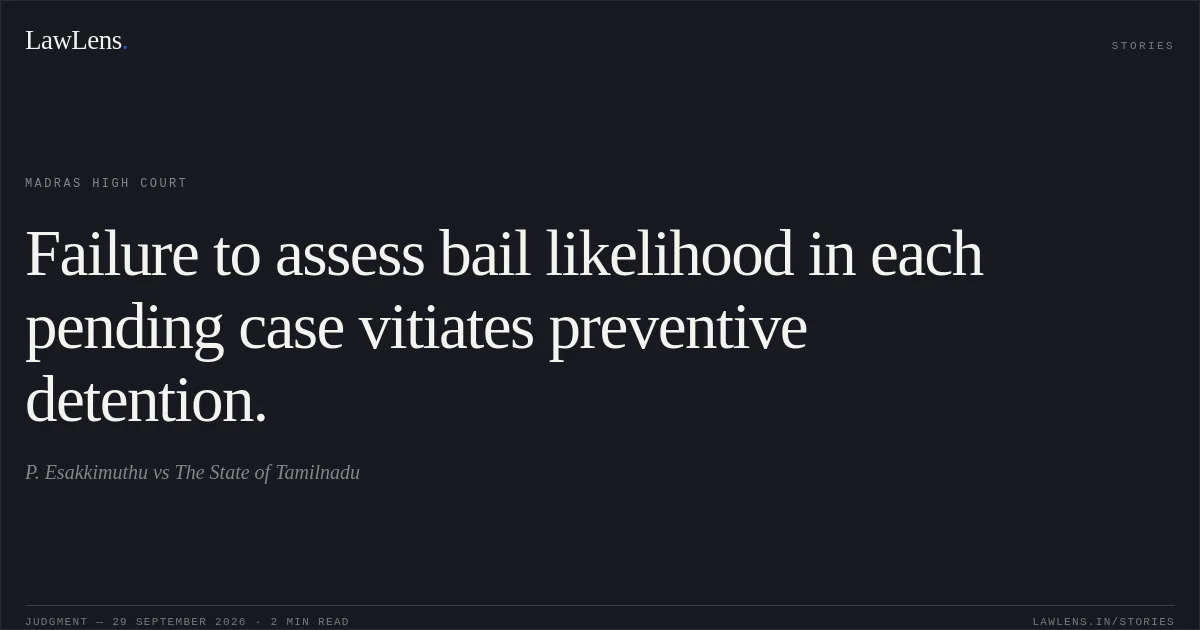
1. Whether the detaining authority’s failure to consider the possibility of the detenu’s release on bail in the adverse case, while bail applications in both cases were pending, showed non-application of mind and vitiated the detention order.
Source reference: pp. 2–32. Whether the authority had cogent material to support its satisfaction that the detenu was likely to be released on bail.
Source reference: p. 3Law Applied
Section 2(f) of the Tamil Nadu Act 14 of 1982 provides the statutory basis for classifying a person as a “Goonda”; Article 226 empowers the High Court to review the legality of detention.
Source reference: pp. 3–9A person already in custody may be preventively detained where the authority is aware of the custody, has reliable material supporting a real possibility of release on bail and has reason to believe that, upon release, the person would likely engage in prejudicial activities.
Source reference: pp. 3–9A conclusion about likely release on bail must rest on cogent material; a bare assertion, without relevant particulars or a demonstrated basis for predicting release, is insufficient.
Source reference: pp. 3–9The Court relied on Alagu v. State of Tamil Nadu, 2026 SCC OnLine SC 976, which discusses the principles in Rekha v. State of Tamil Nadu, Huidrom Konungjao Singh, Rajesh Gulati and Union of India v. Paul Manickam.
Source reference: pp. 3–9Reasoning
The detaining authority addressed only the likelihood of bail in the ground case, although the detenu was also in custody in the adverse case and had a pending bail application there. The omission left the authority’s assessment incomplete.
Source reference: pp. 2–3, 9Further, the order did not disclose facts showing why release on bail in the adverse case was reasonably likely or identify material supporting that conclusion.
Source reference: pp. 2–3, 9Applying the cited principles, the Court held that the satisfaction was unsupported by cogent material and amounted to non-application of mind.
Source reference: pp. 2–3, 9Holding
The Court allowed the habeas corpus petition and set aside the detention order dated 2 April 2026 in Cr.M.P. No. 07/2026.
It directed that the detenu be released forthwith unless his detention was required in connection with another case.
Source reference: p. 10Acts & Sections Cited
1 provisions across 1 statute referred to in this judgment. Linked provisions open on LawLens.
Tamil Nadu Prevention of Dangerous Activities of Bootleggers, Cyber law offenders, Drug offenders, Forest-offenders, Goondas, Immoral Traffic Offenders, Sand offenders, Sexual-offenders, Slum-grabbers and Video Pirates Act, 19821
Original Court PDF
P. EsakkimuthuvsThe State of Tamilnadu
Click to open original judgment
Original judgment, available to read, download and summarize on LawLens.in