Facts
The petitioner, a former Member of the Odisha Legislative Assembly, sought regular bail under Section 483 of the Bharatiya Nagarik Suraksha Sanhita, 2023 (“BNSS”) in Baidyanathpur P.S. Case No. 518 of 2025, relating to the murder of a sitting member of the Odisha State Bar Council.
Source reference: paras. 2–5; pp. 3–6The prosecution alleged that two motorcycle-borne assailants shot the deceased on 6 October 2025 and that the petitioner was involved in a larger conspiracy to procure contract killers through intermediaries and co-accused persons.
Source reference: paras. 2–5; pp. 3–6The petitioner was arrested on 22 October 2025 and remained in judicial custody thereafter.
Source reference: para. 5; p. 6The arrest memo contained, in the grounds-of-arrest column, only the expression “In the strength of above noted case.”
Source reference: para. 6; p. 7The Magistrate rejected his application challenging the legality of the arrest, and the Sessions Court subsequently rejected his bail application.
Source reference: paras. 8–12, 53–57; pp. 7–13, 64–69A charge-sheet and supplementary charge-sheet were filed, alleging the petitioner’s involvement as a conspirator on the basis of circumstantial evidence, co-accused statements, call records, alleged motive and other digital materials.
Source reference: paras. 39–40, 58–60; pp. 37–38, 69–73Issues
Whether the petitioner’s arrest was vitiated by failure to communicate the grounds of arrest effectively and in writing, as required by Article 22(1) of the Constitution and Sections 47, 48 and 62 of the BNSS?
Source reference: paras. 35–38, 53–57; pp. 32–37, 64–69Whether oral communication of the grounds of arrest, an alleged communication to the petitioner’s father, or the petitioner’s refusal to sign the arrest memo could establish compliance with the constitutional and statutory requirements?
Source reference: paras. 19–21, 55–57; pp. 18–21, 67–69Whether the petitioner was entitled to release on bail upon establishment of the violation of Article 22(1), notwithstanding the seriousness of the alleged offences and the filing of the charge-sheet?
Source reference: paras. 45, 47, 60–63; pp. 48–54, 71–75Law Applied
The Court applied Article 21 of the Constitution, protecting personal liberty, and Article 22(1), which prohibits detention without informing the arrested person, as soon as may be, of the grounds of arrest.
Source reference: para. 36; pp. 33–35Section 47 of the BNSS requires the arresting officer to communicate the full particulars of the offence or other grounds of arrest; Section 48 requires information regarding the arrest and place of detention to be given to a relative, friend or nominated person; and Section 62 mandates that every arrest be made strictly in accordance with the BNSS or other applicable law.
Source reference: para. 36; pp. 33–34The Odisha Information of Arrested Persons Rules, 2025, framed under Section 48(3) BNSS, require arrest-related information and the grounds of arrest to be recorded and communicated in the prescribed manner.
Source reference: paras. 41–42; pp. 38–41Relying principally on Vihaan Kumar v. State of Haryana, the Court held that communication of the grounds of arrest is mandatory, that the arresting agency bears the burden of proving compliance, that non-compliance vitiates the arrest and remand, and that the filing of a charge-sheet does not cure the constitutional violation.
Source reference: paras. 43–48; pp. 42–53Relying on Mihir Rajesh Shah v. State of Maharashtra, the Court further held that the grounds of arrest must ordinarily be furnished in writing, in a language understood by the arrestee, and, where not supplied immediately, at least two hours before production for remand; breach renders the arrest and subsequent remand illegal.
Source reference: paras. 50–52; pp. 54–64The Court also referred to Harikisan, Lallubhai Jogibhai Patel, Pankaj Bansal, Prabir Purkayastha and Ashish Kakkar on effective and meaningful communication of grounds of arrest.
Source reference: paras. 45–52; pp. 45–64Reasoning
The Court found that the prosecution failed to prove that written grounds of arrest were ever supplied to the petitioner.
Source reference: para. 57; pp. 68–69The arrest memo did not set out the factual basis of the arrest and merely stated, “In the strength of above noted case,” which did not communicate the basic facts or nature of the allegations against him.
Source reference: para. 57; pp. 68–69The Court held that the prosecution could not rely on the petitioner’s alleged refusal to sign the memo, oral explanation in Odia, or alleged communication to his father, because the burden remained on the arresting agency to establish effective compliance with Article 22(1).
Source reference: paras. 46–47, 57, 61–62; pp. 50–53, 68–74The prosecution also produced no contemporaneous document, apart from insufficient case-diary assertions, demonstrating that the grounds had been communicated.
Source reference: paras. 46–47, 57, 61–62; pp. 50–53, 68–74The Court rejected the argument that the requirement of written communication applied only prospectively from Mihir Rajesh Shah, holding that the requirement flowed from the pre-existing constitutional guarantee under Article 22(1) and was not created for the first time by that judgment.
Source reference: para. 52; pp. 60–64Although the allegations against the petitioner were serious, the Court noted that his alleged role was that of a conspirator and that the case against him was substantially circumstantial, involving co-accused statements, motive and communication records.
Source reference: paras. 58–60; pp. 69–73The Court declined to assess the ultimate evidentiary value of those materials at the bail stage, leaving the conspiracy allegations to be tested at trial.
Source reference: paras. 58–60; pp. 69–73Since the constitutional violation vitiated the arrest and remand, the petitioner’s release could not be denied merely because the offences were serious or the charge-sheet had been filed.
Source reference: paras. 45, 47, 63; pp. 48–53, 73–75Holding
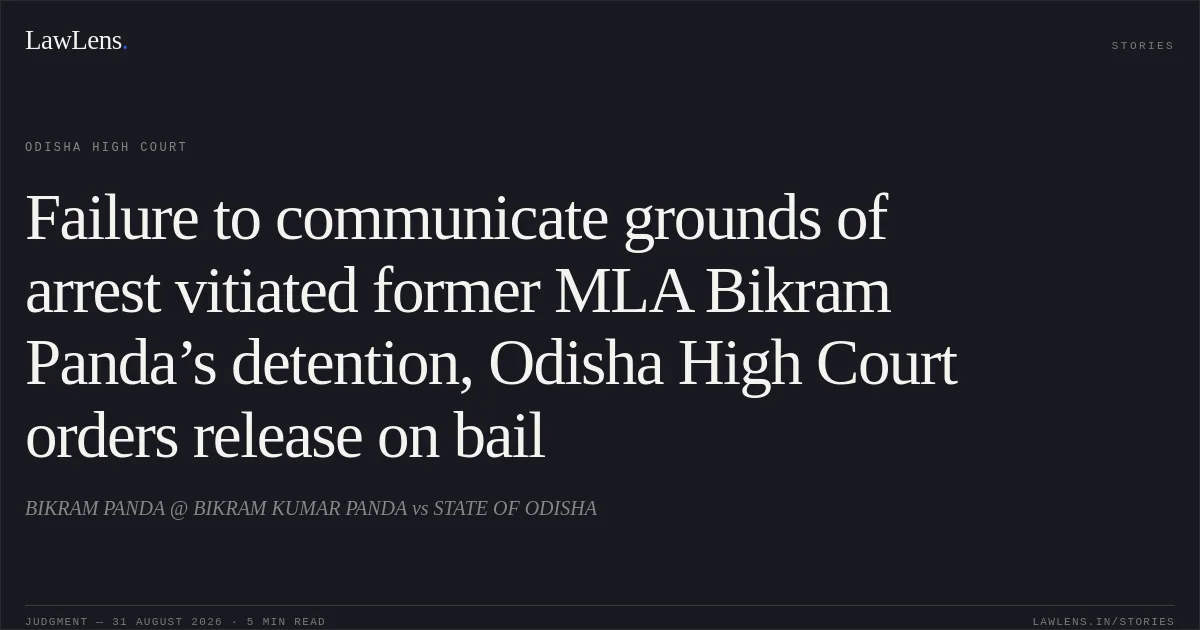
The Court held that the petitioner’s grounds of arrest were not effectively communicated in the manner required by Article 22(1) of the Constitution and Sections 47 and 48 of the BNSS.
Consequently, the arrest and consequential remand were held to be vitiated, and the petitioner was directed to be released forthwith.
Source reference: para. 63(i); p. 74The Court clarified that the finding invalidating the arrest would not affect the merits of the charge-sheet, investigation or pending trial and was confined to the petitioner’s case.
Source reference: para. 63(ii)–(iii); p. 74Release was made subject to furnishing a bail bond under Section 91 BNSS and such conditions as the trial court considered appropriate, including a prohibition against threatening, harassing, terrorising or influencing the informant, the victim’s family or prosecution witnesses.
Source reference: para. 63(iv)–(v); pp. 74–75Breach of the conditions could result in re-arrest in accordance with law.
Source reference: para. 63(iv)–(v); pp. 74–75The Registry was also directed to circulate the judgment to the Odisha Home Department and the Director General of Police for strict implementation of the arrest-related constitutional and statutory safeguards.
Source reference: para. 64; p. 76Acts & Sections Cited
35 provisions across 6 statutes referred to in this judgment. Each provision opens on LawLens.
Bharatiya Nagarik Suraksha Sanhita, 2023
Bharatiya Nyaya Sanhita, 20237
Arms Act, 19593
Code of Criminal Procedure, 19732
Prevention of Money-Laundering Act, 20021
Original Court PDF
BIKRAM PANDA @ BIKRAM KUMAR PANDAvsSTATE OF ODISHA
Click to open original judgment
Original judgment, available to read, download and summarize on LawLens.in