Facts
The applicant was appointed as a Gramin Dak Sevak (GDS) Mail Deliverer on 08.05.2012
Source reference: p. 2In 2016, respondents issued a charge-sheet alleging his matriculation certificate from the Council of Secondary Education, Mohali, was from an unrecognized Board
Source reference: p. 3Following an enquiry, he was discharged on 30.03.2020. Upon revision, the respondents remitted the matter on 11.03.2022 for a de novo enquiry
Source reference: p. 3-4However, without conducting fresh proceedings or examining witnesses, the respondents issued a new order on 28.07.2022 removing the applicant from service
Source reference: p. 4, 11The applicant challenged this fresh removal and a subsequent order dated 29.05.2023 which placed him on "deemed put off duty" retrospecitvely
Source reference: p. 1-2Issues
1. Whether the respondents complied with the legal requirement of conducting a de novo enquiry as per their own remittance order dated 11.03.2022
Source reference: para. 152. Whether an order of removal passed without adhering to the procedural directions of a remand is legally sustainable
Source reference: para. 17-18Law Applied
Rule 10 of the GDS (Conduct and Engagement) Rules, 2011 regarding disciplinary procedures
Source reference: p. 3The Tribunal applied the settled principle of service jurisprudence that an appointment obtained via unrecognized qualifications confers no indefeasible right to service
Source reference: para. 14Crucially, the court applied the procedural principle that when a matter is remanded for a de novo enquiry, the authority is legally bound to initiate proceedings afresh, affording the delinquent employee a full opportunity to defend themselves, including the examination of witnesses and submission of a fresh report
Source reference: para. 16-17Reasoning
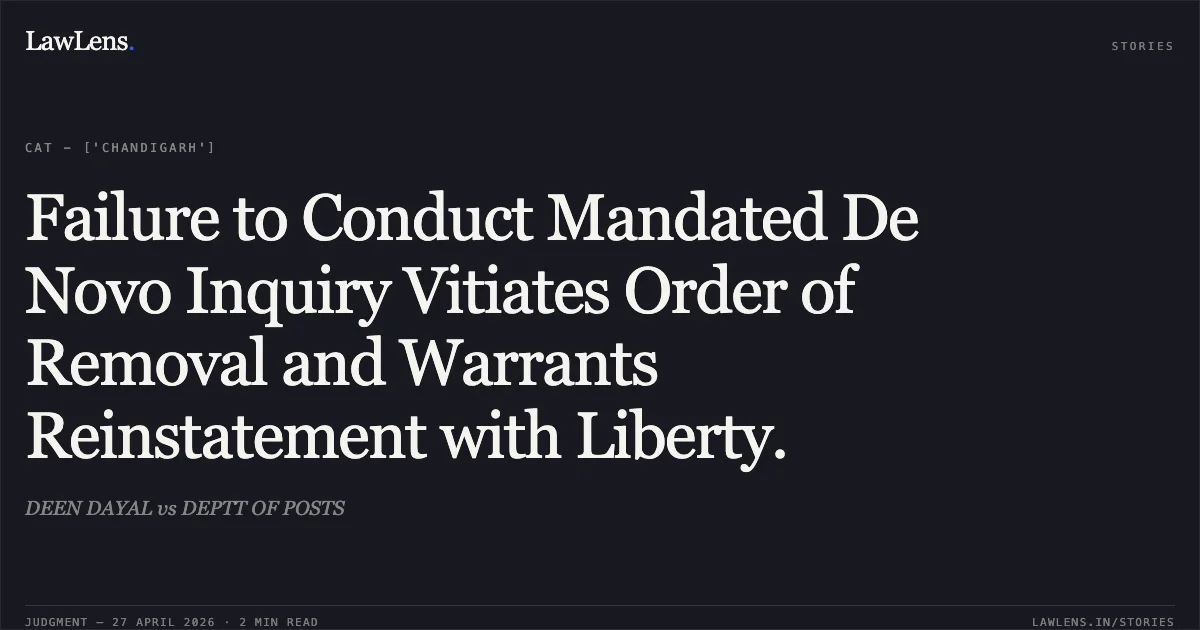
The Tribunal found that while the applicant's initial qualification was indeed invalid and he had admitted to knowing the Board was unrecognized, the respondents committed a fatal procedural error. By remitting the matter for a de novo enquiry on 11.03.2022, the respondents were orignally required to start the process from the beginning
Source reference: para. 13-15Instead, they merely "reconsidered" the existing records and passed the removal order on 28.07.2022 without any fresh evidence or enquiry proceedings
Source reference: para. 16The Tribunal reasoned that "reconsideration" is not equivalent to a de novo enquiry in the eyes of the law; the failure to follow the specific directions of the remand order resulted in a procedural illegality that deprived the applicant of his right to contest the charges
Source reference: para. 17Holding
The Tribunal answered that the respondents failed to conduct a valid de novo enquiry.
Consequently, the impugned order dated 28.07.2022 was set aside. The respondents were directed to reinstate the applicant forthwith. Liberty was granted to the respondents to conduct a fresh de novo enquiry strictly in accordance with law. Pay and allowances for the intervening period were made subject to the outcome of these fresh proceedings
Source reference: para. 19-20Acts & Sections Cited
1 provisions across 1 statute referred to in this judgment. Each provision opens on LawLens.
Administrative Tribunals Act, 19851
Original Court PDF
DEEN DAYALvsDEPTT OF POSTS
Click to open original judgment
Original judgment, available to read, download and summarize on LawLens.in