Facts
On January 24, 2012, three masked individuals allegedly looted ₹1,50,941 from a petrol pump at gunpoint.
Source reference: para. 2The respondents, Ankur and Bhagwan Charan, were tried for robbery and arms possession.
Source reference: para. 1The Trial Court (Additional Sessions Judge, Hata) acquitted the respondents on July 14, 2017, citing a lack of reliable evidence.
Source reference: para. 1The State filed this petition under Section 378(1) of the CrPC seeking leave to appeal against the acquittal, contending that the Trial Court failed to appreciate witness testimony and identification evidence.
Source reference: para. 3Issues
1. Whether the Trial Court committed a perversity or error in law by disregarding the dock identification of the accused by the prosecution witness.
Source reference: para. 52. Whether the findings of acquittal are "palpably wrong" or "manifestly erroneous" so as to warrant interference by the High Court in an appeal against acquittal.
Source reference: para. 6 & 9Law Applied
The Court applied Section 392 read with Section 397 of the IPC (Robbery with attempt to cause death or grievous hurt) and Section 25(1-B)(a) of the Arms Act.
Source reference: para. 1Standards for reversing acquittals established in Ramesh Babulal Doshi v. State of Gujarat (1996), which mandates that acquittal should only be disturbed if findings are "demonstrably unsustainable".
Source reference: para. 6The seven principles from Ajit Savant Majagvai v. State of Karnataka (1997), emphasizing the "double presumption of innocence" for an acquitted accused and the rule that if two reasonable views exist, the one favoring the accused must be adopted.
Source reference: para. 7-8Reasoning
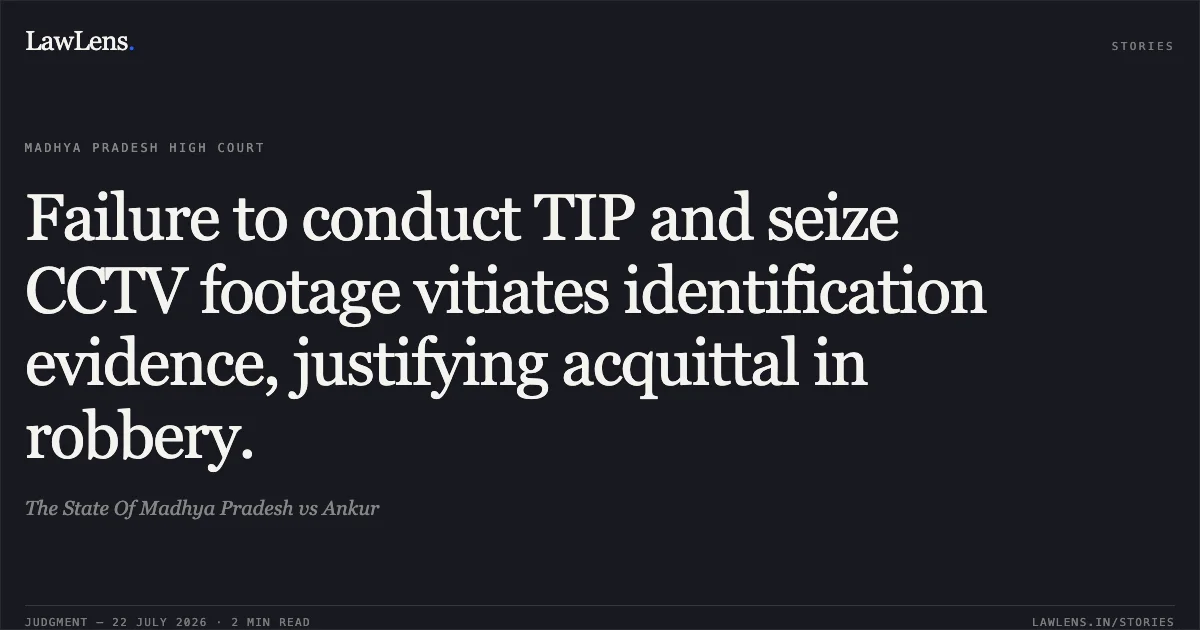
The Court found the prosecution's case structurally weak due to several evidentiary lapses. First, although Vikas (PW-2) identified the accused in court, the Court noted that no Test Identification Parade (TIP) was conducted during the investigation, and the witness admitted he did not know the suspects' names at the time of the incident as they were masked.
Source reference: para. 5Second, the material piece of evidence—CCTV footage—was never seized by the police.
Source reference: para. 5Third, the Court observed that another witness, Rehmat (PW-5), turned hostile, and the testimony of Darbari (PW-6) was deemed unreliable.
Source reference: para. 5Lastly, the prosecution failed to obtain the mandatory sanction from the District Magistrate required under the Arms Act.
Source reference: para. 5Applying the cited precedents, the High Court reasoned that since the Trial Court’s view was a "possible" and "well-reasoned" conclusion based on these omissions, there was no illegality or perversity to justify interference.
Source reference: para. 9Holding
The High Court held that the prosecution failed to prove the charges beyond a reasonable doubt and that the Trial Court rightly granted the benefit of the doubt to the respondents.
The High Court dismissed the petition, upholding the judgment of acquittal.
Source reference: para. 10Acts & Sections Cited
4 provisions across 3 statutes referred to in this judgment. Each provision opens on LawLens.
Code of Criminal Procedure, 19731
Indian Penal Code, 18602
Arms Act, 19591
Original Court PDF
The State Of Madhya PradeshvsAnkur
Click to open original judgment
Original judgment, available to read, download and summarize on LawLens.in