Facts
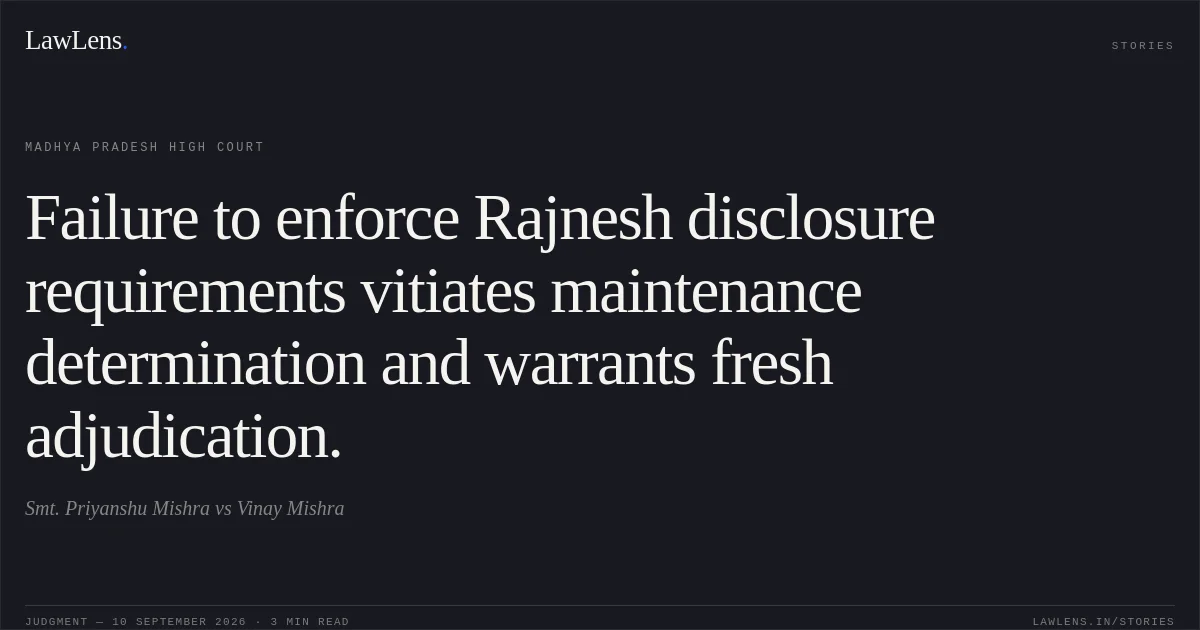
The petitioner-wife challenged the order dated 27.06.2026 passed by the Principal Judge, Family Court, Katni, in MJCR No. 167/2021, whereby her application under Section 125 CrPC was allowed and monthly maintenance of ₹30,000 was awarded from 01.06.2025.
Source reference: p.1The parties were married on 17.06.2019, and the wife had been residing separately from the husband since 16.01.2020. She filed the maintenance application on 06.09.2021.
Source reference: p.1The Family Court assessed the husband’s monthly income at ₹1,50,000 but awarded only ₹30,000 per month.
Source reference: p.1–2The record also showed that she was receiving ₹10,000 per month under proceedings under Section 12 of the Protection of Women from Domestic Violence Act, 2005, and had disclosed the pendency of those proceedings in her affidavit.
Source reference: p.2–3The Family Court had directed the husband to produce his salary slip, and he had undertaken to do so, but failed to produce it.
Source reference: p.7Issues
1. Whether the Family Court erred in determining the maintenance claim without securing the husband’s salary slip or drawing an appropriate adverse inference from his failure to produce it, contrary to the guidelines in Rajnesh v. Neha?
Source reference: paras. 8–12, 18; pp.7–8, 11–122. Whether the award of ₹30,000 per month was legally sustainable when the Family Court had assessed the husband’s monthly income at ₹1,50,000, particularly in light of the principle that approximately one-fourth of the husband’s net salary may ordinarily be considered reasonable maintenance for the wife?
Source reference: para. 19; p.123. Whether maintenance ought to have been awarded from the date of filing of the application under Section 125 CrPC rather than from 01.06.2025?
Source reference: paras. 2, 9, 20; pp.1–2, 5, 12–13Law Applied
The Court applied Section 125 CrPC governing maintenance of a wife unable to maintain herself, read with the Supreme Court’s mandatory disclosure and procedural guidelines in Rajnesh v. Neha, (2021) 2 SCC 324.
Source reference: p.5–8Those guidelines require both parties to file affidavits disclosing assets, income and liabilities, permit the court to direct production of supporting documents, and allow an adverse inference—or, in appropriate cases, striking off the defence—where a party wilfully fails to disclose relevant financial information.
Source reference: p.5–8Rajnesh further directs that maintenance ordinarily be awarded from the date of filing of the maintenance application and that the quantum be determined by considering the parties’ financial circumstances.
Source reference: p.5–6The Court also relied on Kalyan Dey Chowdhury v. Rita Dey Chowdhury, (2017) 14 SCC 200, which states that, ordinarily, 25% or one-fourth of the husband’s net salary may be a reasonable amount of maintenance for the wife, subject to the facts of the case.
Source reference: p.12Reasoning
The High Court found that the husband had failed to produce his salary slip despite a specific direction and undertaking, although that document was material for determining his actual income and financial capacity.
Source reference: p.7Under Rajnesh, the Family Court was required either to secure the document or, upon continued non-compliance, draw an appropriate adverse inference and consider other permissible consequences.
Source reference: paras. 11–13, 18; pp.8, 11–12The Family Court’s failure to do so constituted a material defect in the determination of maintenance.
Source reference: pp.11–12Further, having itself assessed the husband’s monthly income at ₹1,50,000, the Family Court was required to examine the award of ₹30,000 in light of the one-fourth benchmark recognised in Kalyan Dey Chowdhury and provide reasons for departing from it.
Source reference: para. 19; p.12The High Court also observed that the wife’s earlier receipt of ₹10,000 under the DV Act proceedings and her conduct in the proceedings were relevant, but did not justify sustaining an order that failed to properly assess the husband’s income and the appropriate quantum and commencement date of maintenance.
Source reference: paras. 4–7; pp.2–4Holding
The criminal revision was partly allowed.
The High Court set aside the Family Court’s order dated 27.06.2026 and remanded the matter for fresh determination of the wife’s application under Section 125 CrPC.
Source reference: para. 20; pp.12–13The Family Court was directed to reconsider the quantum of maintenance on the basis of the income already assessed at ₹1,50,000 per month, apply the principles in Kalyan Dey Chowdhury, and determine the proper date from which maintenance would be payable.
Source reference: para. 20; p.12–13Until the fresh decision, the husband was directed to continue paying ₹30,000 per month in accordance with the impugned order.
Source reference: para. 21; p.13The revision and pending applications were disposed of accordingly.
Source reference: paras. 22–23; p.13Acts & Sections Cited
7 provisions across 3 statutes referred to in this judgment. Each provision opens on LawLens.
Code of Criminal Procedure, 19732
Protection of Women from Domestic Violence Act, 20051
Indian Penal Code, 18604
Original Court PDF
Smt. Priyanshu MishravsVinay Mishra
Click to open original judgment
Original judgment, available to read, download and summarize on LawLens.in