Facts
Respondent No. 2 initially instituted Original Suit No. 91 of 2019 before the Civil Judge (Senior Division), Rudrapur, for recovery of money against the petitioner. The petitioner entered appearance and filed its written statement in those proceedings. The plaint was subsequently returned under Order VII Rule 10 CPC on 14 September 2023 for presentation before the court having appropriate jurisdiction. The respondent thereafter instituted the suit before the Commercial Court, Haldwani, on 28 May 2024, and after condonation of delay, it was registered as Commercial Suit No. 233 of 2025 on 12 September 2025. Fresh summons were issued, and the petitioner entered appearance through counsel on 16 December 2025
Source reference: para. 3; p. 2–3The petitioner did not file its written statement within 120 days from the date of service/appearance. Instead, on 18 February 2026, it sought summoning of the record of the earlier proceedings, including the written statement allegedly filed before the Civil Court. The Commercial Court rejected that application but granted a final opportunity to file the written statement by 16 March 2026. The petitioner still did not file it by that date and filed the written statement only on 4 May 2026
Source reference: para. 4–5; p. 3–4The plaintiff’s application under Order VIII Rule 10 CPC was rejected by the Commercial Court on 6 July 2026, but the petitioner’s right to file the written statement was forfeited. The petitioner challenged that order under Article 227 of the Constitution, contending that the 120-day period should be calculated from 18 February 2026, when the Commercial Court granted it an opportunity to file the written statement
Source reference: para. 5–6; p. 4–5Issues
Whether the period for filing the written statement commenced from 18 February 2026, when the Commercial Court granted the petitioner an opportunity to file it, rather than from 16 December 2025, when the petitioner entered appearance after service of summons?
Source reference: paras. 6, 8, 11–12; p. 5–7Whether the Commercial Court could accept the written statement filed on 4 May 2026 after expiry of the mandatory 120-day period applicable to commercial suits?
Source reference: paras. 5, 8–13; p. 4–8Whether the Commercial Court’s order dated 6 July 2026, forfeiting the petitioner’s right to file the written statement, warranted interference under Article 227 of the Constitution?
Source reference: paras. 5, 13–14; p. 4, 8Law Applied
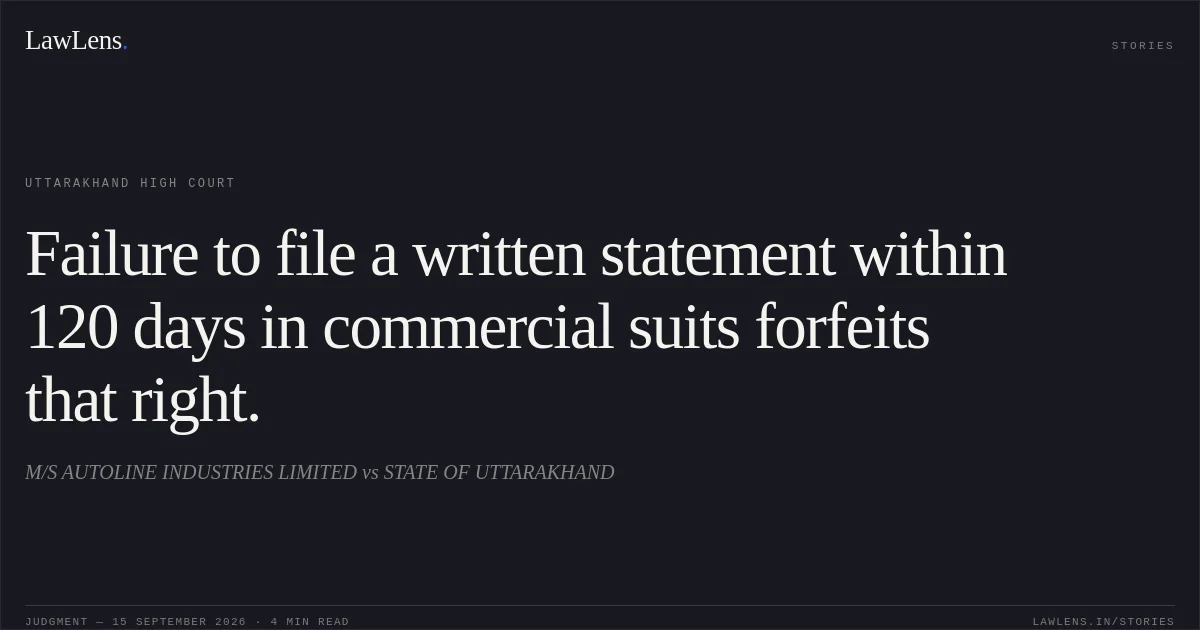
The Court applied Section 16(1) of the Commercial Courts Act, 2015, read with the amended proviso to Order VIII Rule 1 CPC, under which a defendant in a commercial suit must file the written statement within 30 days of service of summons, with a maximum permissible period of 120 days; after expiry of 120 days, the defendant forfeits the right to file the written statement and the court has no power to take it on record.
Source reference: paras. 9–10, 12; p. 6–7The Court also relied on the proviso to Order VIII Rule 10 CPC, which prevents extension of time beyond the prescribed 120-day period.
Source reference: paras. 9–10, 12; p. 6–7These provisions were interpreted in SCG Contracts (India) Pvt. Ltd. v. K.S. Chamankar Infrastructure Pvt. Ltd., (2019) 12 SCC 210, where the Supreme Court held that the 120-day limit is mandatory in commercial suits and distinguished the more flexible principles stated in Kailash v. Nanhku, (2005) 4 SCC 480 and Salem Advocate Bar Association (II) v. Union of India, (2005) 6 SCC 344
Source reference: paras. 9–10, 12; p. 6–7Reasoning
The Court held that the relevant date was 16 December 2025, when the petitioner appeared through counsel after receiving fresh summons in the Commercial Court proceedings. The petitioner’s prior appearance and written statement in the original civil proceedings did not dispense with the requirement of filing a written statement in the newly instituted commercial suit after the plaint had been returned under Order VII Rule 10 CPC. Accordingly, the 120-day period had to be calculated from 16 December 2025, and not from 18 February 2026
Source reference: para. 8; p. 5–6The petitioner had chosen to seek summoning of the earlier record instead of filing its written statement within time, and that procedural choice could not reset or suspend the statutory period
Source reference: para. 11; p. 7Even the additional opportunity granted by the Commercial Court until 16 March 2026 could not legally extend the mandatory statutory period, and the written statement filed on 4 May 2026 was plainly beyond the permissible period
Source reference: paras. 8, 12; p. 5–7Applying SCG Contracts, the Court found that the Commercial Court correctly forfeited the petitioner’s right to file the written statement. No jurisdictional or apparent error justified interference under Article 227
Source reference: para. 13; p. 8Holding
The Court answered the issues against the petitioner. It held that the 120-day period commenced from 16 December 2025, the date on which the petitioner entered appearance after service of fresh summons in the commercial suit.
The written statement filed on 4 May 2026 was therefore barred, and the petitioner’s right to file it stood forfeited.
Source reference: paras. 12–14; p. 7–8Finding no error in the Commercial Court’s order dated 6 July 2026, the High Court dismissed the writ petition under Article 227 of the Constitution
Source reference: paras. 12–14; p. 7–8Acts & Sections Cited
1 provisions across 1 statute referred to in this judgment. Each provision opens on LawLens.
Commercial Courts Act, 20151
Original Court PDF
M/S AUTOLINE INDUSTRIES LIMITEDvsSTATE OF UTTARAKHAND
Click to open original judgment
Original judgment, available to read, download and summarize on LawLens.in