Facts
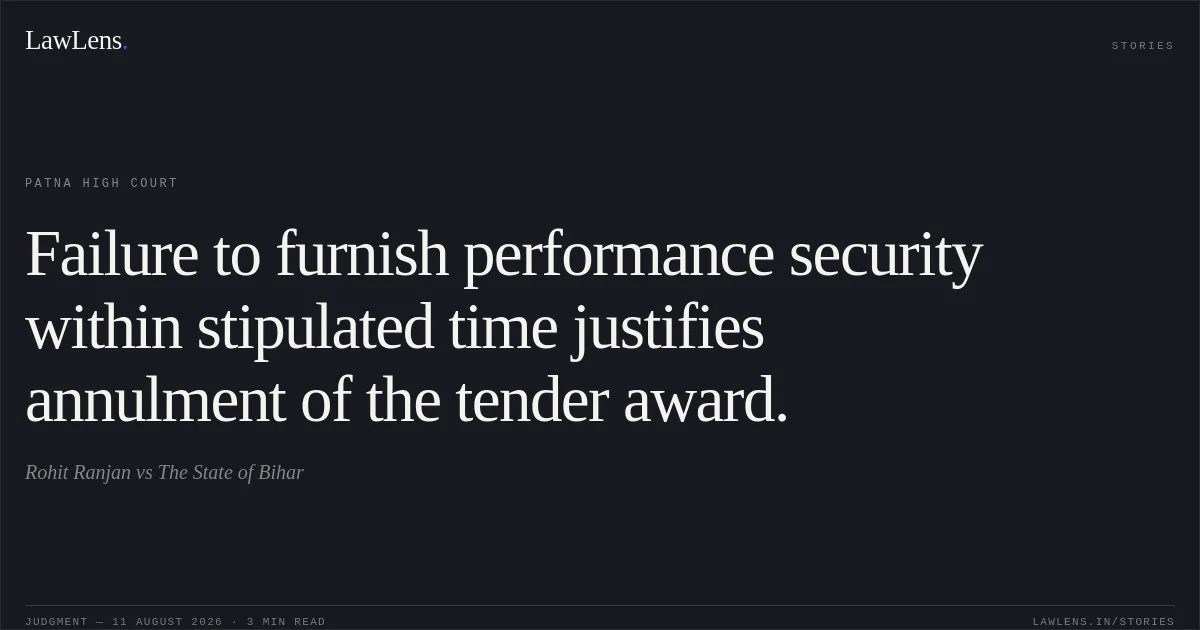
The petitioner participated in NIT No. RWD/MMGSY (AWSESH-SC)/HQ/ET/2025-26/25 dated 4 October 2025 for Package No. MMGSY (AWSESH-SC) Harnaut-883, Tender ID-145414. He was declared technically qualified, emerged as the L-1 bidder, and was issued a Letter of Acceptance dated 14 January 2026 requiring submission of the prescribed performance security within the stipulated period.
Source reference: p.3, para. 3The petitioner failed to furnish the bank guarantee within time, attributing the delay to his illness from typhoid. After recovery, he submitted the bank guarantee on 22 February 2026 along with medical documents, allegedly accepted by the authorities.
Source reference: p.3, para. 4Before execution of the agreement, the Chief Engineer-I cancelled the work allotment/Letter of Acceptance by Memo No. 30 dated 14 March 2026, relying upon the petitioner’s failure to furnish the performance security and execute the agreement within the prescribed period.
Source reference: p.4, para. 6During the proceedings, the respondents disclosed that the tender itself had subsequently been cancelled by Office Order No. 03 dated 30 April 2026 under Clause 33 of the NIT.
Source reference: p.5, para. 7; p.6, para. 16Issues
Whether the respondents were justified in cancelling the petitioner’s Letter of Acceptance/work allotment for failure to furnish the requisite performance security within the stipulated period, despite its subsequent submission?
Source reference: p.6, para. 9Whether the petitioner was entitled to a writ directing the respondents to permit execution of the agreement and commencement of work after the tender itself had been cancelled?
Source reference: p.6, paras. 7–9; p.8, para. 12Whether the cancellation order was arbitrary, violative of natural justice, or otherwise amenable to interference under Article 226 of the Constitution?
Source reference: p.4, para. 5; p.8, paras. 11–13Law Applied
The Court applied Clause 34.2 of the Conditions of the Model Bidding Document, under which failure by the successful bidder to submit the performance security or sign the contract constitutes sufficient ground for annulment of the award and forfeiture of the bid security.
Source reference: p.5, para. 6; p.6, para. 15It further applied Clause 33 of the NIT, reserving the Engineer-in-Chief’s power to accept or reject any bid and cancel the bidding process before award of the contract without assigning reasons.
Source reference: p.6, paras. 8 and 17Relying on Central Coalfields Ltd. v. SLL-SML (Joint Venture Consortium), (2016) 8 SCC 622, and the principles stated in Tata Cellular v. Union of India, (1994) 6 SCC 651, the Court held that tender conditions must ordinarily be enforced as framed and that judicial review in contractual tender matters is limited to arbitrariness, irrationality, mala fides, bias, or favouritism.
Source reference: p.7–8, para. 11The Court also recognised that subsequent compliance cannot retrospectively cure an admitted failure to satisfy a mandatory tender condition within the prescribed time.
Source reference: p.8–9, para. 13Reasoning
The Court found that the petitioner admittedly failed to submit the performance security within the time stipulated in the Letter of Acceptance, irrespective of whether the delay was caused by illness.
Source reference: p.7, para. 10Clause 34.2 expressly authorised annulment of the award for such failure; therefore, the subsequent submission of the bank guarantee could not extinguish the petitioner’s accrued default or compel the authorities to accept delayed compliance.
Source reference: p.7–9, paras. 10–13The Court declined to rewrite or dilute the tender conditions and found no material demonstrating arbitrariness, mala fides, bias, or favouritism in the cancellation decision.
Source reference: p.7–8, paras. 11 and 13Further, because the tender process itself had been cancelled under Clause 33, no enforceable right survived in favour of the petitioner merely because he had earlier been declared L-1 or issued a Letter of Acceptance.
Source reference: p.8, para. 12Holding
The Court answered the framed issue against the petitioner and upheld the respondents’ decision to cancel the work allotment/Letter of Acceptance for failure to furnish the performance security within the prescribed period.
It also held that the subsequent cancellation of the tender eliminated any enforceable basis for directing execution of the agreement or commencement of the work.
Source reference: p.8, para. 12The writ petition was accordingly dismissed, and any pending interlocutory applications were disposed of.
Source reference: p.9, paras. 15–16Original Court PDF
Rohit RanjanvsThe State of Bihar
Click to open original judgment
Original judgment, available to read, download and summarize on LawLens.in