Facts
Land measuring 209.80 hectares at Village Kalothra, Tehsil Karera, District Shivpuri, was acquired for a public purpose under the Land Acquisition Act, 1894.
Source reference: no citationThe Land Acquisition Officer passed the original award under Section 11 on 30 March 1996.
Source reference: no citationCertain landholders sought references under Section 18, pursuant to which compensation was enhanced.
Source reference: no citationThe respondent thereafter applied under Section 28-A for re-determination of compensation.
Source reference: no citationFollowing directions issued by the High Court in W.P. No. 2706/2019, the Sub-Divisional Officer and Land Acquisition Officer, Karera, decided the application by order dated 31 January 2020.
Source reference: para. 2The Union of India challenged that order under Article 226, principally alleging denial of adequate hearing, failure to consider objections, and non-application of mind on the question of limitation under Section 28-A.
Source reference: para. 3The Court also allowed an application for deletion of respondent No. 10.
Source reference: no citationIssues
1. Whether the order dated 31 January 2020 passed under Section 28-A of the Land Acquisition Act, 1894, was vitiated by failure to adequately consider the petitioners’ objections, particularly regarding limitation and other jurisdictional issues.
Source reference: paras. 6–72. Whether the impugned order was a reasoned and speaking order consistent with the principles of natural justice.
Source reference: paras. 7–83. Whether the High Court should itself decide the merits of the Section 28-A application or remand the matter for fresh consideration.
Source reference: paras. 9–12Law Applied
The Court applied Article 226 of the Constitution, under which judicial review is available where a statutory or quasi-judicial authority acts illegally, arbitrarily, without jurisdiction, or in breach of natural justice.
Source reference: no citationSection 28-A of the Land Acquisition Act, 1894, permits re-determination of compensation for landholders whose land was acquired under the same notification where compensation has been enhanced by a Reference Court; the limitation requirement under that provision is jurisdictional and must receive proper consideration.
Source reference: para. 6A quasi-judicial authority exercising statutory power and affecting valuable rights must pass a reasoned and speaking order dealing with all material objections; recording reasons is an essential component of natural justice, transparency, and fairness.
Source reference: paras. 7–8The Court also followed the approach adopted in the similar matter reproduced in the judgment, namely that disputed factual and statutory issues under Section 28-A should ordinarily be reconsidered by the competent authority rather than determined for the first time in writ jurisdiction.
Source reference: para. 3Reasoning
The Court found that, although the Land Acquisition Officer recorded conclusions on the Section 28-A application, the order did not comprehensively address the petitioners’ objections concerning limitation and other jurisdictional questions.
Source reference: para. 7It also failed to disclose adequate reasons or demonstrate proper application of mind to the material issues requiring determination.
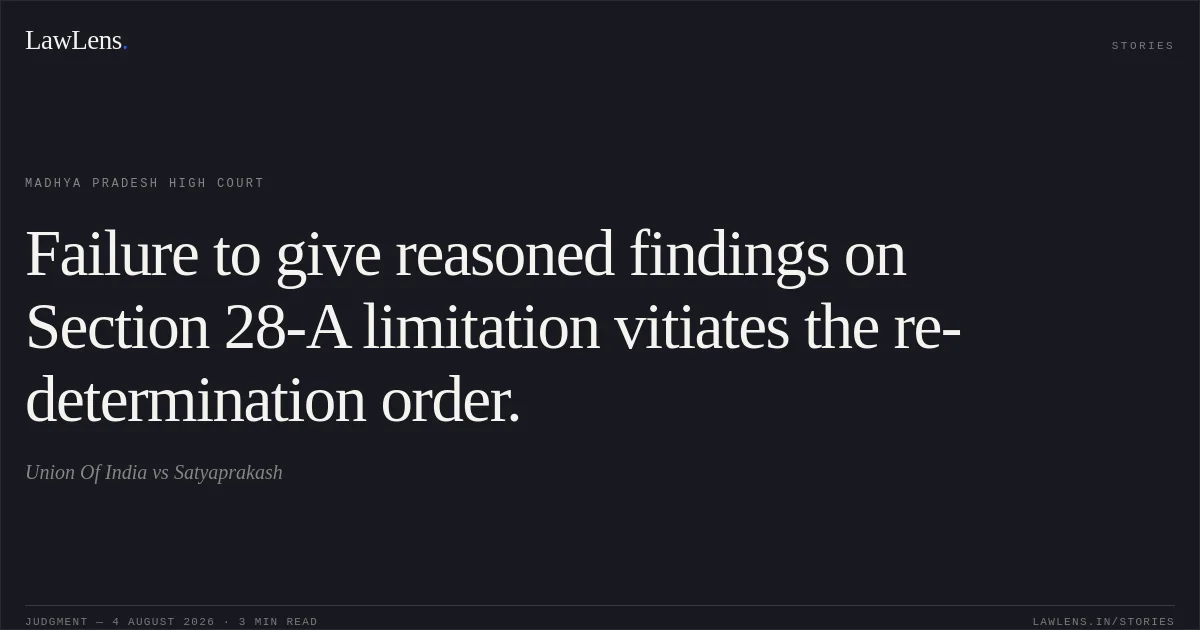
Source reference: para. 7Since limitation under Section 28-A goes to the authority’s jurisdiction, the failure to provide an independent and reasoned determination materially impaired the validity of the decision.
Source reference: no citationThe defect could not be cured by the existence of conclusions unsupported by adequate reasoning.
Source reference: no citationHowever, because the controversy involved factual determination and application of statutory provisions, the High Court declined to decide the merits itself and considered remand to be the appropriate relief.
Source reference: para. 9Holding
The High Court allowed the writ petition to the limited extent of setting aside the order dated 31 January 2020 passed by the Sub-Divisional Officer and Land Acquisition Officer, Karera.
The matter was remanded for fresh consideration of the respondent’s Section 28-A application.
Source reference: no citationThe competent authority was directed to provide all concerned parties an effective hearing, permit them to submit relevant material, and pass a detailed, reasoned, and speaking order dealing specifically with all objections, including limitation, in accordance with law.
Source reference: paras. 10–11The exercise was to be completed expeditiously, preferably within three months of receipt of the certified copy of the order.
Source reference: no citationThe Court expressly left all questions of fact and law open and clarified that it had not expressed any opinion on the merits.
Source reference: paras. 11–12Acts & Sections Cited
7 provisions across 1 statute referred to in this judgment. Linked provisions open on LawLens.
Land Acquisition Act, 18947
Original Court PDF
Union Of IndiavsSatyaprakash
Click to open original judgment
Original judgment, available to read, download and summarize on LawLens.in