Facts
The petitioner, wife of the detenu Raju Kale, challenged the detention order dated 3 July 2026 issued by the Inspector General of Police, Northern Range, Belagavi, under Section 3(1) of the Prevention of Illicit Traffic in Narcotic Drugs and Psychotropic Substances Act, 1988 (“PIT-NDPS Act”).
Source reference: para. 1The detention was based principally on three NDPS cases: Crime No. 44/2022, in which the detenu had been convicted and fined; Crime No. 79/2024, involving alleged possession of 3.171 kilograms of ganja, in which he had been granted regular bail and the trial was pending; and Crime No. 57/2026, in which his wife was allegedly found selling ganja and allegedly stated that it had been supplied by the detenu.
Source reference: paras. 3, 16–17The detenu had submitted representations to the Detaining Authority, the State Government and the Advisory Board, but the detention materials did not inform him of his separate right to represent to the Central Government under Section 12 of the PIT-NDPS Act.
Source reference: paras. 3–4, 10Issues
Whether failure to inform the detenu of his right to make a representation to the Central Government for revocation or modification of the detention order violated Article 22(5) of the Constitution and vitiated the detention.
Source reference: paras. 7–12, 25Whether subsequent consideration or reference of the detention case to the Advisory Board could cure the failure to communicate the detenu’s right of representation to the Central Government.
Source reference: para. 12Whether preventive detention could validly be used when the detenu had been granted regular bail under Section 37 of the NDPS Act, the bail had not been cancelled, and the prosecution had not initiated proceedings alleging breach of bail conditions.
Source reference: paras. 13–15, 18–26Whether the Detaining Authority’s subjective satisfaction was vitiated by reliance on stale or concluded criminal proceedings, an unproven allegation of bail violation, and Crime No. 57/2026 in which the detenu was not shown as an accused.
Source reference: paras. 16–24Law Applied
The Court applied Section 3(1) of the PIT-NDPS Act, which empowers the competent authority to order preventive detention to prevent illicit traffic in narcotic drugs, and Section 12(1), which independently empowers both the State and Central Governments to revoke or modify a detention order, including one made by a State-authorised officer.
Source reference: paras. 7–8Article 22(5) of the Constitution requires the detaining authority not only to communicate the grounds of detention but also to afford the detenu the earliest effective opportunity of making a representation to every competent authority capable of granting relief.
Source reference: paras. 9–11Relying on Kamleshkumar Ishwardas Patel v. Union of India, (1995) 4 SCC 51, Alfiya A. v. State of Kerala, and Amreen v. Commissioner of Police, 2025 SCC OnLine Kar 20389, the Court held that failure to inform the detenu of the right to represent to the Detaining Authority, State Government or Central Government, as applicable, violates Article 22(5).
Source reference: paras. 9–11The Court further relied on Sushanta Kumar Banik v. State of Tripura, 2022 SCC OnLine SC 1333, Roshini Devi v. State of Telangana, (2026) 7 SCC 302, and related authorities for the rule that preventive detention cannot be used as a substitute for cancellation of bail or as a means of circumventing ordinary criminal procedure.
Source reference: paras. 20–24Reasoning
The detention order informed the detenu that he could represent to the Detaining Authority, the State Government and the Advisory Board, but omitted his distinct statutory right to approach the Central Government under Section 12(1)(b) for revocation or modification of an order made by a State-authorised officer.
Source reference: paras. 10–12, 16.1The Court held that the existence of the right was insufficient; the detenu had to be expressly informed of it so that he could exercise the earliest effective opportunity guaranteed by Article 22(5).
Source reference: paras. 10–12Subsequent reference to, or consideration by, the Advisory Board could not substitute for this separate constitutional safeguard.
Source reference: para. 12Independently, the Court found the preventive detention substantively infirm. The detenu’s regular bail in Crime No. 79/2024 had not been cancelled, and the prosecution had not moved the competent criminal court alleging breach of bail conditions.
Source reference: paras. 18–19, 22–24The Detaining Authority’s assertion that the detenu had violated bail conditions was therefore unsupported by corresponding legal action.
Source reference: paras. 18–19, 22–24Since the bail order had been granted in the context of Section 37 of the NDPS Act, it could not be disregarded through a bare executive apprehension that the detenu might reoffend.
Source reference: paras. 20–22Crime No. 44/2022 was concluded by conviction and fine, while Crime No. 57/2026 involved the detenu’s wife as the alleged seller, with the detenu’s involvement still under investigation and awaiting an FSL report.
Source reference: paras. 16–17The Court consequently held that preventive detention had been deployed as a parallel mechanism to neutralise the effect of bail rather than on the basis of a sufficiently demonstrated and proximate preventive necessity.
Source reference: paras. 24–26Holding
The Court answered the issues in favour of the petitioner.
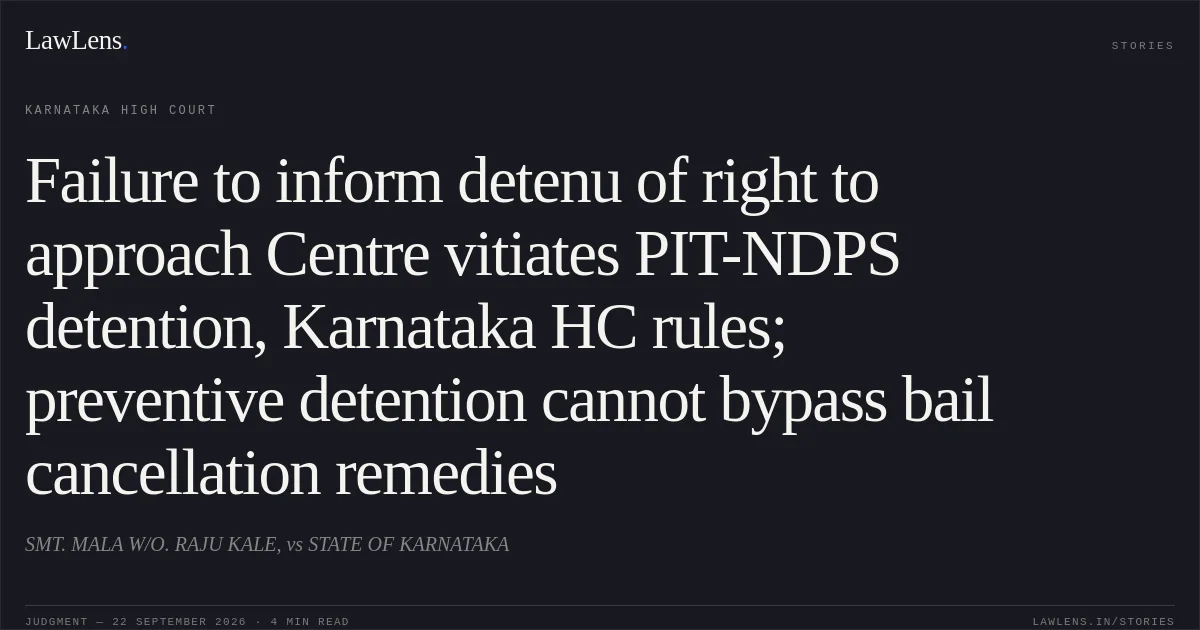
It held that non-communication of the detenu’s right to represent to the Central Government violated Article 22(5) and rendered the detention constitutionally unsustainable; the subsequent Advisory Board process did not cure that defect.
Source reference: paras. 12, 25It further held that preventive detention could not be used as a substitute for seeking cancellation of bail, particularly where the bail order remained operative and no breach had been established before the competent criminal court.
Source reference: paras. 18–26The writ petition was allowed; detention order No. Crime/Misc/64/NR/2026 dated 3 July 2026 was quashed; and the Superintendent of Central Prison, Hindalga, was directed to release Raju Kale forthwith, unless his custody was required in any other case.
Source reference: final order, clauses (i)–(iii)Acts & Sections Cited
12 provisions across 7 statutes referred to in this judgment. Each provision opens on LawLens.
Prevention of Illicit Traffic in Narcotic Drugs and Psychotropic Substances Act, 19883
Narcotic Drugs and Psychotropic Substances Act, 19854
General Clauses Act, 18971
Conservation of Foreign Exchange and Prevention of Smuggling Activities Act, 19741
National Security Act, 19801
Bharatiya Nagarik Suraksha Sanhita, 20231
Code of Criminal Procedure, 19731
Original Court PDF
SMT. MALA W/O. RAJU KALE,vsSTATE OF KARNATAKA
Click to open original judgment
Original judgment, available to read, download and summarize on LawLens.in