Facts
The appellants were convicted by the Sessions Judge, Banda, for offences under Sections 302 and 307 IPC, on the prosecution case that Ram Milan shot Phallu dead and Badri Prasad fired shots that injured four others during a village dispute
Source reference: para. 2–4The prosecution relied principally on the accounts of the deceased’s father, another eyewitness, and a constable; the incident was alleged to have occurred in the presence of police personnel
Source reference: para. 6, 9The FIR was lodged at 10:00 p.m., although the incident was alleged to have taken place at about 10:30 a.m.
Source reference: para. 22The prosecution did not examine the other police personnel said to have witnessed the incident, the injured persons, or Shiv Sagar, and no ballistic expert was examined. The appellants appealed against their convictions.
Source reference: para. 23, 28–30Issues
1. Whether the prosecution evidence proved the appellants’ guilt beyond reasonable doubt, given the delay in lodging the FIR and the alleged occurrence in the presence of police personnel who were not examined.
Source reference: para. 222. Whether the non-examination of material witnesses and the failure to obtain or present ballistic evidence undermined the prosecution case in the circumstances.
Source reference: para. 23–30Law Applied
Sections 302, 307 and 34 IPC governed the charged offences.
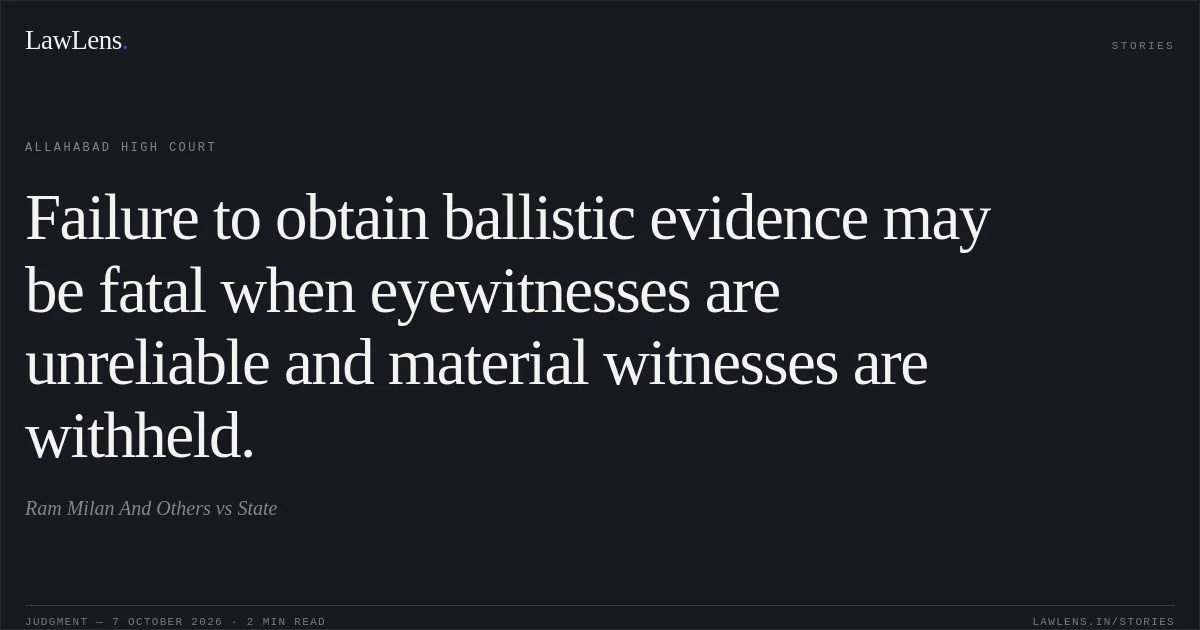
Source reference: para. 2Under Gurucharan Singh v. State of Punjab, AIR 1963 SC 340, ballistic evidence is not invariably required; whether its absence matters depends on the circumstances, including the quality of the direct evidence and its consistency with the medical evidence.
Source reference: para. 24Sukhwant Singh v. State of Punjab, (1995) 3 SCC 367, recognises that failure to produce ballistic opinion may seriously affect the prosecution case where it could link recovered firearms or cartridges to the crime.
Source reference: para. 25Conversely, under State of Punjab v. Jugraj Singh, (2002) 3 SCC 234, non-examination of an expert does not impair otherwise convincing eyewitness evidence.
Source reference: para. 26–27Under Takhaji Hiraji v. Thakore Kubersing Chamansing, (2001) 6 SCC 145, withholding an available material witness may justify an adverse inference where that witness could explain the genesis of the incident or fill a material gap in the prosecution case.
Source reference: para. 29Reasoning
The Court held that the prosecution evidence did not have the strength needed to render the absence of ballistic evidence immaterial.
Source reference: para. 23–29The ten-hour delay in lodging the FIR, despite the alleged presence of police at the occurrence, raised serious doubts about the prosecution’s account; the Court also regarded the allegation that Ram Milan first went to the outpost and then returned with police to shoot Phallu as suspicious.
Source reference: para. 22The police personnel said to have witnessed the shooting, along with Shiv Sagar and the four injured persons, were not examined.
Source reference: para. 22, 30Given these weaknesses, the eyewitness evidence did not inspire sufficient confidence, and the lack of ballistic opinion further impaired the prosecution case.
Source reference: para. 23, 27–29Holding
The Court answered the issues in favour of the appellants, extended the benefit of doubt, and acquitted both appellants of all charges.
It set aside the trial court’s judgment and allowed the appeal; as the appellants were on bail, their bail bonds were cancelled and their sureties discharged, and they were not required to surrender.
Source reference: para. 32–34Acts & Sections Cited
4 provisions across 2 statutes referred to in this judgment. Each provision opens on LawLens.
Indian Penal Code, 18603
Code of Criminal Procedure, 19731
Original Court PDF
Ram Milan And OthersvsState
Click to open original judgment
Original judgment, available to read, download and summarize on LawLens.in