Facts
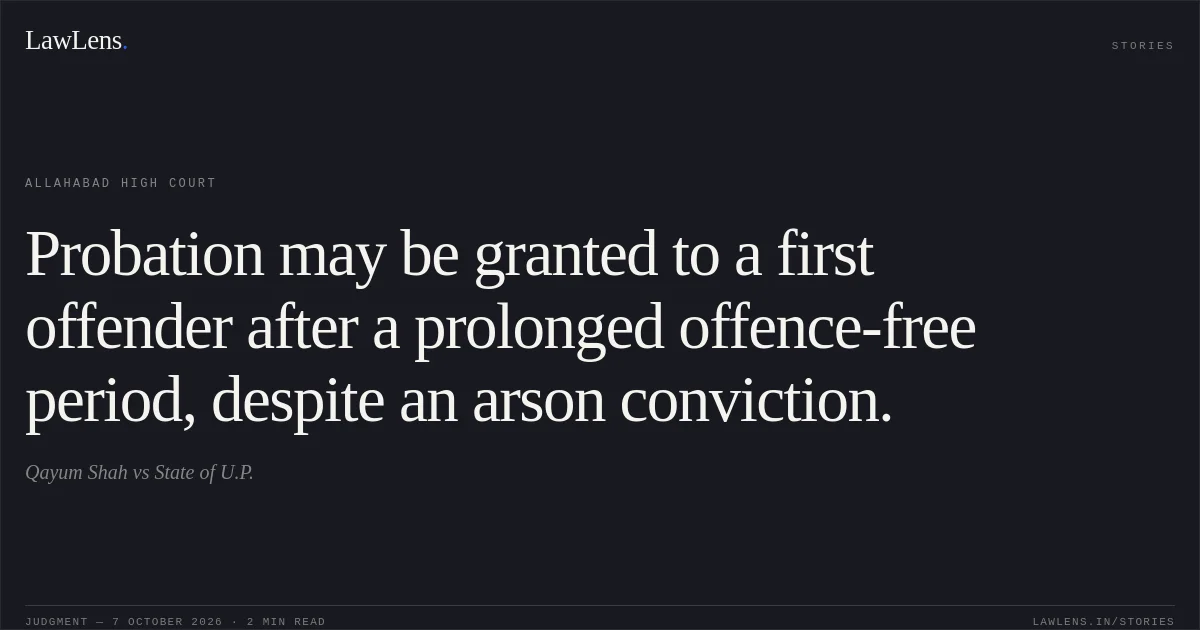
The appellant was convicted under Section 436 IPC for setting fire to the complainant’s thatched roof, destroying stored grain, household items and cash.
Source reference: para. 4–8The trial court sentenced him to four years’ rigorous imprisonment and a fine of ₹5,000; it acquitted him of charges under Sections 504 and 506 IPC.
Source reference: para. 4–8On appeal, the appellant did not challenge the conviction and sought only the benefit of Section 4 of the Probation of Offenders Act, 1958.
Source reference: para. 3The probation officer reported that the appellant was a labourer with family responsibilities and that the inquiry had disclosed no adverse facts.
Source reference: para. 9, 14The appellant was stated to be a first offender, and no other criminal involvement was identified.
Source reference: para. 9, 14Issues
Whether the appellant, whose conviction under Section 436 IPC was not challenged, should be granted release under Section 4 of the Probation of Offenders Act, 1958.
Source reference: para. 3, 10, 14–15Whether, given the time elapsed since the offence and the absence of any reported subsequent offence, the appellant should be placed on probation for a further period.
Source reference: para. 16–17Law Applied
Section 4 of the Probation of Offenders Act, 1958 permits a court to release an offender on a bond to keep the peace and be of good behaviour, instead of sentencing the offender, where the statutory conditions are met; the court must consider the circumstances of the case, the nature of the offence, the offender’s character and any probation officer’s report.
Source reference: para. 10Section 11 authorises the High Court to make a probation order in an appeal.
Source reference: para. 13Relying on Sunita Devi v. State of Bihar, 2024 SCC OnLine SC 984, the Court noted the duty to consider probation provisions before sentencing.
Source reference: para. 11Relying on Chellammal v. State, 2025 SCC OnLine SC 870, it stated that, where Section 4 is applicable, the court must consider probation and give reasons if it declines to grant it.
Source reference: para. 12Reasoning
The appellant sought relief only as to sentence, and the State did not dispute that he was a first offender or identify any other criminal case.
Source reference: para. 3, 14The probation report disclosed no adverse circumstances, and the Court considered the nature of the allegations and the circumstances sufficient to support probationary relief.
Source reference: para. 9, 15It further reasoned that more than a decade had elapsed since sentencing, during which the appellant was not reported to have committed another offence; that period exceeded Section 4’s maximum probation period of three years, making a further period of probation unnecessary.
Source reference: para. 16–17Holding
The Court disposed of the appeal, upheld the conviction under Section 436 IPC, and granted the appellant the benefit of the Probation of Offenders Act, 1958.
It directed him to deposit the ₹5,000 fine within two weeks; no further probation period was imposed.
Source reference: para. 18Acts & Sections Cited
9 provisions across 3 statutes referred to in this judgment. Each provision opens on LawLens.
Code of Criminal Procedure, 19732
Indian Penal Code, 18603
Probation of Offenders Act, 19584
Original Court PDF
Qayum ShahvsState of U.P.
Click to open original judgment
Original judgment, available to read, download and summarize on LawLens.in